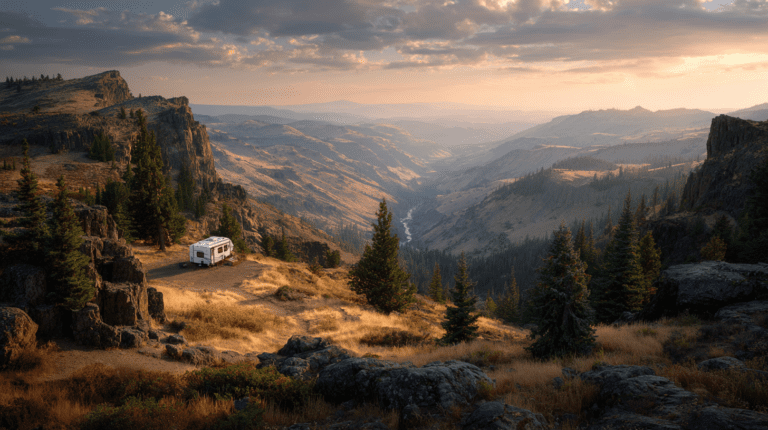
Most people choose an RV and then figure out where it fits.I’d argue that’s the wrong sequence, at least if national parks are central to your travel plan. The parks should influence the purchase. Not the other way around.
Here is what I’ve learned spending time with campground maps, reservation systems, and the fine print of 63 different park websites: the RV that looks perfect on a dealer lot can become a logistical problem the moment you try to book it into the places you actually want to go. Length matters. More than almost any other spec on the sheet.
Heads up. Some of the links here are affiliate links with Amazon and other partners I trust.
You pay nothing extra. I earn a small commission. Everyone wins – and the road stays funded.
How National Park Campgrounds Actually Work
National park campgrounds were largely built in an era when the typical RV was smaller, simpler, and shorter. The sites were carved into natural terrain… around trees, along ridgelines, beside rivers… not engineered as flat, open parking lots. That history has a practical consequence today.
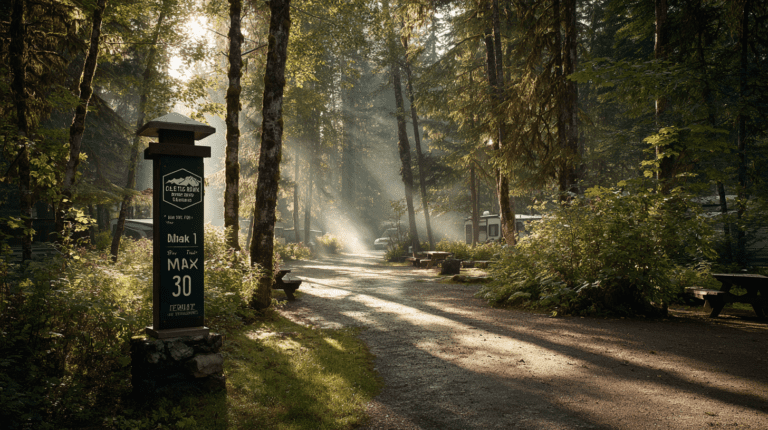
A significant number of national park campsites cap at 20 to 30 feet. Some are shorter. A few of the more developed campgrounds in larger parks can accommodate longer rigs, but they represent a fraction of total availability — and they book up first, fastest, and furthest in advance.
This isn’t a fringe consideration. If you’re planning to camp inside the parks rather than at private campgrounds outside the boundaries, length restrictions are a primary filter. Not a secondary one.
The difference between a 28-foot rig and a 35-foot rig isn’t seven feet of living space. It’s the difference between having options and spending your planning energy working around the lack of them.
The Reservation Reality
Let me be direct about something that surprises almost everyone who hasn’t tried to book a national park campsite recently. Popular parks don’t have availability. They have competition.
Recreation.gov — the federal reservation platform for most national park campgrounds — opens reservations on a rolling window, typically six months in advance, often to the exact calendar date. For parks like Yosemite, Glacier, Zion, and the Great Smoky Mountains, sites at the popular campgrounds fill within minutes of becoming available. Not hours. Minutes.
That’s not an exaggeration. It’s the reality of the current system.
Which means spontaneity, as a primary travel strategy, doesn’t work well for national park camping — especially with a larger rig that has fewer site options to begin with. The smaller and more maneuverable your setup, the more you can lean on first-come-first-served sites, shoulder season availability, and the occasional last-minute cancellation.
None of that eliminates planning. It just gives you more tools when the plan needs to flex.
Recreation.gov is the federal reservation platform for most national park campgrounds. For the nights when you’re staying outside park boundaries, Harvest Hosts puts you on farms, wineries, and working landscapes near the parks — no reservation window required.
The Under-30-Foot Threshold
Thirty feet isn’t a magic number. But it shows up often enough in campground restriction tables that it functions as a meaningful threshold.
Under 30 feet, and the majority of national park sites that accept RVs at all will accept yours. You’ll still hit restrictions as some sites cap at 21 feet, others at 25, but you’re working with the widest possible field of options.
Over 30 feet, and the narrowing begins. Not a cliff edge, but a steady reduction in site availability, flexibility, and the ease with which you can navigate interior park roads.
Those roads deserve their own mention. Many of the most scenic drives inside national parks… the ones that lead to the viewpoints, the trailheads, the photography locations that don’t appear in the first page of Google results… were not designed for long vehicles. Tight switchbacks. Low-clearance tunnels. One-lane sections with passing pullouts. A rig that fits comfortably in a campsite can still be the wrong tool for exploring the park itself.
This is part of why the two-vehicle system keeps reasserting itself throughout this series. The RV is the home base. Something smaller does the exploring. That combination — whatever form it takes — gives you access that a single large rig simply can’t.
Park-Specific Research Is Non-Negotiable
Every park is different. And the difference matters enough that general advice only gets you so far.
Before you commit to any rig, I’d strongly recommend researching the specific campgrounds at your top five or ten target parks. Look at the site length restrictions. Look at which campgrounds require reservations versus which offer first-come-first-served access. Look at road restrictions for RVs on the routes you actually want to drive.
Recreation.gov is the starting point for reservations. Each park’s own NPS page typically includes vehicle length restrictions and road condition information. The detail is there — it just requires looking before you buy rather than after.
The America the Beautiful Annual Pass is worth mentioning here as well. At $80, it covers entrance fees to all national parks and federal recreation areas for a full year. If you’re planning more than a handful of park visits, it pays for itself quickly and eliminates one variable from every arrival. It doesn’t cover campground fees, but it removes the entrance math entirely.
For the 63 parks project, it’s simply a given.
The Photographer’s Consideration
There’s a layer to this that goes beyond logistics, and it’s specific to the kind of travel I’m planning. The best light in a national park is rarely at the main overlook at noon. It’s at a secondary pullout before sunrise. It’s on a road that branches off the main loop and dead-ends at a meadow. It’s at a trailhead accessed by a narrow road with a 25-foot vehicle restriction and no room to turn around.
A large rig eliminates those locations entirely. A smaller rig with a nimble second vehicle opens them back up.
For photography-driven travel, where the mission is to find the light rather than the crowd, access is everything. The most interesting images rarely come from the places everyone can reach easily. They come from arriving earlier, going further, and having the right tool for the last mile. That’s a strong argument for keeping the rig short and keeping the second vehicle capable.
A smaller rig with a nimble second vehicle opens everything back up. If you haven’t settled on your platform yet, Outdoorsy is worth using to test different rig lengths across different parks before committing.

What This Means for the Decision
If you’re planning serious national park travel — and by serious I mean more than a few parks, more than a few nights inside the boundaries — build your RV decision around access first.
Ask these questions before you fall for a floorplan:
What are the site length restrictions at the parks I most want to visit? Look them up specifically. Don’t assume.
Are the campgrounds I want reservable, and how far in advance do they open? Set calendar reminders. The six-month window moves faster than you think.
Are there road restrictions that would prevent me from driving my rig to the locations I actually care about? Check the park’s RV and oversized vehicle guidance, not just the campground page.
Do I have a plan for the last mile? The trailhead. The pre-dawn pullout. The photography location down the road the RV can’t navigate. What’s the second vehicle, and does it fit the mission?
For me, all of those questions keep pointing back to the same answer: stay under 30 feet, stay maneuverable, and don’t let the comfort of the home base come at the cost of access to the places that make the whole thing worthwhile.
The parks don’t bend for oversized ambition. But they reward the traveler who plans to fit inside them.
Planning Your First Park Visit?
A few resources worth having before you book anything:
Test your rig before you commit — Outdoorsy has rentals across every class and length. Book a rig close to the size you’re considering and take it to a real park before any paperwork changes hands.
Stay near the parks without the reservation scramble — Harvest Hosts puts you on farms, wineries, and unique properties just outside park boundaries. No six-month booking window required.
When flying in makes more sense than driving — Hotels.com covers the parks where a fly-in and local exploration beats hauling a rig across the country.
About this series: The RV Question is a 12-part exploration of RV life written from the perspective of a photographer and storyteller planning to visit all 63 U.S. national parks. It’s not a buying guide. It’s a thinking guide — for anyone considering a significant change in how they move through the world.
As an Amazon Associate, I earn from qualifying purchases.