At some point in every serious RV conversation, you hit this fork.
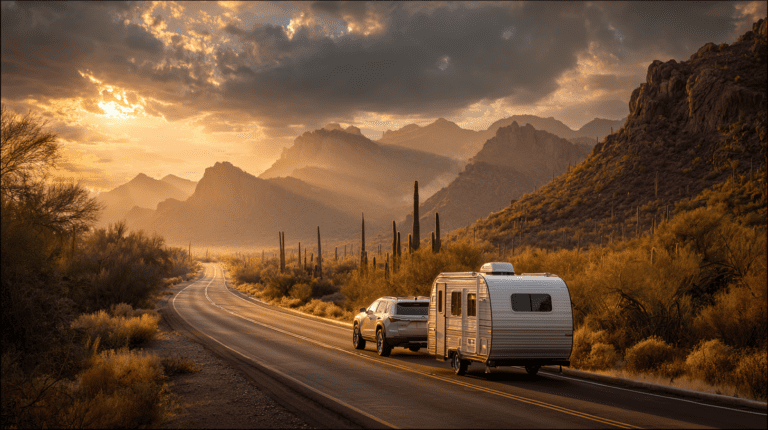
- Towable or driveable?
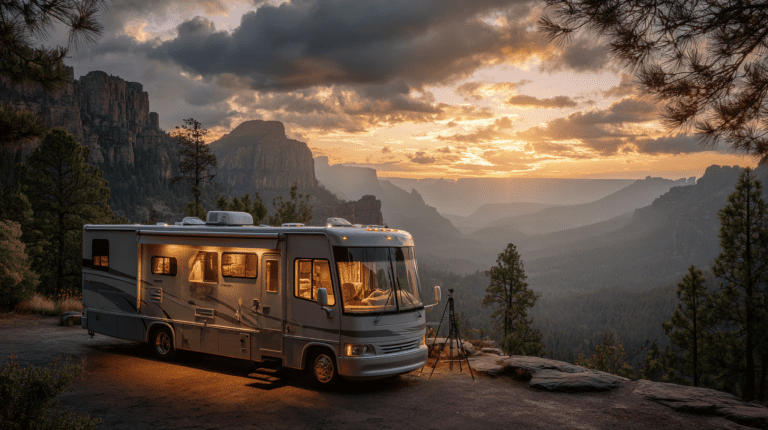
- Trailer or motorhome?
- Two pieces or one?
It sounds like a simple question. It isn’t. Because the answer isn’t really about the vehicles… it’s about how you move through a day, what your travel rhythm looks like, and who’s along for the ride. Get that right and the vehicle choice becomes obvious. Skip it and you’ll find yourself doing the mental math again six months after you’ve signed the paperwork.
Let’s work through it honestly.
Heads up. Some of the links here are affiliate links with Amazon and other partners I trust.
You pay nothing extra. I earn a small commission. Everyone wins – and the road stays funded.
The Case for Towable: Freedom in Two Pieces
The appeal of a trailer setup is real and it’s not just about price.
Once you unhitch, you’re free. The tow vehicle becomes the everyday vehicle… nimble, familiar, easy to park at trailheads or in town without navigating a 30-foot rig through a grocery store parking lot. The trailer stays put, stabilized, plugged in. Home base holds while the explorer leaves.
For the way I’ve been thinking about the 63 national parks project, that separation has genuine appeal. Park the trailer. Hook up to electric. Leave Penny in a stable, temperature-controlled environment. Then head out before sunrise with the camera gear without breaking camp or anxiously watching the clock.
That rhythm — set up, stay, explore, return — plays to the towable system’s strengths.
But those strengths come with a cost that isn’t just financial.
Hitching and unhitching takes time. Backing into a tight campsite requires skill that builds slowly and sometimes painfully. Managing sway in crosswinds on a mountain highway is a different experience than driving a car. Fuel stops require more planning with combined length. And every move means repeating the entire setup sequence… leveling, stabilizing, and hooking back up.
None of it is hard. Millions of people do it every week. But it’s a skill set and a rhythm, and it suits some personalities far more than others.
But here’s the honest filter: how often do you plan to move?
If you’re pulling up stakes every day or two, the setup-and-breakdown cycle adds up quickly. It becomes the job. If you’re staying three, four, five days in one place, which is closer to how I want to travel, the overhead feels more manageable. You do it once, settle in, and the system earns its keep.
Tow Ratings: The Reality Beneath the Brochure
If you go the trailer route, the phrase “tow rating” will follow you everywhere. And it’s more nuanced than the number on the window sticker suggests.
Yes, a capable SUV or truck might be rated to tow 7,000 pounds. But tow rating is not the whole story. There’s also payload capacity. How much weight the vehicle itself can carry, including passengers, gear, and tongue weight from the trailer. Real life loads heavier than spec sheets assume.
The question worth asking isn’t “Can this vehicle tow that trailer?”
It’s “Can this vehicle tow that trailer comfortably, in crosswinds, up a mountain grade, for six hours, without making me white-knuckle every pass?”
Those are different questions with different answers.
If you’re seriously considering a towable setup, get the tow vehicle and trailer evaluated together… not just against each other’s numbers, but against the actual conditions you’ll be driving in. A conversation with a knowledgeable RV dealer or a towing-specific mechanic before you buy is worth far more than an afternoon of forum reading.
The Case for Driveable: One Piece, One Decision
The motorhome argument, a Class C or a Class A, rests on a different premise entirely.
You turn a key. You drive. You arrive. You’re home.
No hitching. No separate vehicle to manage on the highway. No unhooking at the campsite before you can go anywhere. The living space travels with you as one integrated unit.
For someone who wants to simplify the operational side of travel, that integration is compelling. Fewer variables. Fewer things to forget at setup. Fewer pieces to maintain separately.
The tradeoff is what you do once you’re parked.
Park the trailer. Hook up to electric. Leave Penny my cat in a stable, temperature-controlled environment. Then head out before sunrise with the camera gear. Harvest Hosts memberships are worth having in this setup — wineries, farms, and working landscapes where the trailer stays put and the explorer leaves.
A motorhome at a campsite is committed. If you want to drive into town, scout a location, or reach a trailhead, you’re either unhooking the utilities and moving the whole rig or you’ve already planned for a second vehicle… like a small car or Jeep towed behind, what RV people call a “toad.”
Which means the two-piece reality reasserts itself. Just in a different configuration.
And this is the thing most people don’t fully reckon with until they’re deep into the research: there is almost no serious RV travel setup that doesn’t eventually involve two vehicles. The question is whether the second one leads or follows.
The Driving Comfort Variable
I keep coming back to this because it genuinely surprised me.
When I rented a Class C through Outdoorsy, I was prepared for the learning curve. What I wasn’t prepared for was how much the driving experience itself would color the whole trip. A vague steering feel and a stiff ride on highway miles is manageable for a weekend. Repeated over thousands of miles across dozens of parks, it becomes something you work around rather than enjoy.
Then I sat in the Class A, specifically the Hurricane 29L, and the difference was immediate. The cockpit felt purposeful. The sight lines were better. The seating position was grounded in a way that made long drives feel less like an endurance test.
That’s not a universal experience. Some people find Class C driving perfectly comfortable. Some prefer the towable setup because they feel more in control of a familiar vehicle. But the lesson is worth taking seriously: don’t evaluate a rig without driving it, and don’t evaluate the drive on a short lot loop.
If you can, arrange a highway test drive. A few miles under real conditions tells you more than a showroom ever will.
The Size Reality: Under 30 Feet Matters
Whether you go towable or driveable, one number keeps showing up in serious national park research.
Thirty feet.
A large number of national park campgrounds cap site length somewhere around there, some less. The parks were built when rigs were smaller, roads were narrower, and the idea of a 42-foot diesel pusher rolling through a canyon was still theoretical.
Under 30 feet opens up more sites, more flexibility, and less stress navigating interior park roads. Over it, and your options narrow in ways that start to define your entire trip planning process.
The Hurricane 29L sits right at that threshold. Some trailers do too, depending on configuration. But if national parks are central to your plan, and for me they’re the whole plan, this filter belongs in the conversation before you fall for a floor-plan that won’t fit where you want to go.
So How Do You Actually Decide?
There’s no universal right answer here. But there are four questions that tend to cut through the noise:
How often will you move? Daily movers lean toward motorhomes. Slow travelers who linger can make either work, but the towable setup rewards the longer stays.
How important is driving comfort on long hauls? If highway miles are going to be substantial, don’t underestimate this. Test drive both formats before deciding.
Who or what travels with you? A pet with specific comfort needs, a partner with strong preferences, a creative workflow that requires gear storage and workspace, all of these reshape the equation in ways the spec sheet won’t capture.
What’s your honest parking situation? Storage for two vehicles versus one. HOA rules. Driveway dimensions. These are unglamorous considerations that matter more than most people think until they’re standing in the driveway with a ruler.
For me, the honest answer still sits somewhere between a well-chosen trailer and a manageable Class A, with the 30-foot ceiling, the Penny factor, and the creative mission all applying pressure in different directions. I haven’t resolved it yet. But I understand the question better than I did at the start of this series. And that’s exactly the point.

Want to Test Both Before You Decide?
The towable vs. driveable question answers itself faster behind the wheel than on the page. Here’s how to start:
Rent a motorhome first — Outdoorsy has Class A, Class C, and van rentals. Drive one before you commit to either format.
Plan where you’ll stay — Harvest Hosts works beautifully with both setups. Farm and winery overnights where you park, settle in, and actually experience the lifestyle.
For the nights the rig stays home — Hotels.com covers the trips where flying in makes more sense than driving.
About this series: The RV Question is a 12-part exploration of RV life written from the perspective of a photographer and storyteller planning to visit all 63 U.S. national parks. It’s not a buying guide. It’s a thinking guide — for anyone considering a significant change in how they move through the world.
As an Amazon Associate, I earn from qualifying purchases.