A Photographer’s Return to the Old-Growth Floodplain — and What a Rushed First Visit Left Behind
When planning a visit to America’s national parks, some destinations get treated as a convenient stop rather than a destination in their own right. I know this because I did it myself at Congaree.
I was passing through South Carolina on a longer trip — one of those drives where the route takes you near a national park and the logic of stopping feels obvious. I arrived close to closing time, walked the elevated boardwalk through the floodplain forest in flat afternoon light, got bitten by mosquitoes I was not prepared for, took a few photographs I have never gone back to look at carefully, and left. It took maybe ninety minutes. I told myself I had seen Congaree.
I had not seen Congaree.
What I had seen was the boardwalk in bad light on a rushed afternoon. What I had missed was the old-growth forest at dawn, the flooded bottomland after a rain when the water reflects the ancient cypress canopy above it, the synchronous firefly display in late spring that draws photographers from across the country, and the specific quality of filtered light in a cathedral forest that has been growing undisturbed for centuries. Congaree does not announce itself the way the canyon parks do. It requires a different kind of attention — slower, closer, more patient. I did not bring that attention on the first visit. The return trip is about correcting that.
The Landscape That Draws People Here
Congaree National Park protects the largest intact expanse of old-growth bottomland hardwood forest in the United States — 26,000 acres of floodplain forest in central South Carolina where the Congaree and Wateree Rivers deposit rich sediment that has allowed trees to grow to extraordinary size for centuries. The park contains the highest temperate deciduous forest canopy in North America, with loblolly pines, bald cypress, water tupelo, cherrybark oak, and sweetgum reaching heights that dwarf the surrounding managed timberlands.
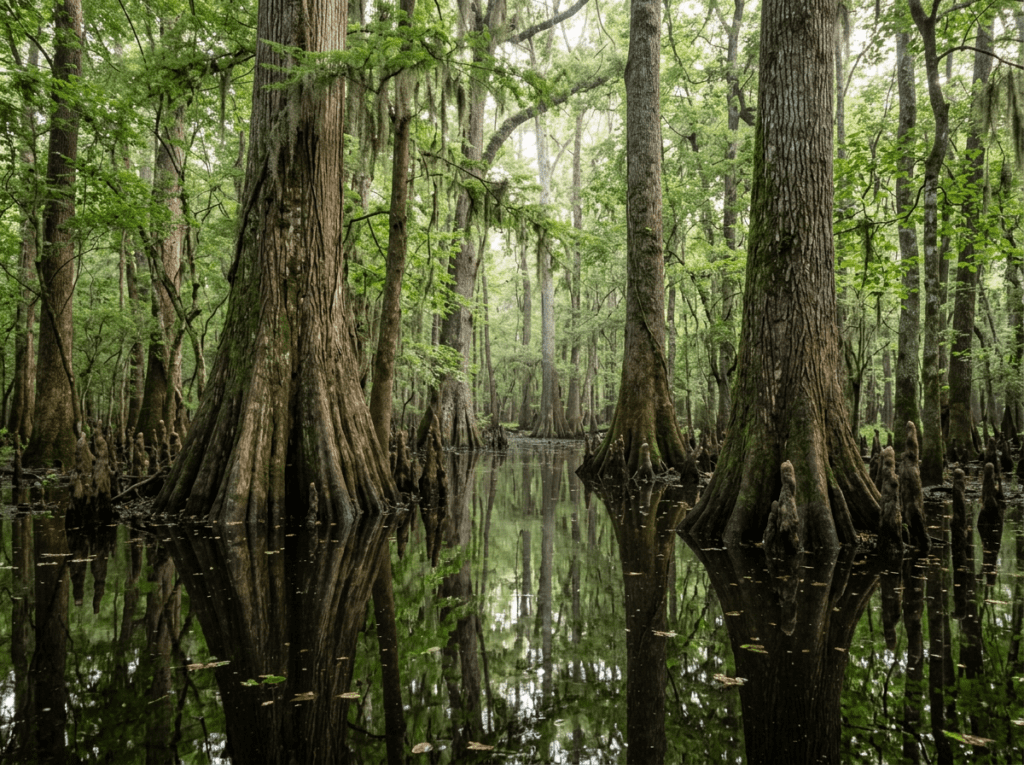
The floodplain floods. This is not a complication — it is the defining ecological process of the park. The Congaree River floods an average of ten times per year, depositing nutrients across the forest floor and filling the low areas with still, dark water that reflects the canopy above. After a flood, the forest floor becomes a shallow mirror. The ancient cypress knees rise from black water. The roots of the champion trees disappear into their own reflections. The park becomes something that looks less like a forest and more like a fever dream of the American Southeast — ancient, humid, layered, alive.
The elevated boardwalk — the 2.4-mile loop that most visitors walk — provides access to the forest without requiring waders, and it is a genuinely good introduction to the canopy and the scale of the old-growth trees. But it is the introduction, not the destination. The Cedar Creek canoe trail, the longer hiking loops beyond the boardwalk, and the early morning hours before the park fills with midday visitors — that is where Congaree reveals what it actually is.
The Photographer’s Chase
The images worth making at Congaree fall into three distinct categories, and none of them are available from the boardwalk in the middle of the afternoon — which is when most visitors, myself included on the first trip, encounter the park.
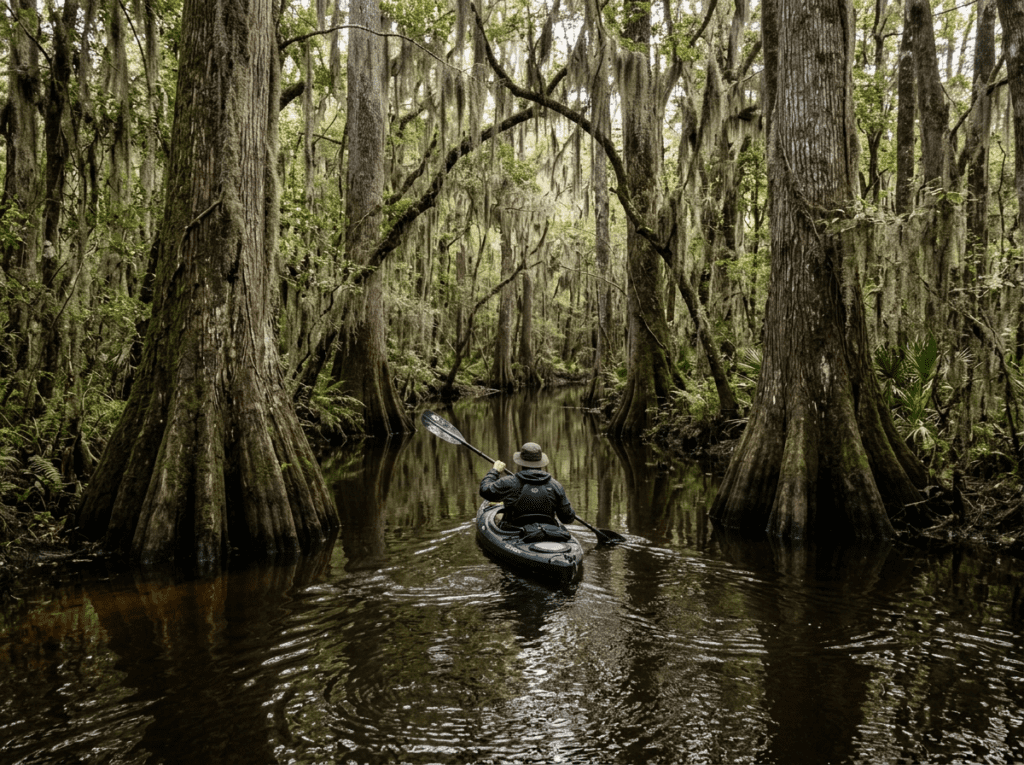
The flooded forest is the primary target. Check the park’s flood status before visiting — the NPS posts current water levels on the park website, and the photography after a moderate flood is categorically different from the photography in dry conditions. You need waders or waterproof boots and a willingness to move slowly through knee-deep water to reach the best positions. A tripod is essential — the light in the forest interior is low, the reflections require a long exposure to resolve the still water properly, and the best compositions are often low to the water surface to maximize the reflection of the canopy above. The image here is the ancient tree reflected in the water below it, the cypress knees breaking the surface, the dark tannic water holding the forest upside down.
The champion trees are the second subject. Congaree contains more national champion trees — the largest known specimens of a given species — than any other place in the United States. The loblolly pine that stood as a national champion reached 167 feet before it fell; the current champions are marked on the longer trail system. Photographing a tree that is the largest of its kind on earth requires the same thinking as a giant sequoia — a person at the base for scale, a wide angle close in to communicate trunk diameter, and the upward perspective into the canopy to convey height. Standard landscape composition does not work on trees this large.
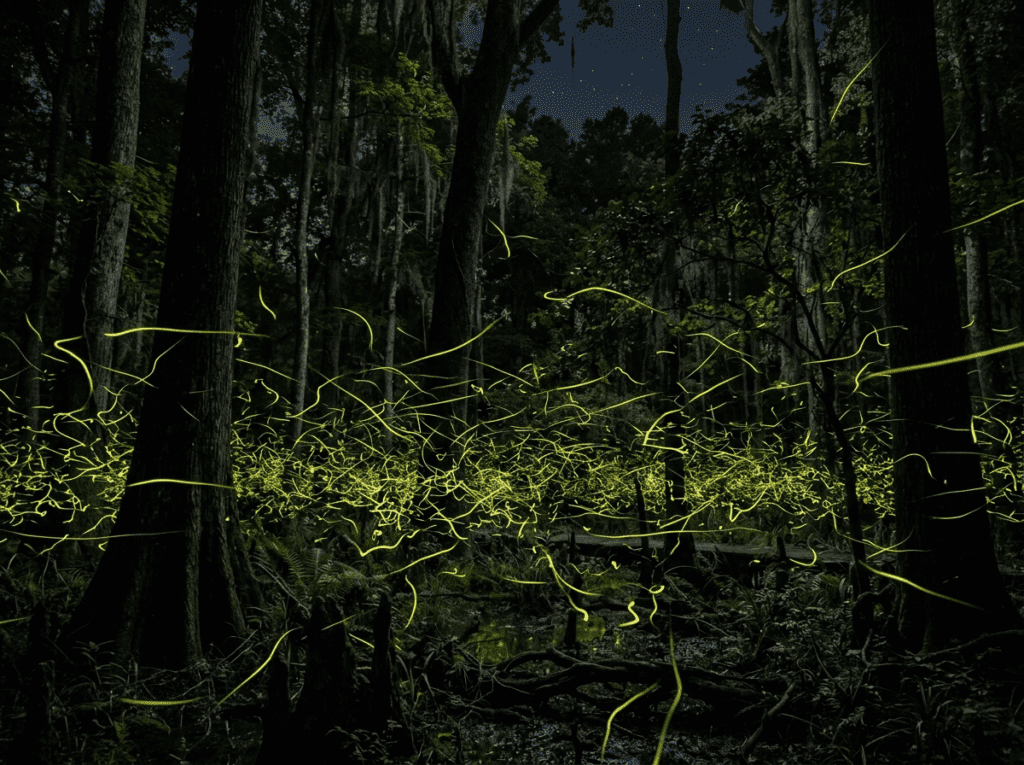
The synchronous firefly event is the third and most extraordinary subject. In late May and early June, Congaree hosts one of only a few places in the world where Photinus carolinus fireflies synchronize their bioluminescent flashes — thousands of fireflies lighting simultaneously in the darkened forest, creating a pulsing light show that has no parallel in the natural world. The NPS issues free timed-entry tickets for the firefly viewing period, which typically lasts two to three weeks. Long-exposure photography of the synchronous display — thirty-second exposures in near-total darkness, capturing the synchronized flash patterns as light trails in the forest — produces images unlike anything else in the 63-park series. It requires planning, patience, and a reservation. It is worth every bit of the effort.
Visiting the Park
Congaree requires preparation that the more famous parks do not, and most of that preparation is practical rather than logistical. The mosquitoes are not a rumor — they are an ecological fact of a healthy floodplain forest and they are present from spring through fall in numbers that can make an unprepared visit genuinely miserable. DEET-based repellent, long sleeves and pants, and a head net for dawn and dusk visits are not optional accessories. They are the admission price for spending meaningful time in the forest. Arrive prepared.
The best photography seasons are the shoulder seasons — March through early May before the mosquito peak, and October through November when the fall color arrives in the floodplain and the insect pressure drops. Winter is surprisingly productive: the leaf-off forest opens sightlines through the canopy that summer closes entirely, the mosquitoes are absent, and the low winter light in the bare hardwood forest has a stark, structural quality that the lush summer canopy cannot offer.
The Cedar Creek canoe trail is a 15-mile paddle through the heart of the park — a full-day commitment that provides access to the most remote sections of the floodplain. Canoe and kayak rentals are available near the park. A canoe puts you at water level in the forest interior with no boardwalk crowds and no time pressure — the slow pace of paddling through old-growth bottomland is the most intimate way to experience what Congaree actually is.
Where to Stay
There is no in-park lodging at Congaree. Columbia, South Carolina — the state capital — is about 20 miles from the park entrance and the natural base camp. Columbia has a good restaurant scene, comfortable lodging across all price ranges, and enough to occupy an evening after a long day in the forest. The drive to the park takes under 30 minutes from most Columbia hotels.
Hopkins, the small community closest to the park, has limited lodging but a handful of vacation rental options for those who want a quieter base. For photographers targeting the pre-dawn forest light or the firefly event, a Hopkins rental eliminates the Columbia commute and puts you within minutes of the park entrance for an early start.
Longleaf Campground inside the park offers primitive tent camping — no hookups, pit toilets, and the full experience of spending the night in the old-growth forest. For RV travelers the park has no hookup facilities, but Columbia’s commercial campgrounds provide full hookup options within a reasonable drive. The primitive camping at Longleaf is the right choice for firefly season — being in the park after the day visitors leave, with the forest going dark and the synchronous display beginning in the canopy, is the Congaree that ninety-minute boardwalk visits cannot reach.
If I Were Planning My First Visit
The honest answer is that my first visit was already made — and it was made wrong. What I am planning now is a return, and it looks nothing like what I did the first time.
I would go in late March or early April — before the mosquito peak, when the spring green is just coming into the floodplain and water levels are likely elevated from winter rains. I would arrive before sunrise, walk into the forest with a tripod and waders and no particular agenda beyond being in the old-growth light at the hour when it is most interesting. Not the boardwalk in the afternoon. The forest floor at dawn, moving slowly, looking for the reflected water and the ancient trees and the specific filtered light that only exists inside a canopy this old and this dense.
And I would check the firefly calendar. If the timing can align with late May and a reservation is available, I would plan the whole trip around that night in the forest. Because there is no image in the 63 parks project quite like the one the synchronous fireflies produce — and it is available only in a narrow window, in a park most people treat as a convenient stop, to the photographers who bothered to find out it existed.
The Light I’m Curious About
There are two. I cannot choose between them.
The first is the dawn light in the flooded forest — the specific quality of early morning illumination filtered through a canopy that has been growing for centuries, arriving at the forest floor so diffused and so soft that it seems to have no source, only a direction. The ancient trees in that light, reflected in the still dark water below them, the cypress knees breaking the surface, the Spanish moss moving slightly in the morning air — that is the image the boardwalk visit cannot find. It requires waders and patience and being in the forest before the light arrives rather than after.
The second is the firefly light. Bioluminescence in a synchronized pattern across an old-growth forest floor — thousands of small cold lights pulsing in unison in the dark, produced by a living thing doing something it has been doing for millions of years with no awareness that anyone is watching. That is not landscape photography. That is not architecture or geology or atmospheric light. That is something else entirely, and it is available in a national park two hours from Charlotte and three hours from Atlanta that most people pass through in ninety minutes on the way somewhere else.
I passed through it in ninety minutes. I am not making that mistake again.
A Deeper Exploration
This article is part of my ongoing project documenting and photographing all 63 national parks across the United States.
Along the way, I’m creating deeper guides that explore photography locations, travel planning, seasonal light conditions, and personal reflections from the road. Congaree is the park in this project I feel most motivated to do justice to — because I already did it an injustice once, and I know exactly what I missed.
Because the most interesting parks are not always the most dramatic ones. Sometimes they are the ones that require you to slow down, prepare properly, and pay the kind of attention that a rushed afternoon visit will never demand of you.
One more thing – just between us.
Congaree’s boardwalk loop handles most visitors efficiently and the old-growth floodplain forest it traverses is as extraordinary as any temperate forest in the eastern United States. Here are three ways to find what the boardwalk cannot show.
The Weston Lake Loop trail — a 4.4-mile trail into the park’s interior — reaches the lake and the backwater sloughs where the floodplain’s aquatic character is most visible and most photogenic. The still dark water reflecting the cypress knees and the bald cypress canopy above, in the early morning light before the trail fills with hikers, is the Congaree forest photography that the boardwalk only hints at.
For the firefly synchronization event that has made Congaree internationally known among a small and passionate community of photographers, the synchronous firefly viewing program in late May and early June — when thousands of Photinus carolinus fireflies flash in coordinated patterns across the forest floor in one of the rarest natural light shows in North America — is the Congaree photography event that most visitors never know exists. The NPS runs a ticketed shuttle program during the peak two-week window; reservations open on recreation.gov and sell out immediately. The firefly light in the old-growth forest is the most specifically extraordinary natural light subject in the eastern park system.
And for the South Carolina experience that frames the park visit, the city of Columbia — the state capital 20 miles north — has a genuinely underrated food and arts scene anchored by the University of South Carolina and the historic Five Points neighborhood. Worth a dinner stop rather than a fuel stop on the drive through.