A Photographer’s First Look at the World’s Greatest Concentration of Natural Stone Arches
When planning a visit to America’s national parks, some destinations immediately rise to the top of the list. Arches National Park is almost always one of them.
The name tells you exactly what you’re going to find, which is unusual for a landscape. Most parks require explanation — you have to describe the geology, the scale, the conditions that made the place. Arches does not. There are arches. More than two thousand of them, carved from Entrada sandstone by millions of years of water, ice, and wind working on a plateau in southeastern Utah. The largest natural arch span on earth is here. So is the most photographed arch in the American West.
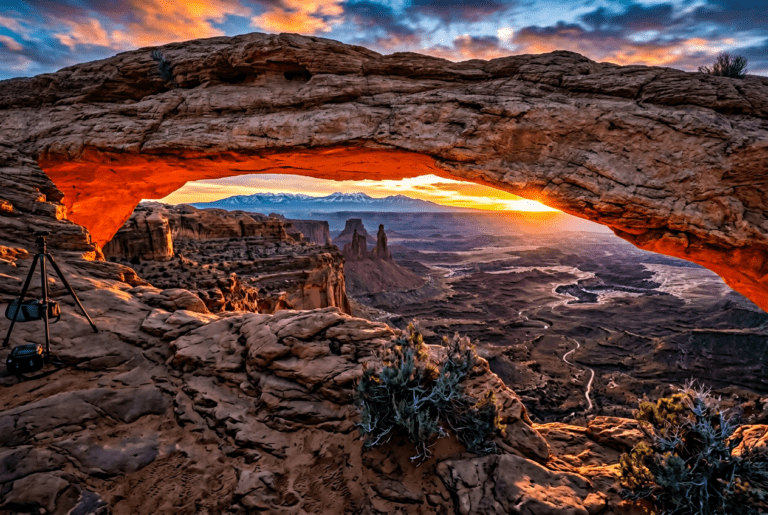
But here is what the name does not tell you, and what I have been thinking about since I first started studying this park in earnest: the arches are frames. Stone frames, suspended in the air, with the sky and the canyon and the La Sal Mountains behind them. And what a photographer does with a frame is put something inside it.
The question at Arches is not whether the arches are beautiful. They are. The question is what you choose to frame with them — and at what hour the light makes that choice matter.
The Landscape That Draws People Here
Arches sits just outside Moab, Utah — a small town that has become the outdoor recreation capital of the Colorado Plateau, and one of the more useful base camps in the national parks system. The park itself is compact by national park standards: the main road runs eighteen miles from the entrance to the Devils Garden trailhead in the north, with spurs leading to the Windows Section, Delicate Arch, and the Fiery Furnace along the way. You can drive the entire main road in an hour. That accessibility is part of what makes the park so visited — and so crowded at peak times.
The geology here is specific and worth understanding before you arrive. The Entrada sandstone that forms the arches is a warm red-orange, and it sits above a layer of cream-colored Navajo sandstone that creates a two-tone landscape throughout the park. The La Sal Mountains to the southeast — snow-capped for much of the year — provide the distant backdrop that appears behind Delicate Arch in its most famous compositions. These are not incidental details. They are the color palette and the composition geometry of the park, and every photography decision is shaped by them.
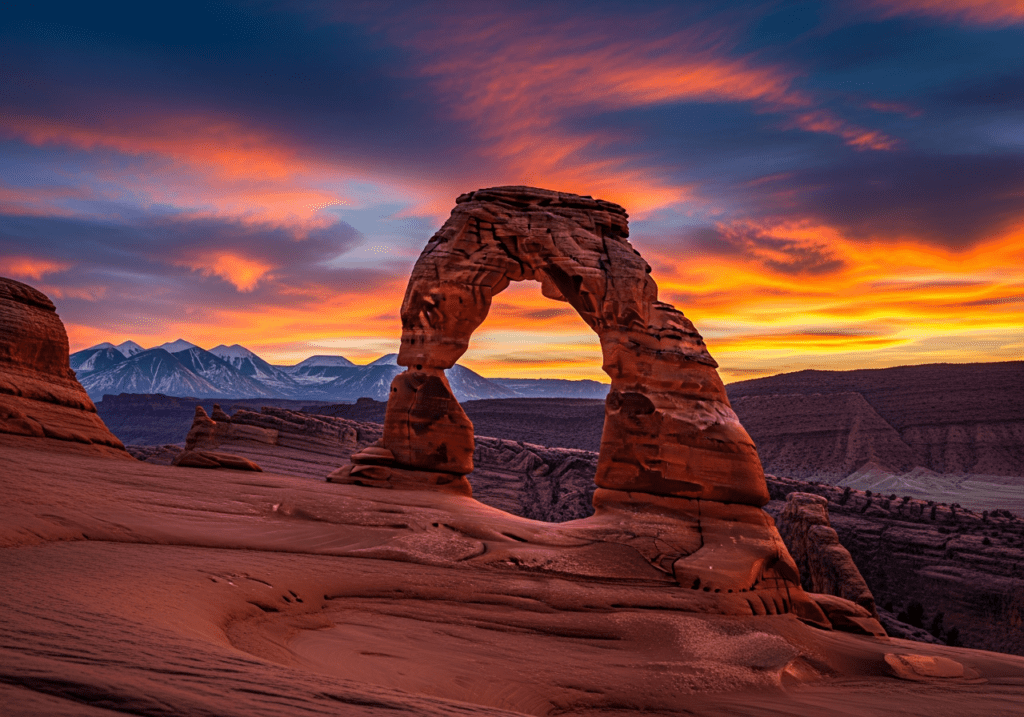
Delicate Arch is the iconic subject — the 65-foot freestanding sandstone arch on the edge of a slickrock bowl, with the La Sal Mountains rising behind it and nothing but sky on three sides. It appears on Utah’s license plate. It has been photographed millions of times. And it is still, in person, at the right hour, a genuinely extraordinary thing to stand in front of. Some icons earn their status.
The Photographer’s Chase
The challenge at Arches is one every photographer knows: how do you make a genuine image of a subject that has been photographed two million times before you arrived? The answer, as always, is light and timing and a willingness to look past the obvious composition.
Delicate Arch at sunset is the postcard shot, and it is a postcard shot for good reason — the arch faces west, the last light hits it directly, and the Entrada sandstone goes from orange to deep red to a glowing amber that seems to come from inside the rock rather than from the sun. The hike to the arch is three miles round trip with 480 feet of elevation gain across open slickrock. Arrive 90 minutes before sunset. The arch bowl fills with photographers, and the crowd itself becomes a compositional element — the human figures standing beneath the arch provide scale that the wide landscape shot alone cannot. Use them intentionally.
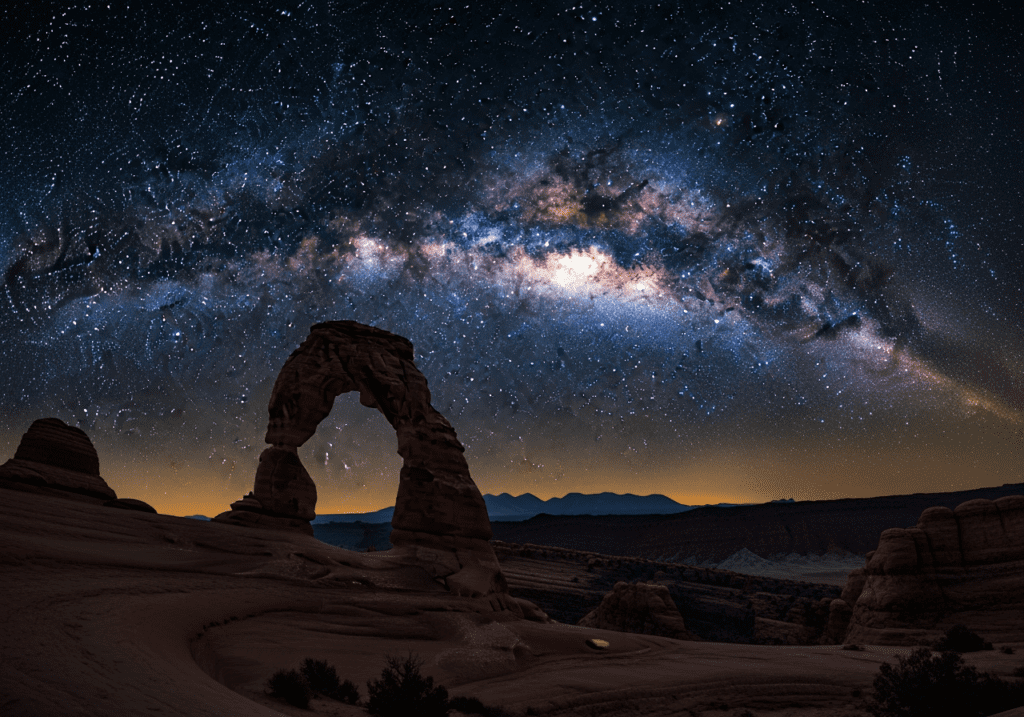
But the image I am most curious about is not the sunset shot. It is the Milky Way through Delicate Arch on a moonless night in spring or fall, when the core of the galaxy rises above the La Sal Mountains and the arch frames it from below. Dark sky photography at Arches — the park sits in one of the lowest light-pollution zones in the lower 48 states — is legitimately world-class. The combination of Entrada sandstone formations as foreground subjects and the clarity of the desert night sky above them is the photography that the daytime crowds cannot touch. That requires a longer stay, a dark sky forecast, and a headlamp for the hike in. It is absolutely worth the planning.
The Windows Section offers the counterpoint to Delicate Arch’s solitary drama. North Window and South Window frame the Turret Arch and the canyon beyond — a natural double-frame composition that rewards the long lens as much as the wide. In the morning, before the tour buses arrive, the light through the Windows from the east is the quiet, interior Arches photograph that the evening rush at Delicate Arch cannot provide.
Visiting the Park
Arches has introduced a timed entry reservation system during peak season — typically April through October — that requires advance booking through recreation.gov to enter the park during morning hours. Check current requirements before planning. The reservation window opens months in advance and the morning slots fill quickly. Afternoon entry does not currently require a reservation, which means the Delicate Arch sunset hike remains accessible for walk-up visitors — but confirm current policy before you build your trip around it.
Spring and fall are the clear photography seasons. March through May brings wildflowers in the canyon — the yellow of desert phlox and the purple of scorpionweed against red sandstone — and temperatures that make the exposed slickrock hikes manageable. September and October bring lower crowds, cooler air, and the low autumn sun angle that does the most interesting things to the Entrada sandstone color. Summer temperatures regularly exceed 100°F on the open rock, and the midday light is as flat and harsh as anywhere in the desert Southwest. Early morning starts are non-negotiable in summer.
The Fiery Furnace — a labyrinth of narrow sandstone fins in the middle of the park — requires either a ranger-led tour or an advance permit for self-guided entry. It is one of the most unusual walking experiences in the park system: no marked trail, just a maze of slot passages between towering red walls. The photography inside the Fiery Furnace, with the narrow light angles and the close-range sandstone textures, is unlike anything available from the main road pullouts.
Where to Stay
There is no in-park lodging at Arches. Moab, five miles from the park entrance, is the base camp — a lively small city with a genuine range of lodging, good restaurants, and enough outdoor infrastructure to support a week-long photography trip without feeling constrained. The proximity means that being in Moab at 4am and at the Delicate Arch trailhead by 5am for a sunrise attempt is entirely practical.
Moab lodging runs from budget motels on Main Street to the upscale Sorrel River Ranch along the Colorado River northeast of town — a property with views that rival anything inside the park. The Under Canvas Moab glamping property offers the canvas tent experience near the park entrance for those who want proximity without traditional camping.
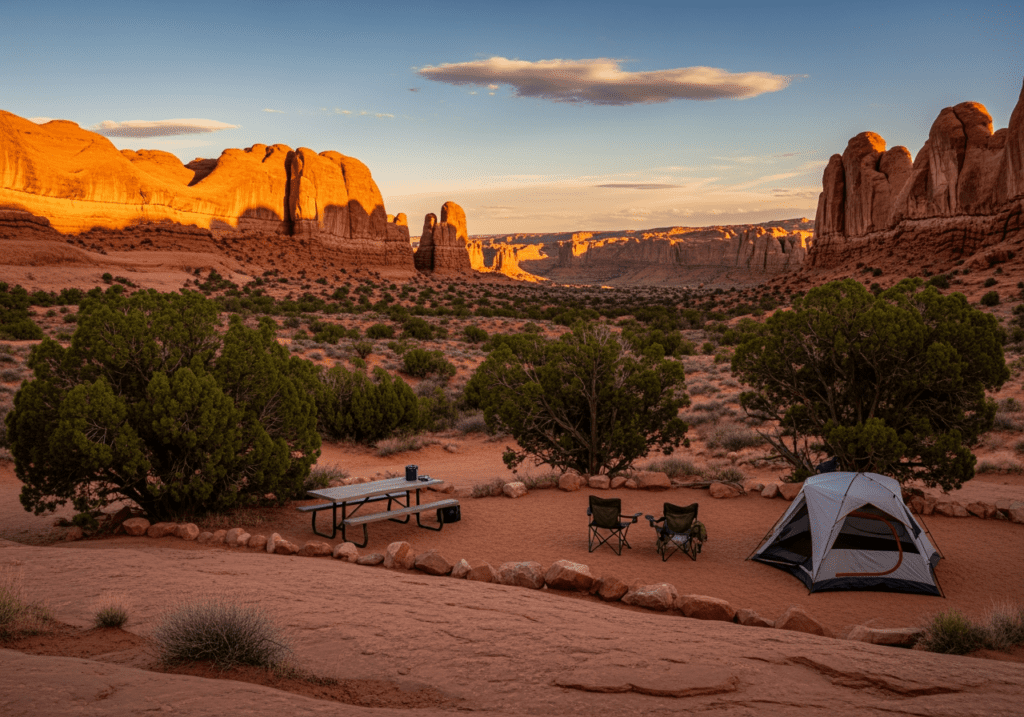
For RV travelers, Moab has several well-equipped campgrounds with full hookups. Inside the park, Devils Garden Campground is one of the most coveted reservations in the Utah parks system — 51 sites set among the sandstone fins at the end of the main park road, surrounded by the park’s densest concentration of arches. Sites book out months in advance through recreation.gov. The campground is the only way to be inside the park for sunrise and for the dark sky photography that begins after the day visitors leave.
If I Were Planning My First Visit
I would base in Moab and plan the trip around two specific light windows: the Delicate Arch sunset, and the Windows Section at sunrise.
The Delicate Arch sunset hike is the non-negotiable. I would allow 90 minutes for the hike in, arriving at the arch bowl with time to find a position before the crowd fills the viewpoint. I would shoot the arch in the warm light, then shoot the people under the arch for scale, then stay after the crowd left for the blue hour when the arch goes from glowing orange to a cooler silhouette against the deepening sky. That transition — the five minutes after the sun drops — is the image most people miss.
And if the conditions aligned — a moonless night, a clear forecast, a spring or fall date when the Milky Way core is positioned right — I would go back to Delicate Arch after dark. The hike in with a headlamp across the open slickrock. The arch against the galaxy. That is the photograph that would justify the entire trip by itself.
The Light I’m Curious About
It is the dark sky light, if light is even the right word for it.
The desert Southwest has some of the lowest light pollution in the continental United States, and Arches sits in the middle of it. On a moonless night in October, the Milky Way is not a suggestion above the park — it is a presence. The galaxy core rises above the La Sal Mountains and the Entrada sandstone formations stand against it in silhouette, glowing faintly red from the starlight. This is astrophotography with the best possible foreground subjects, in one of the best possible locations, under genuinely dark skies.
That is the image I am most curious about at Arches. Not because the sunset photographs are not extraordinary — they are. But because the sunset crowd sees Arches as it was designed to be seen. The dark sky version is Arches as it actually is: ancient, quiet, indifferent to the two thousand visitors who walked beneath its arches that afternoon, still doing what it has been doing for millions of years while the desert goes completely dark around it.
A Deeper Exploration
This article is part of my ongoing project documenting and photographing all 63 national parks across the United States.
Along the way, I’m creating deeper guides that explore photography locations, travel planning, seasonal light conditions, and personal reflections from the road. Arches pairs naturally with Canyonlands just to the southwest — two parks that share the same geology and the same Moab base camp, but offer completely different photographic scales and moods.
Because sometimes the best way to understand a landscape is to come back after dark, when the crowds are gone and the arch is just standing there against the stars the way it has been for longer than anyone can usefully imagine.
One more thing — just between us.
Arches has become one of the most visited parks in the system and the timed entry system exists for a reason — the parking areas at Delicate Arch and the Windows fill fast. Here are three places worth knowing when you want the red rock experience with room to breathe.
Dead Horse Point State Park sits on a narrow peninsula above the Colorado River gorge about 30 miles from Moab and delivers one of the most dramatic overlook views in the entire Southwest — the river making a near-complete loop 2,000 feet below, the canyon walls in every direction. Most Arches visitors drive past the turnoff without stopping.
Don’t. Within the Moab area, the Corona Arch Trail — a 3-mile round trip off Highway 279 along the Colorado River — leads to a freestanding arch that rivals Delicate in scale and beauty with a fraction of the foot traffic and no timed entry requirement.
And for the night sky photography that Arches does so well, Canyonlands Needles District shares the same dark sky designation and the same Moab base camp, with colored sandstone spires as foreground subjects and almost none of the Arches crowd. Same stars. Different park. Worth the 45-minute drive.