A Photographer’s First Look at America’s Most Visited Park — and the Smoke That Makes It Extraordinary
Every photographer eventually builds a list of landscapes they hope to experience at least once. Great Smoky Mountains National Park is rarely at the top of that list. It probably should be.
The Smokies suffer from a reputation problem among serious photographers. It is the most visited national park in the system — twelve to fourteen million visitors a year, nearly double Yosemite — and that number conjures images of traffic on Newfound Gap Road and crowded overlooks and the kind of experience that has nothing to do with solitude or light. All of that is real. But it is not the whole truth about the park.
The whole truth is this: Great Smoky Mountains contains the largest tract of old-growth forest in the eastern United States. It has more tree species than all of northern Europe. Its waterfalls run year-round, fed by some of the highest annual rainfall of any place in the country outside the Pacific Northwest. The smoke… the natural hydrocarbon haze that gives the mountains their name, produced by the forest itself the same way the Blue Ridge haze is produced… creates a soft, layered atmospheric quality in the morning light that photographers who know this park chase obsessively.
You just have to get there before everyone else does. Which, in the Smokies, means before sunrise. It always means before sunrise.
The Landscape That Draws People Here
The park straddles the Tennessee-North Carolina border along a 70-mile stretch of the Appalachian Mountains, with Clingmans Dome, at 6,643 feet the highest point in the park and the highest point on the entire Appalachian Trail, marking the spine. The two primary gateway communities are Gatlinburg, Tennessee, on the northern side, and Cherokee, North Carolina, on the southern side. Gatlinburg is the more developed and more visited; Cherokee has a quieter character and access to the less-trafficked southern sections of the park.
The photography locations divide broadly into three categories. The elevated viewpoints — Clingmans Dome, Andrews Bald, and the Alum Cave Trail ridgeline — offer the sweeping smoky mountain vistas that define the park’s visual identity, best in the morning before the haze thickens and the crowds arrive. The valley waterfalls… Laurel Falls, Ramsey Cascades, Abrams Falls, Grotto Falls… run through old-growth forest and produce the intimate cascade photography that the elevated viewpoints cannot. And the historic structures — the Cades Cove grist mills, the Cataloochee Valley log cabins, the Mingus Mill — provide a human-scale photography subject specific to the cultural history of this particular mountain community.
Cades Cove deserves special mention. A broad valley ringed by mountains on the Tennessee side of the park, it contains a preserved 19th-century farming community… cabins, churches, barns, and open meadows where white-tailed deer and black bears are reliably present at dawn and dusk. The Cades Cove loop road opens before sunrise on Wednesday and Saturday mornings for bicycle and foot traffic only, before vehicles are permitted. Those mornings — the meadow in early light, the historic structures in the mist, the deer grazing in the open fields — represent some of the finest photography the park produces.
The Photographer’s Chase
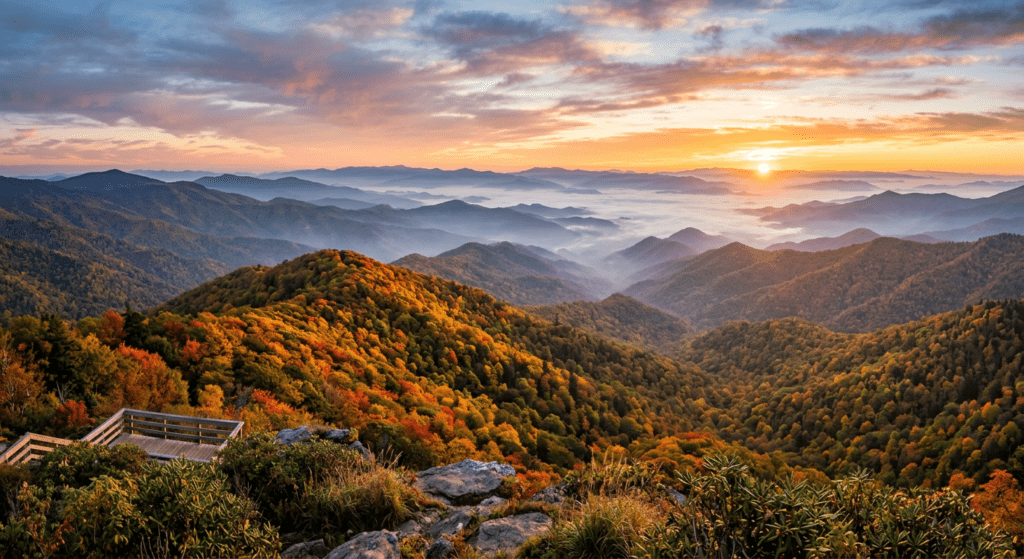
The smoke is the subject and the challenge simultaneously. In the early morning, before the temperature rises and the haze thickens, the smoke sits in the valleys between the ridges — a low, soft layer that the first light catches and turns gold before it dissipates. The ridgeline views in that early window, with the smoke pooled in the hollows and the forest emerging above it in the first direct light, produce the layered atmospheric image that defines Great Smoky Mountains photography. By 9am that window is usually closed. The smoke has thickened or lifted, the light has gone overhead, and the crowds have arrived.
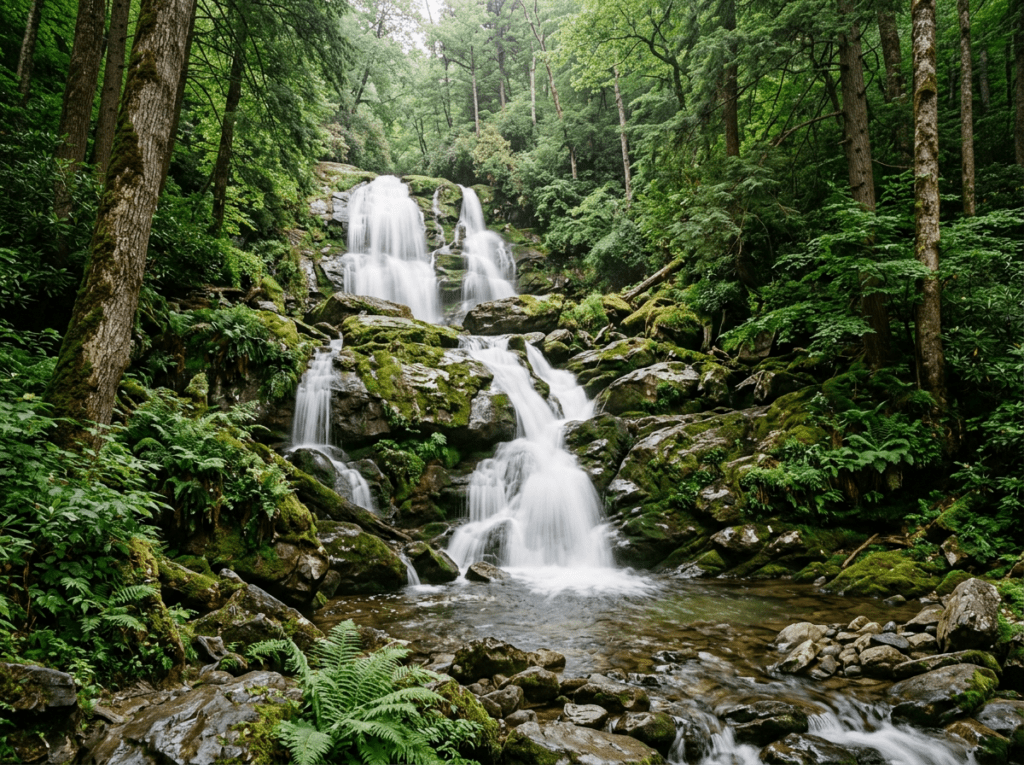
Waterfall photography in the Smokies operates on a different schedule entirely — it is less light-dependent and more flow-dependent, and the best conditions are the overcast days that most visitors write off as disappointing. An overcast sky over a waterfall in old-growth forest eliminates the harsh contrast between bright water and deep shadow that makes sunlit waterfall photography technically difficult. It also saturates the greens of the moss and fern and rhododendron surrounding the falls in a way that direct sun cannot. Ramsey Cascades, a 100-foot cascade deep in old-growth hemlock forest on the eastern side of the park, is the most spectacular of the park’s falls and worth the 8-mile round trip hike on a gray morning in spring when the flow is at its peak.
Fall color in the Smokies is an elevation game. The higher elevations above 4,000 feet peak in early to mid-October. The mid-elevations follow in mid to late October. The lower valleys and coves don’t peak until early November, which extends the fall color photography season across nearly a full month. A well-planned fall trip moves up and down in elevation as the color progresses, following the peak from the high ridges down to the valley floors over the course of a week.
Visiting the Park
Great Smoky Mountains is the only national park in the system with no entry fee, a legacy of the original land donation agreements that established the park in the 1930s. That accessibility contributes to the visitor numbers, and those visitor numbers require a crowd strategy. The strategy is consistent and effective: be in the park before 8am, out of the primary corridors by 10am, and back for the golden hour. Midday in the Smokies in summer or fall is not a photography proposition. It is a logistics problem.
The Cades Cove loop road deserves its own planning note. On standard days, vehicles line up for the 11-mile one-way loop from mid-morning onward and the drive can take two to three hours in peak season. On Wednesday and Saturday mornings before 10am, when the loop is open only to foot and bicycle traffic, (double check that!), the experience is completely different — quiet, unhurried, and genuinely special. Rent a bicycle from the Cades Cove campground store (again, this could change) or walk sections of the loop. The light on those mornings, before the vehicle traffic begins, is the Cades Cove most visitors never experience.
The Cataloochee Valley on the North Carolina side is the least-visited major valley in the park and one of its finest photography locations — a narrow road through a remote valley containing historic homesteads and a reintroduced elk herd that is most active at dawn and dusk. The drive in is not casual, but the solitude and the wildlife photography are worth the effort.
Where to Stay
There is no in-park lodging at Great Smoky Mountains. LeConte Lodge, on the summit of Mount LeConte, is accessible only by hiking trail and books out a year or more in advance. It is a genuine wilderness experience and worth the planning for a dedicated visit, but it is not the practical base camp for a photography trip.
Gatlinburg is the primary base for most visitors. It’s a walkable resort town immediately outside the Sugarlands entrance with a full range of lodging from chain hotels to cabin rentals on the forested hillsides above town. The cabin rentals, particularly those with mountain views on the ridges above Gatlinburg, provide the elevated perspective and the sense of place that the town-center hotels cannot. Pigeon Forge, a few miles north, is more developed and less charming but has broader availability and lower prices. Townsend, on the quieter western side of the park near the Cades Cove entrance, offers a completely different and more tranquil base camp experience.
Elkmont Campground near the Sugarlands entrance is the most popular in-park campground and the most centrally located for the Tennessee-side photography. Cades Cove Campground puts you at the entrance to the loop road — the practical choice for photographers targeting the Wednesday and Saturday morning bicycle hours. Both campgrounds are reservable through recreation.gov. RVs are accommodated at most campgrounds with varying size limits; the mountain roads leading to some campgrounds have tight turns that larger rigs should approach carefully.
If I Were Planning My First Visit
I would time the trip to arrive on a Tuesday evening in mid-October and be at Cades Cove before dawn on Wednesday morning, on foot or bicycle, before the vehicles are admitted. (Triple check that!) The meadow in the early light, the historic structures in the mist, the deer in the open fields before the loop road fills with cars. That is the first image I want from this park, and it requires the specific Wednesday or Saturday morning window to find it.
I would plan one overcast day specifically for waterfall photography. That would begin at Ramsey Cascades or Grotto Falls, deep in the forest, with a tripod and a neutral density filter and no agenda beyond the water and the light. Overcast is not a consolation in the Smokies. It is an invitation.
And I would be at an elevated viewpoint like Clingmans Dome or the Alum Cave Trail ridgeline before sunrise on at least one clear morning, to watch the smoke settle into the valleys in the first light. That image, the smoke doing what it has been doing in these mountains since long before anyone arrived to photograph it, is the one I keep coming back to when I think about what this park actually is.
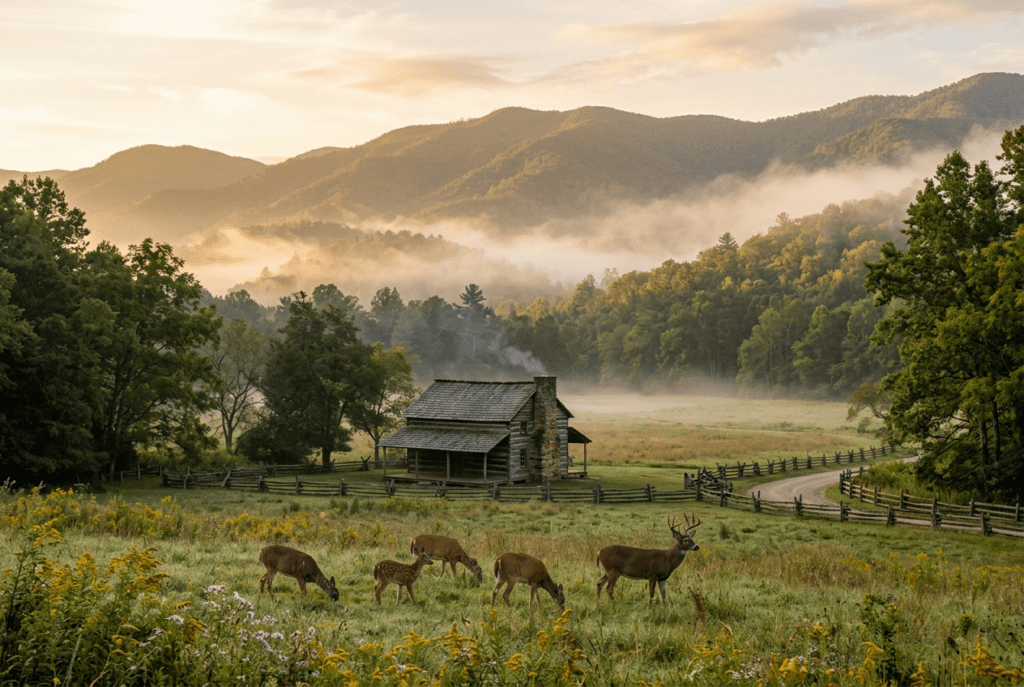
open meadows, and the light before the crowds
The Light I’m Curious About
It is the smoke light in the hollows at dawn.
Not the broad ridgeline panorama, that view is well documented and beautiful in a predictable way. What I am curious about is the close version: standing at the edge of a hollow in the early morning, looking down into a pocket of smoke and light where the sun has just found the treetops but the lower forest is still in soft gray shadow, and the smoke is catching the light and turning it gold before it disappears into the canopy above. The forest doing what the forest has always done, and the light arriving at the angle that makes it visible.
This is the most visited national park in America. Twelve million people a year. And that intimate smoke-and-hollow light is something most of them never see because it requires being there at an hour when most people are still asleep, looking at something small and specific when the big view is right there demanding attention.
That is the light worth getting up for. It always is.
A Deeper Exploration
This article is part of my ongoing project documenting and photographing all 63 national parks across the United States.
Along the way, I’m creating deeper guides that explore photography locations, travel planning, seasonal light conditions, and personal reflections from the road. Great Smoky Mountains is the park that most rewards the visitor who looks past the visitor numbers and finds the light that twelve million people a year mostly miss. Because the most visited place in the national park system is still, in the right hour, one of the most beautiful.
One more thing — just between us.
Twelve million visitors a year means the Smokies require a crowd strategy, and the Cades Cove loop and Newfound Gap Road absorb the majority of them. Here are three places that put you in the same landscape with a fraction of the traffic.
The Cataloochee Valley on the North Carolina side is inside the park but requires a longer, narrower road that filters out the casual visitors — the result is a remote mountain valley with historic homesteads, a reintroduced elk herd most active at dawn and dusk, and a sense of solitude that Cades Cove on a Saturday cannot offer. The drive is worth every mile.
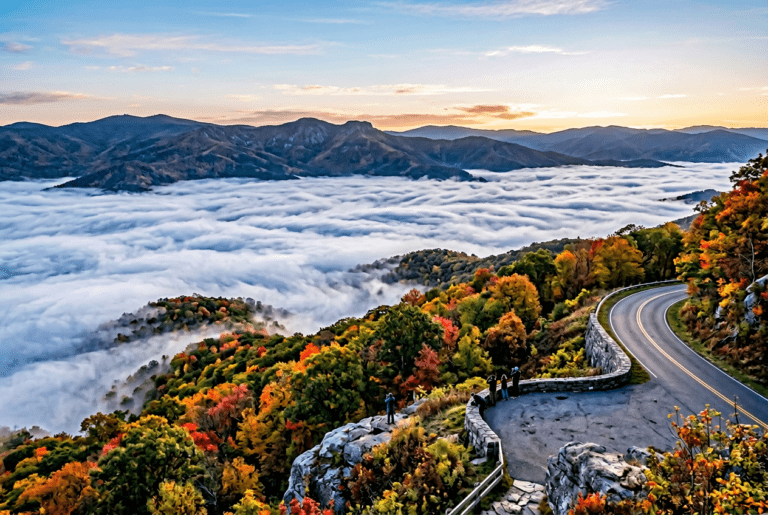
Just outside the park on the North Carolina side, the Blue Ridge Parkway picks up near Cherokee and runs northeast through mountain scenery that rivals anything in the park — ridgeline views, fall color, and the quiet that a 45mph speed limit and no commercial traffic creates. The parkway is consistently underused relative to the park itself and the photography along it is exceptional.
And within the park, the Cosby area on the park’s northeastern Tennessee side is the quietest of the park’s major campground areas — the same old-growth forest, the same waterfall trails, and consistently the lowest visitation of any comparable section in the park. If the Sugarlands entrance feels overwhelming, Cosby is the answer.