A Photographer’s First Look at Utah’s Canyon of Bouncing Light
Every photographer eventually builds a list of landscapes they hope to experience at least once. Not the famous photographs of a place… those are easy to find. The actual light. The way a canyon wall holds warmth long after the sun has moved on. The moment when color bounces between rock faces and illuminates the floor below in a glow that has no obvious source.
Zion National Park has been on that list for a long time.
The canyon is unlike anything else in the American Southwest. The Navajo sandstone walls rise two thousand feet from the Virgin River below. These surfaces help craft the light that moves between them. Warm tones seem to emenate from these canyon walls… illuminating the river, the cottonwood trees and the hikers standing in the middle of it all. All of this helps create a photographic environment that simply cannot be replicated anywhere else. I’ve studied the photographs for years. I’ve read the field notes. But there are certain places you have to stand inside before you understand what they actually are.
Zion is one of those places.
The Landscape That Draws People Here
Zion Canyon is a single road. That is not a limitation, it is the defining fact of the place. One narrow corridor running roughly north to south, the Virgin River running along the floor, the walls rising on both sides. Private vehicles are not permitted beyond the visitor center during peak season. A free shuttle carries everyone deeper into the canyon, stop by stop.
What the canyon offers is a complete education in directional light. The eastern walls catch the morning sun first. The western walls catch the afternoon. The canyon floor itself receives direct sunlight only briefly, the walls cut it off early and claim it back quickly. For a photographer, this is not a complication. It is the curriculum.
The iconic landmarks here have names that feel earned: the Court of the Patriarchs, three massive sandstone monoliths rising from the canyon floor. Angels Landing, a 1,488-foot summit reached by a trail that uses iron chains bolted into the exposed rock. The Narrows, where the canyon walls close to thirty feet apart and the Virgin River becomes the trail itself. Each one is a different expression of the same geology – ancient sand dunes compressed into stone over millions of years, then carved by water into this.
The Photographer’s Chase
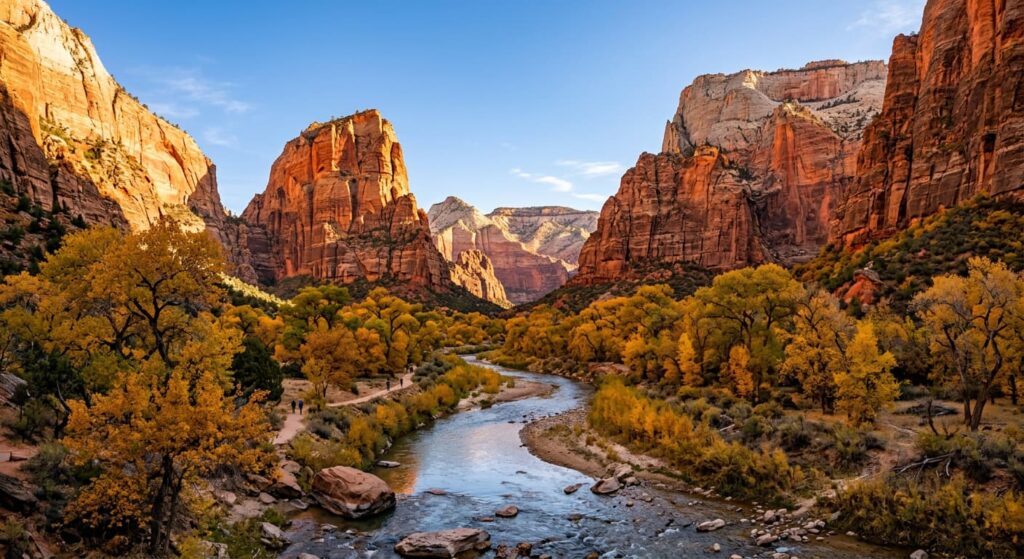
The thing I keep coming back to when I study Zion photography is the reflected light. In most canyon landscapes, you are photographing surfaces that the sun hits directly. Zion is different. The canyon is narrow enough that the walls talk to each other. The morning light strikes the eastern wall and bounces warm and amber across the canyon to illuminate the western wall in a glow that feels almost manufactured. It is not. It is just physics and sandstone doing something extraordinary.
The canyon floor along the Virgin River, particularly in October when the cottonwood trees go gold, offers what I think of as the intimate counterpoint to all of that vertical drama. Get low near the still pools between the river riffles. A wide lens six inches above the water surface captures the canyon wall reflected in the pool, the cottonwood gold, the strip of blue sky above the rim. That is the image you don’t see on postcards. It requires getting your knees wet and being there before the crowd.
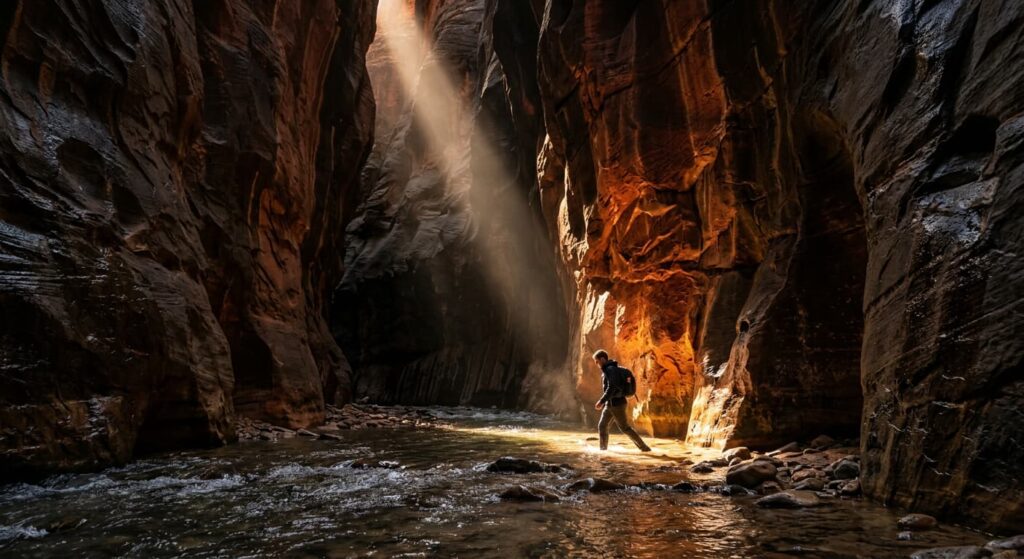
The Narrows, the slot canyon hike where you walk in the Virgin River itself, is the landscape I most want to experience through a lens. The walls narrow to the point where direct light becomes a shaft, a single beam penetrating from above and illuminating a section of rock or water while the rest of the canyon stays in deep shadow. That contrast is the image. It requires timing, patience, and waterproof gear. I have been thinking about that light for a long time.
Visiting the Park
Zion is the most visited national park in the system during peak season, and its crowds concentrate in a way that makes timing essential. The shuttle system solves a lot of the friction. There are no cars in the canyon which means no parking lots, no traffic, and a surprisingly civil way to move between locations. Board the first shuttle of the morning and you’re already ahead of most visitors.
The two photography seasons worth planning around are spring and fall. Spring brings higher water in the Virgin River and wildflowers in the canyon… the yellow of mule’s ear sunflower against orange sandstone is a combination that doesn’t exist anywhere else. Fall brings the cottonwood color, lower crowds after Labor Day, and the most saturated reflected light of the year as the lower autumn sun angle increases the warmth bouncing between the walls. October is the primary month. If you can only go once, go in October.
One permit matters significantly: Angels Landing requires a lottery permit through recreation.gov for the final chain section. The seasonal lottery opens months in advance. Plan around it early. The summit view of the canyon from 1,488 feet, in the morning light before the canyon fills with overhead sun, is the defining elevated perspective of the park.
Where to Stay
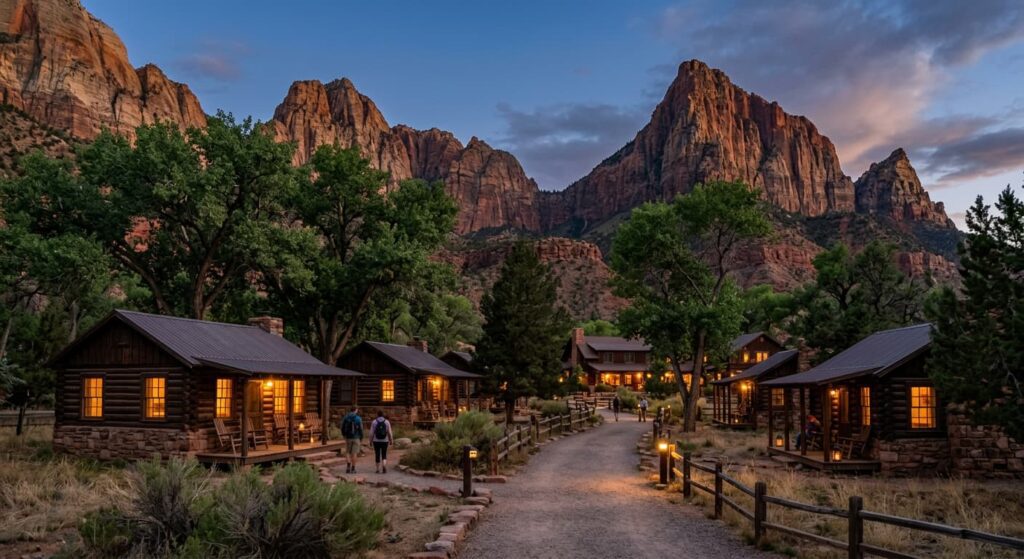
Zion Lodge is the only in-park lodging and the strong preference for photographers. Being inside the canyon at first light allows walking to the shuttle stop in three minutes. I remember being welcomed by a small family of 3 deer the last time I stayed there… right in the parking lot!. It books out a year in advance for peak season. Book it early or build a backup plan.
Springdale, immediately outside the south entrance, is the gateway town and a genuinely good one. Independent restaurants, solid lodging options, and the Virgin River run through it with the canyon walls rising above the town. Flanigan’s Inn offers canyon views from some rooms. The Desert Pearl Inn sits on the river. Multiple vacation rentals in the neighborhoods above Main Street provide kitchen access and the best views in town.
For RV travelers: the Watchman Campground at the park entrance has hookups and is reservable through recreation.gov. There is an important tunnel restriction on the eastern approach to keep in mind. Vehicles over 21 feet require an escort through the Zion-Mt. Carmel Highway tunnel. The south entrance through Springdale has no such restriction. Check current vehicle limits before routing.
If I Were Planning My First Visit
I would go in October. I would book the Angels Landing permit lottery the moment it opened. I would stay at Zion Lodge or as close to the canyon entrance as I could manage, and I would be on the first shuttle before the canyon woke up.
I would spend one full morning in the Narrows, renting the neoprene socks and canyon boots from a Springdale outfitter the night before. I would enter at the Temple of Sinawava as early as possible, walking upstream until the walls narrowed and the light did what I’ve been reading about for years. I would protect the camera. I would go slowly. I would let the canyon set the pace.
And I would stay in the canyon five minutes after sunset. There is apparently a window, maybe seven minutes give or take, when the direct light is gone but the reflected light from the western walls continues to illuminate the eastern walls in a warm pink-gold that has no direct-sun source. The photographers who leave when the sun sets miss it. I don’t want to miss it this time!
The Light I’m Curious About
Every national park has a light that defines it in photographs. In Yosemite it is the alpenglow on Half Dome. In the Grand Canyon it is the layered color at sunset from the South Rim. In Zion, from everything I have studied, it is the reflected light! The warm amber that fills the canyon floor not from above but from the sides, bounced off two thousand feet of orange sandstone until the whole canyon seems to glow from within are what help make this place unique.
I want to photograph that from the canyon floor in October, from six inches above a still pool in the Virgin River, with the cottonwood gold in the frame and the walls wrapping around everything. I want to be in the canyon when the last light disappears and the seven-minute window opens. I want to understand, from inside it, how this particular combination of geology and sun angle produces something that looks like this.
That is what the 63 parks project is, at its core… not checking boxes, but standing inside the light that made you curious in the first place.
A Deeper Exploration
This article is part of my ongoing project documenting and photographing all 63 national parks across the United States.
Along the way, I’m creating deeper guides that explore photography locations, travel planning, seasonal light conditions, and personal reflections from the road. Zion is one of the parks I’m most eager to get inside with a camera. The reflected light alone is worth the trip!
Sometimes the best way to understand a landscape is simply to stand in it, at the right hour, and let the light explain itself. Can’t wait to head back there!
One more thing — just between us
Zion is the most visited park in the system during peak season and the shuttle line at 7am can already feel like a lot. Here are three ways to find your own version of this canyon when the main corridor is running at capacity.
Within the park, Kolob Canyons — the park’s northwestern section accessible from its own exit off I-15 — is technically the same park as the main Zion Canyon and covered by the same entry fee, but receives a tiny fraction of the visitors. The finger canyons here are a different and quieter expression of the same Navajo sandstone geology. Most people have never heard of it.
Grafton Ghost Town — a 19th-century Mormon settlement a few miles outside the park near Rockville — is free, open to the public, and one of the most atmospheric historic photography subjects in southern Utah. The abandoned sandstone buildings against the red canyon walls in the late afternoon light are a completely different visual story from the canyon itself.
And if you want more canyon on a quieter scale, Kanarra Creek Canyon near Kanarraville — about 30 miles north — is a slot canyon hike through a creek that requires a permit but draws a fraction of the Narrows traffic. The slot photography is extraordinary and the permit is genuinely available. Worth the extra homework.