A Photographer’s First Look at the Largest Living Things on Earth — and How They Differ From the Tallest
Every photographer eventually builds a list of subjects they most want to stand in front of. The giant sequoia is on that list — not because of the photographs I have seen, which are numerous, but because of the specific thing the photographs consistently fail to communicate: mass.
I have been to the Redwood forests of northern California. I know what it feels like to stand at the base of a coast redwood and look up 300 feet and understand, intellectually, that this is the tallest tree on earth. The redwoods make you feel small through height — through the vertical distance between the forest floor and the canopy far above. The giant sequoia does something different. The sequoia makes you feel small through sheer mass — through the incomprehensible volume of living wood standing in front of you, a trunk so wide that the human figure at its base disappears not upward but outward, the bark so thick and so deeply furrowed that it reads as geological rather than biological.
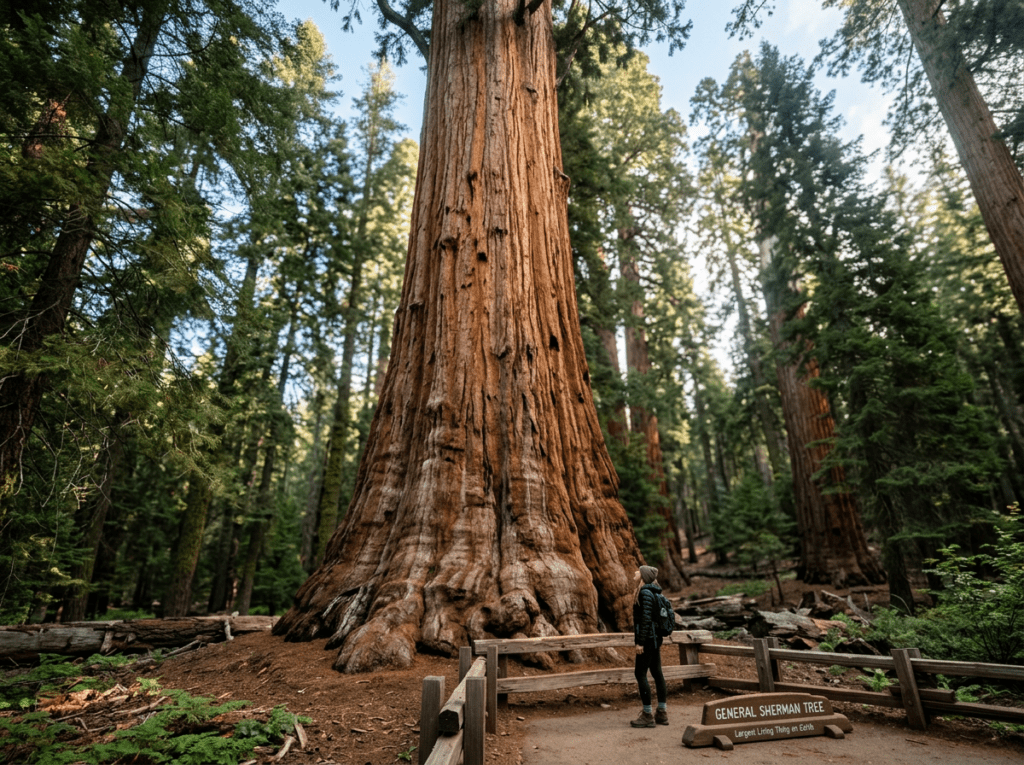
The General Sherman Tree in Sequoia National Park is the largest living thing on earth by volume — 52,500 cubic feet of living wood in a single tree that is approximately 2,200 years old. It was alive when Rome was a republic. It will likely still be alive when whatever comes after our current civilization has its own set of concerns. Standing in front of it is one of the experiences I am most looking forward to in this entire 63-park project — not because I expect the photographs to be easy, but because I expect the standing there to be unlike anything else.
The question of how Sequoia differs from the Redwoods is worth answering directly, because it comes up for anyone who has visited one and is planning the other. The coast redwoods are the tallest trees — they grow in a narrow coastal fog belt in northern California and reach heights up to 380 feet. The giant sequoias are the largest trees by volume — they grow on the western slopes of the Sierra Nevada between 5,000 and 7,000 feet and reach trunk diameters of up to 40 feet. The redwood forest feels like a cathedral of vertical space. The sequoia grove feels like standing among ancient monuments. Both are extraordinary. They are not the same experience.
The Landscape That Draws People Here
Sequoia National Park protects the largest groves of giant sequoias on earth, concentrated on the western Sierra Nevada slopes in central California. The park is managed jointly with Kings Canyon National Park immediately to the north — a combined area of 1,353 square miles that covers the full range of the Sierra Nevada from the sequoia groves of the foothills to the granite peaks of the high country above 14,000 feet. The two parks share an entrance fee and a management structure but have distinct characters: Sequoia is defined by the Giant Forest and the massive trees within it, while Kings Canyon adds the deepest canyon in North America and the high alpine wilderness of the Kings River drainage.
The Giant Forest is the heart of the park — a plateau at 6,400 feet containing the largest concentration of mature giant sequoias anywhere, including the General Sherman Tree, the General Grant Tree, the President, the Lincoln, and hundreds of other named and unnamed specimens. Walking through the Giant Forest on the Congress Trail — a 2-mile loop connecting the major trees — is one of the more genuinely humbling experiences available in the national park system. The trees are so large and so numerous that the scale takes time to absorb. You keep thinking you have understood it and then a slightly larger tree appears around the bend and resets the calculation.
Moro Rock, a granite dome rising from the forest at 6,725 feet, provides the elevated perspective that the forest floor cannot — a 360-degree panorama from the summit that takes in the sequoia forest below, the Great Western Divide to the east, and the Kaweah River canyon dropping away to the south and west. The hike to the summit is steep, short, and involves carved granite stairways — 350 steps to a view that recontextualizes everything you have been seeing from ground level in the forest below.
The Photographer’s Chase
The photography challenge at Sequoia is the same one the Redwoods present and then amplifies it: the trees are too large for conventional landscape composition. A wide angle at the base of the General Sherman Tree cannot capture both the full trunk diameter and the upper canopy in a single frame — the tree simply exceeds the field of view. The solutions are the same as at the Redwoods, but more extreme: the person-at-the-base for scale, shot from enough distance to show meaningful height; the upward perspective looking into the canopy along the column of the trunk; the macro lens at the bark surface where the extraordinary cinnamon-red texture reads as geological strata.
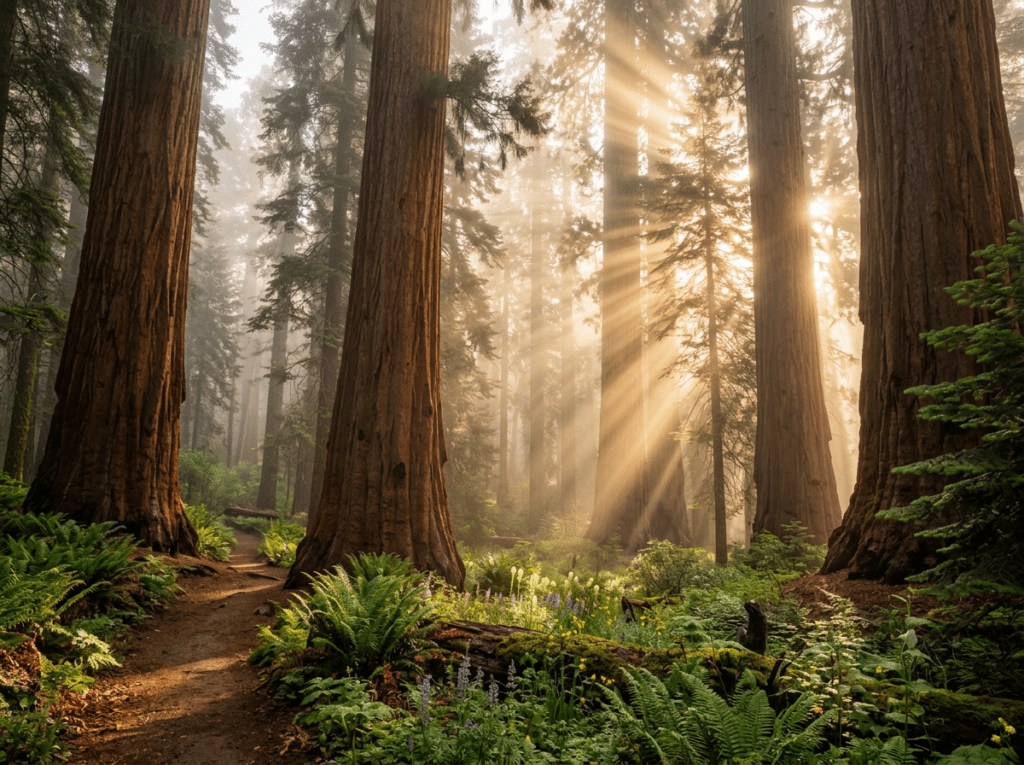
The shaft-of-light photography in the Giant Forest is the atmospheric condition most associated with sequoia photography — and it requires the same timing formula as at the Redwoods. The shafts appear when fog or haze is present in the forest but the sun is at an angle that creates direct light beams through the canopy. Early morning in the Giant Forest, before the convective heating burns off the ground fog, is when the light does this. The Congress Trail before 8am, when the mist is still moving between the trunks and the first shafts of direct light are finding gaps in the canopy — that is the sequoia morning.
The difference from Redwood photography that I am most curious about is the bark. Giant sequoia bark is extraordinary up close — the deep reddish-brown color, the fibrous texture, the fire scars that record centuries of wildfire history in the surface of the wood. The sequoia’s bark can be up to three feet thick, which is part of what makes the trees so resistant to fire. That thickness is visible and tactile and photographs in a way that communicates the tree’s age more directly than any measurement can. A macro lens on the bark surface of a tree that was alive when Julius Caesar was born is not conventional landscape photography. It is something more specific and more interesting.
Tunnel Log — a fallen sequoia through which the park road passes — is the human-scale comparison that most communicates trunk diameter to a viewer unfamiliar with the trees. The road passes through a tunnel carved through the fallen log at 17 feet wide and 8 feet high — and the log is 275 feet long and 21 feet in diameter. Photographing a vehicle passing through the tunnel, with the full diameter of the log visible above the roof of the car, is the scale demonstration that abstract measurements cannot provide.
Visiting the Park
Sequoia and Kings Canyon are accessed from the west via Highway 180 from Fresno to Kings Canyon or Highway 198 from Visalia to Sequoia. The primary season runs from late May through October, when the Generals Highway connecting the two parks is fully open and the higher elevation roads are snow-free. The Generals Highway itself is one of the more challenging park roads in the system for larger vehicles — narrow, steep switchbacks, and a vehicle length restriction of 22 feet for the stretch between the Potwisha Campground and the Giant Forest area. Larger RVs must enter from the Kings Canyon side via Highway 180.
The park does not currently require timed entry reservations, though the Giant Forest parking areas fill by mid-morning on summer weekends. The shuttle system connecting Lodgepole, the Giant Forest Museum, the General Sherman trailhead, and Moro Rock operates during peak season and eliminates the parking pressure for visitors willing to use it. An early arrival — in the forest before 7am — is the consistent answer to the summer crowd question.
Fall is the photography sweet spot — September and October bring lower crowds, the possibility of the first dusting of snow on the high country above the forest, and the low-angle autumn light that builds the most texture and shadow into the sequoia bark and the forest floor. The sequoias themselves do not produce fall color — they are evergreen — but the white fir and the sugar pine surrounding them drop needles and the forest floor goes gold in October in a way that the summer green cannot match.
Where to Stay
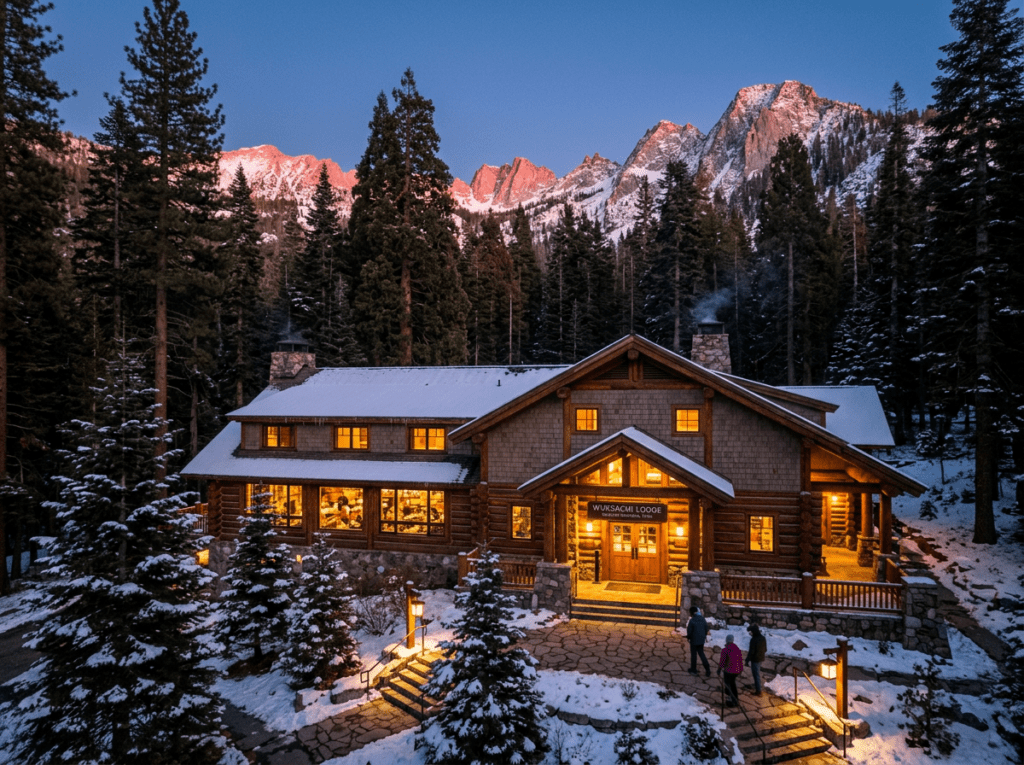
Wuksachi Lodge, at 7,200 feet in the Giant Forest area, is the only in-park lodging in Sequoia and the practical choice for photographers targeting the early morning light in the forest. The lodge sits above the sequoia groves with Sierra Nevada views and a position that makes pre-dawn trailhead starts entirely practical. It books out for peak summer season well in advance; the shoulder season availability in September and October is considerably better and coincides with the best photography conditions.
Grant Grove Village in Kings Canyon, about 30 miles north, provides additional in-park lodging — cabins in the Grant Grove area near the General Grant Tree, which is the largest sequoia in Kings Canyon and the designated National Christmas Tree. The Grant Grove area is less visited than the Giant Forest and the morning photography in the grove is consistently quieter.
Visalia and Fresno provide the gateway city lodging — both are about 1.5 hours from the Giant Forest area and provide the airport connections and full-service lodging that the park’s mountain communities cannot. For RV travelers, Lodgepole Campground inside Sequoia and Sunset Campground at Grant Grove in Kings Canyon are the primary in-park options, both reservable through recreation.gov. The 22-foot vehicle restriction on the Generals Highway approach from the Sequoia entrance is the critical planning note — larger rigs must enter via Highway 180 from the Kings Canyon side.
If I Were Planning My First Visit
October. Wuksachi Lodge if available, Lodgepole Campground if not. The goal is to be in the Giant Forest before the light arrives — on the Congress Trail by 6am, before the parking areas open to the day crowd, in the mist and the quiet that the forest has every morning before the visitors arrive.
The General Sherman Tree first — not to photograph immediately but to stand in front of it and let the scale land. This is the discipline I have learned in this project: the first look is a look, not a session. Let the place show you what it is before you ask the camera to record it.
Then the bark. Close, with a macro lens, at the surface of a tree that is two thousand years old. The texture, the fire scars, the color that is not quite red and not quite brown and is entirely specific to this species. That close-range image is the one I am most curious about — the one that tells the tree’s age more honestly than any wide-angle composition can.
And Moro Rock at sunset — the granite dome above the forest, the Great Western Divide catching the last light to the east, the sequoia canopy below going from green to gold to silhouette as the light leaves the mountains. The forest from above, after a day spent inside it. That is the full picture.
The Light I’m Curious About
It is the morning shaft light — the specific condition in the Giant Forest when ground fog is present and the first direct sun finds gaps in the canopy and descends in visible beams between the sequoia trunks.
I have seen this light in photographs from both the Redwoods and the Sequoias and the difference is not just scale — it is the color of the trunks the light illuminates. The coast redwood bark is darker, more uniform, and the shafts in a Redwood forest have a cool, silvery quality. The giant sequoia bark is that deep cinnamon-red, and the morning shafts in the Giant Forest pick up that color and warm the whole grove in a way that feels almost internal — the light not just falling on the trees but being modified by them, the red of the bark contributing to the quality of the light that surrounds it.
That is the photograph I am planning the October trip around. The sequoia grove at 6am, the mist still in the forest, the shafts finding the cinnamon trunks and warming the air between them. A tree that is 2,200 years old, in the light that makes it look like it has been growing since before photography existed to record it — which it has.
A Deeper Exploration
This article is part of my ongoing project documenting and photographing all 63 national parks across the United States.
Along the way, I’m creating deeper guides that explore photography locations, travel planning, seasonal light conditions, and personal reflections from the road. Sequoia closes a batch of five parks that ranged from the darkest sky in the lower 48 to the bluest lake in the country to an urban monument to a Midwest lakeshore to the largest living things on earth. That range is the project — 63 parks, 63 different answers to the question of what light does to a landscape when you show up early enough to find out.
Because the General Sherman Tree has been standing since before the Roman Empire fell. It does not need a photographer. But a photographer who stands in front of it with patience and a macro lens might come away with something that communicates, however imperfectly, what 2,200 years of living looks like.
One more thing — just between us.
Sequoia and Kings Canyon are managed jointly and the combination is genuinely greater than either park alone — but here are three places worth knowing when you want the giant tree experience with a different kind of quiet.
Cedar Grove in Kings Canyon — the valley floor of Kings Canyon at the end of a dramatic road descending 2,000 feet from the rim — is one of the least visited and most spectacular valley settings in the California park system. The Kings River through a granite canyon with walls deeper than the Grand Canyon, almost no crowds, and the sequoias of the Grant Grove above on the rim. A completely different park from the Giant Forest and worth the drive north.
Within Sequoia itself, Mineral King Valley — accessed by a narrow 25-mile road from the park’s southern entrance — is a remote subalpine valley at 7,800 feet that sees a fraction of the Giant Forest traffic. Wildflowers, marmots, high Sierra views, and the genuine solitude that the main park corridor cannot offer. The road is not suitable for RVs or trailers but is straightforward in a regular vehicle.
And for the Sierra Nevada experience that extends the Sequoia visit into a full mountain trip, the John Muir Trail begins at Mount Whitney — the highest peak in the contiguous United States — just east of the park boundary. The Whitney Portal at sunrise, with the Sierra crest above and the Owens Valley below, is the high-altitude California photography that the sequoia grove cannot provide and that completes the full Sierra Nevada story. Same trip, different altitude, different world.