A Photographer’s First Look at the Blue Ridge, the Morning Fog, and the Long Light of Skyline Drive
Some landscapes become part of our imagination long before we ever visit them. Shenandoah works differently. It becomes part of your imagination on the drive in — the moment Skyline Drive begins to climb the Blue Ridge and the valley below starts to fall away and the Appalachian ridgeline opens up on both sides, layered blue on blue on blue into the distance.
The Blue Ridge haze that gives these mountains their name is not pollution and it is not quite fog. It is terpenes — organic compounds released by the dense hardwood and conifer forest covering every ridge — that scatter the blue wavelengths of light and turn the distant mountains a soft, luminous blue. It is atmospheric. It is specific to these mountains. And for a photographer, it is one of the most distinctive and most challenging light conditions in the eastern park system.
Shenandoah is not a park of dramatic geological formations or iconic solitary subjects. It is a park of mood, season, and layered distance — and photographing it well requires understanding all three.
The Landscape That Draws People Here
Shenandoah National Park runs 105 miles along the crest of the Blue Ridge Mountains in northern Virginia, from Front Royal in the north to Waynesboro in the south. Skyline Drive — the only public road through the park — follows the ridge the entire length, never dropping below 2,000 feet, with 75 designated overlooks offering views east across the Virginia Piedmont and west across the Shenandoah Valley. At 105 miles with a 35mph speed limit, Skyline Drive is not a road to rush.
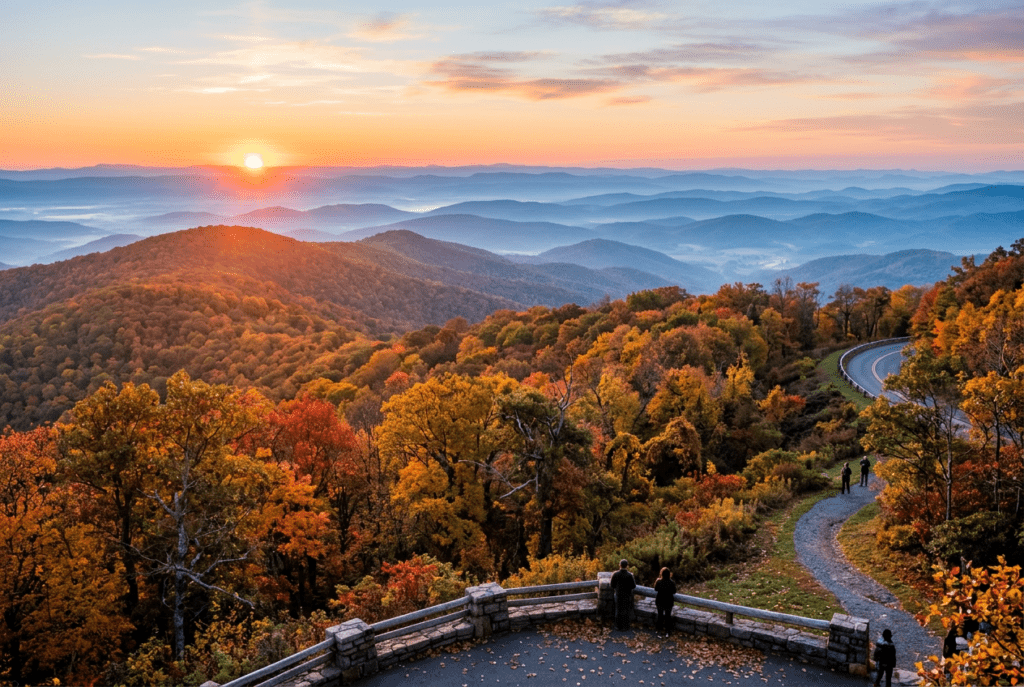
The park’s character is defined by its forest. Shenandoah is 95 percent forested — one of the most heavily wooded parks in the system — and the hardwood canopy that covers the ridge produces the fall color event that draws the park’s largest crowds every October. Oak, maple, hickory, and tulip poplar turn the ridgeline every shade of amber, orange, and gold in a display that, while not as dramatic as New England’s, has a softer, more enveloping quality. You are not looking at fall color from a distance here. You are inside it.
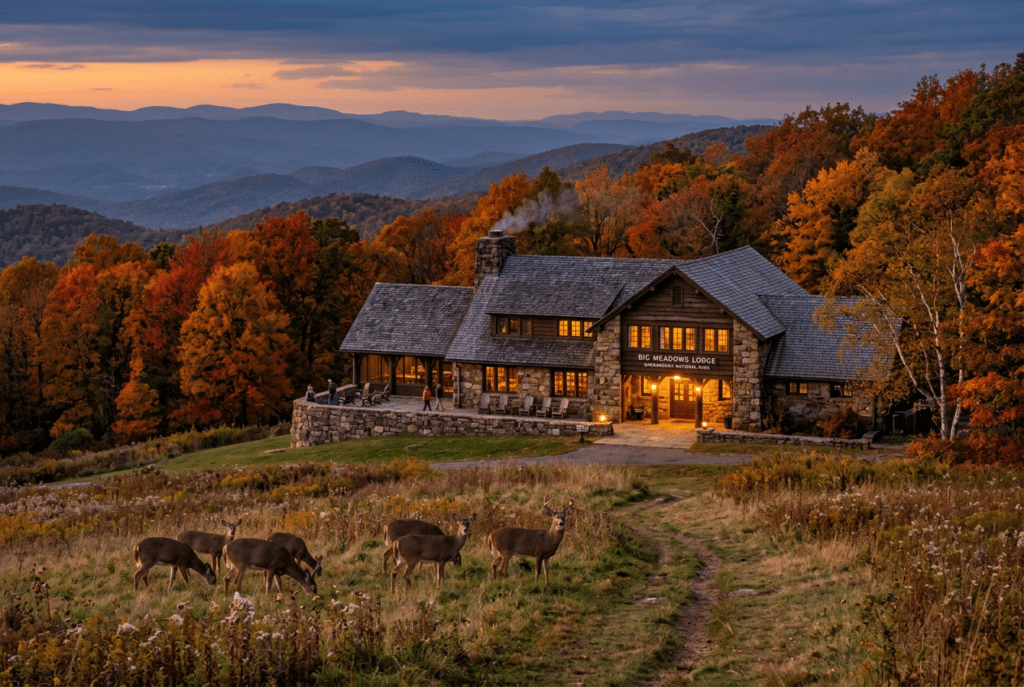
The Shenandoah River and its tributaries run through the valley below the western escarpment, and the white-tailed deer population in the park is among the most visible of any park in the system — habituated to humans, present at the overlooks at dawn and dusk, and a consistent wildlife photography subject throughout the year. Black bears are also resident and regularly seen, particularly in spring and fall.
The Photographer’s Chase
The fundamental photography challenge at Shenandoah is the haze. The blue atmospheric quality that makes the distant ridgelines so beautiful in person is the same quality that reduces contrast and flattens color in photographs. A polarizing filter helps — rotating it to cut the atmospheric scatter brings back some of the color differentiation between the ridgeline layers — but it cannot fully resolve a problem that is atmospheric rather than optical. The solution is to work with the haze rather than against it: shoot in the early morning when the haze is thinnest and the light is most directional, and embrace the blue tones as the mood of the place rather than fighting them as a technical obstacle.
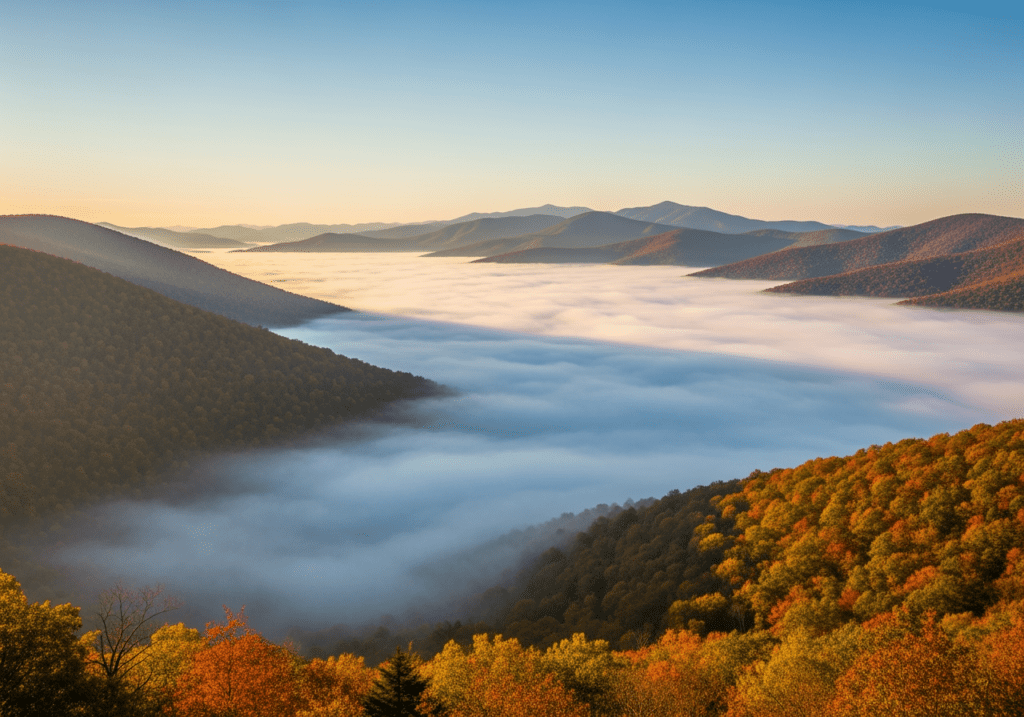
The sea of fog photography is the condition every Shenandoah photographer hopes for. On autumn mornings after a clear, cool night, cold air drains into the Shenandoah Valley and fills it with fog while the ridge above stays clear. From the western overlooks on Skyline Drive, the valley below disappears entirely — replaced by a white sea of fog with the distant mountain ridgelines floating above it. The near hillsides emerge from the fog in fall color. The sun rises over the eastern ridge and light hits the fog surface. It is one of the most extraordinary recurring atmospheric events in the eastern park system, and it happens multiple times each fall.
Stony Man overlook and Timber Hollow overlook are the two western-facing positions most consistently recommended for the fog photography — both provide clear sightlines down into the Shenandoah Valley and enough elevation to be reliably above the fog layer on the mornings it forms. Neither requires more than a short walk from a parking area. The work is in the waking up early and being there before the fog burns off — which happens quickly once the sun is up and the temperature rises.
Wildlife photography along Skyline Drive in the early morning hours — deer at the overlooks, occasional bear sightings, wild turkeys in the forest clearings — is some of the most accessible in the eastern parks. The deer in particular are reliably present at dawn and dusk, close enough for a mid-range telephoto to produce strong environmental portraits with the Blue Ridge behind them.
Visiting the Park
Shenandoah is one of the most accessible national parks in the system — within a few hours’ drive of Washington D.C., Baltimore, Richmond, and Philadelphia, which means it draws large crowds on fall weekends when the color peaks. Arriving on a Thursday or Friday rather than a weekend in October makes a meaningful difference in how the park feels. The four entrances along the park’s length allow visitors to choose their starting point on Skyline Drive; the central section around Big Meadows and Skyland tends to be the most visited.
Spring is an underrated photography season here — the wildflowers along the hiking trails in April and May, the waterfalls running at full volume from spring rains, and the fresh green of the emerging hardwood canopy produce a completely different park than the fall version. Summer is warm and hazy, and the dense canopy reduces the overlook photography considerably — but the forest itself is at its most lush and the wildlife activity is high. Winter closes some facilities and occasionally closes Skyline Drive in sections after snow or ice, but the park in winter with snow on the ridgeline is serene and rarely crowded.
No timed entry reservations are currently required for Shenandoah, which makes it one of the more spontaneous parks in the eastern system. An America the Beautiful pass covers the entry fee. Pets are permitted on most trails, which is relatively unusual in the national park system and worth knowing for travelers with dogs.
Where to Stay
Skyland Resort and Big Meadows Lodge are the two in-park lodging options — both historic properties operated by the park concessionaire along the central section of Skyline Drive. Skyland sits at the highest elevation on Skyline Drive and has the most dramatic views; Big Meadows sits adjacent to the largest open meadow in the park, where deer are reliably present at dawn and dusk. Both book out well in advance for October fall color season. For a photography trip built around the sea of fog phenomenon, being inside the park and able to reach the western overlooks before sunrise without a long drive is a genuine practical advantage.
Gateway towns on both sides of the park offer additional options. Luray, Virginia — in the Shenandoah Valley on the western side — is a pleasant small town about 20 minutes from the Thornton Gap entrance, with good independent lodging and the famous Luray Caverns nearby. Front Royal anchors the northern end and Waynesboro the southern, both with reasonable lodging clusters.
For RV travelers, Mathews Arm, Big Meadows, Loft Mountain, and Dundo campgrounds are spaced along the length of Skyline Drive and provide the inside-the-park access that makes the sunrise and fog photography practical. Big Meadows is the most popular and the most central. Reservations through recreation.gov are essential for fall season; some sites are first-come, first-served outside peak season. RVs up to 35 feet are accommodated at most campgrounds, though some individual sites are more limited.
If I Were Planning My First Visit
I would go in mid-October and I would stay inside the park. The fall color window, the fog probability, and the quality of the autumn light on the ridgeline all converge in a ten-day window in mid-October that is as good as Shenandoah gets for photography. Missing it by two weeks in either direction means missing the primary event.
I would check the overnight forecast every evening. A clear, cold night after a warm day is the fog recipe — cold air draining into the valley, temperature inversion forming, the valley filling white by midnight and holding until the sun climbs high enough to burn it off. When that forecast appeared, I would set an alarm for well before sunrise and be at a western overlook — Stony Man or Timber Hollow — before the light arrived. I would have the tripod up and the composition ready. Then I would wait.
The rest of the trip I would spend slower — driving Skyline Drive in the late afternoon with the light going golden on the fall color, stopping at overlooks not to shoot aggressively but to look, to understand how the haze changes through the day and what the light does to the layered ridgelines at different hours. Shenandoah is a park that teaches you to read atmosphere. That education is worth the trip by itself.
The Light I’m Curious About
It is the sea of fog at first light.
Not the fog itself — fog as a photographic subject is difficult, flat, and often disappointing. What I am curious about is the specific moment when the rising sun clears the eastern ridge and the first direct light crosses the fog surface while the near hillsides are still in shadow. The fog goes from white to gold in seconds. The fall color on the emerging hilltops catches the light while the valley below stays buried. The distant ridgelines float above it all in their characteristic blue. That is the image — the transition moment, the ten seconds when the light and the fog and the color are all doing something at the same time.
It requires the right conditions, the right season, and being at the right overlook before the light arrives. It cannot be manufactured. It can only be waited for.
That patience — the willingness to set the alarm, drive to the overlook in the dark, and wait for something that may or may not happen — is what this project is teaching me to practice. Shenandoah will be a good teacher.
A Deeper Exploration
This article is part of my ongoing project documenting and photographing all 63 national parks across the United States.
Along the way, I’m creating deeper guides that explore photography locations, travel planning, seasonal light conditions, and personal reflections from the road. Shenandoah sits at the heart of the Eastern cluster — closer to more Americans than almost any other national park, and underestimated by most of them.
Because sometimes the most extraordinary light is not at the end of a long flight and a remote trailhead. Sometimes it is three hours from home, on a Tuesday morning in October, when the valley fills with fog and the sun comes over the ridge and everything goes gold for ten seconds.
One more thing — just between us.
Shenandoah on a fall weekend draws serious traffic from the D.C. metro area — the Skyline Drive can feel like a very scenic parking lot by mid-morning in October. Here are three ways to find the same light and color with significantly more breathing room.
The George Washington National Forest flanks the park on both sides and covers nearly two million acres of the same Blue Ridge and Allegheny Mountain terrain — the same fall color, the same ridgeline views, and almost none of the Skyline Drive traffic. The forest roads require more navigation than the park road but reward it with genuine solitude.
On the western side of the valley, Luray Caverns near the Thornton Gap entrance is not a landscape photography subject but it is one of the most extraordinary interior photography environments on the East Coast — vast cave chambers, mirror-still reflection pools, and geological formations lit in a way that rewards a slow walk with a camera. Worth knowing about for the inevitable overcast day when the overlook photography is flat.
And for a quieter section of the park itself, the southern entrance near Rockfish Gap and the Loft Mountain area see a fraction of the Big Meadows and Skyland traffic — the same Skyline Drive, the same fog conditions, the same fall color, with room to pull off and set up a tripod without negotiating with the car behind you.