A Photographer’s Return to Wyoming’s Cathedral Range — This Time With a Camera Instead of Just a Heart
Some landscapes become part of our imagination long before we ever visit them. And some visits become part of us in ways that have nothing to do with the photographs we came home with.
I want to be honest about something before I write about Grand Teton National Park as a photographer. My one visit there — during my 50 at 60 journey through all fifty states — was not primarily a photography trip. It was a trip with my daughter and my ex-wife, who is also one of my closest friends, and the memories we made in that landscape matter more to me than any image I captured there. I have said throughout this project that these posts are not really about me — they are about what I can share with you as a viewer and a photographer, what to look for, when to go, how to find the light. That is still true. But occasionally the personal breaks through and it would be dishonest to pretend otherwise. Grand Teton is one of those occasions.
The videos from that trip — which you can find linked here if you want to see what Grand Teton looks like through the eyes of three people having a genuinely good time — are some of my favorite work from the entire 50 at 60 project. Not because of the technical execution but because of what they captured: the scale of the Teton Range seen for the first time, the light on the Snake River in the late afternoon, the laughter of people who figured out that friendship is possible in all kinds of configurations. Some images are worth more than others for reasons that have nothing to do with photography.
The return trip is different in intention. It is about the light. About the photography that the first visit, full of better things to pay attention to, did not fully deliver. The Tetons deserve both visits — the one you take for the memory and the one you take for the image. I have had the first one. Now I want the second.
The Landscape That Draws People Here
Grand Teton National Park occupies the Teton Range and the Jackson Hole valley in northwestern Wyoming, immediately south of Yellowstone. The Tetons are among the youngest mountain ranges in the Rocky Mountains — only nine to thirteen million years old — and their youth shows in their geology. There has not been enough time for erosion to soften the peaks into the rounded profiles that characterize older ranges. The Tetons rise almost vertically from the valley floor, with no significant foothills, the granite faces going from 6,800 feet at Jackson Hole to 13,770 feet at the Grand Teton summit in a nearly uninterrupted vertical rise that produces the most dramatic mountain-to-valley silhouette in the continental United States.
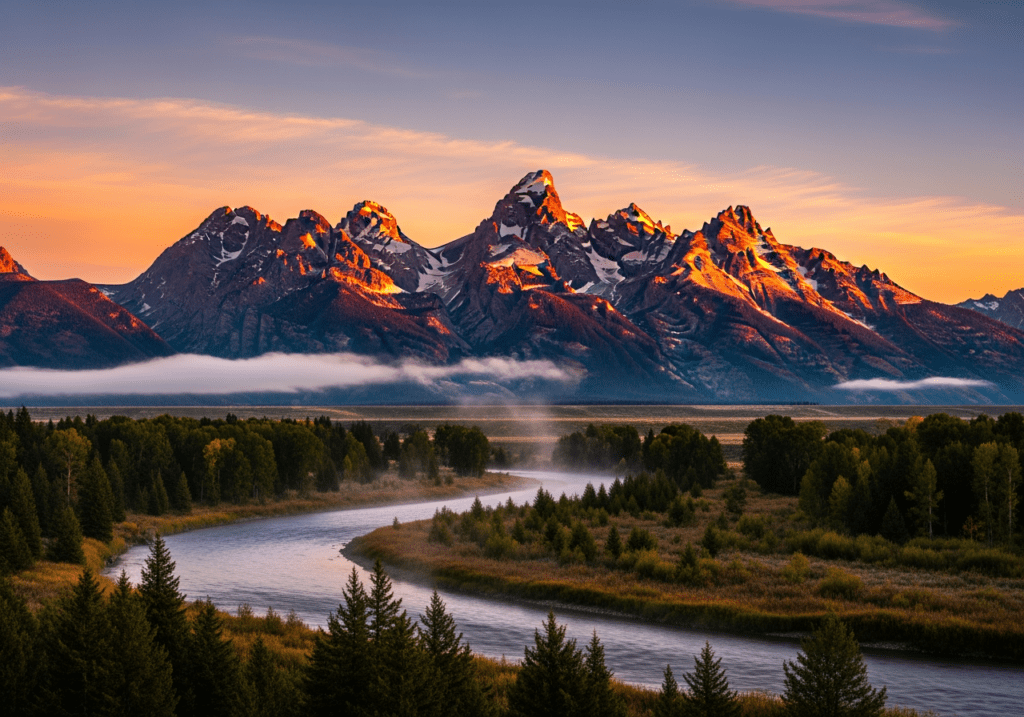
The Snake River in the foreground, the Teton Range behind it, and the specific light quality of a Wyoming morning or evening — this is the composition that Ansel Adams established as the defining image of the park in his 1942 photograph from the Snake River Overlook, and it remains the benchmark against which every Teton photograph is measured. The overlook is still there. The composition is still extraordinary. The light on a clear September morning, with the first alpenglow on the peaks and the river in the foreground catching the color of the sky, is still producing images that justify the drive.
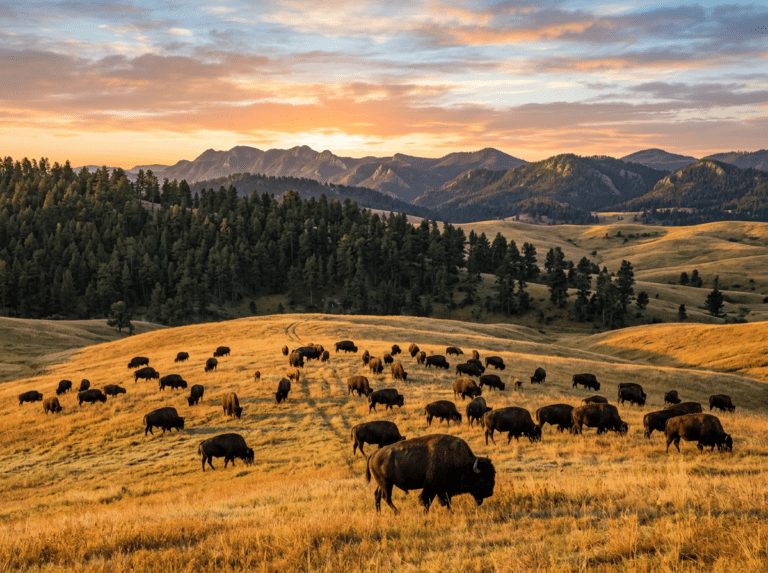
The park extends beyond the mountains into the Jackson Hole valley, with Oxbow Bend on the Snake River, the Willow Flats moose habitat, the sagebrush flats of Antelope Flats where bison herds graze with the Tetons behind them, and the string of glacial lakes — Jenny Lake, String Lake, Leigh Lake — along the base of the range. Each location is a different expression of the same mountain and valley system, and each one has its specific light window and its specific wildlife rhythm.
The Photographer’s Chase
The Tetons are among the most photographed mountains in the world, and the challenge they present to a photographer is not finding beautiful subjects but finding a personal interpretation of subjects that have been shot from every angle in every season for more than a century. The Snake River Overlook composition is the benchmark precisely because it is so strong — but it is also the image that a million photographers have made before you, and the question is what you bring to it that is specifically yours.
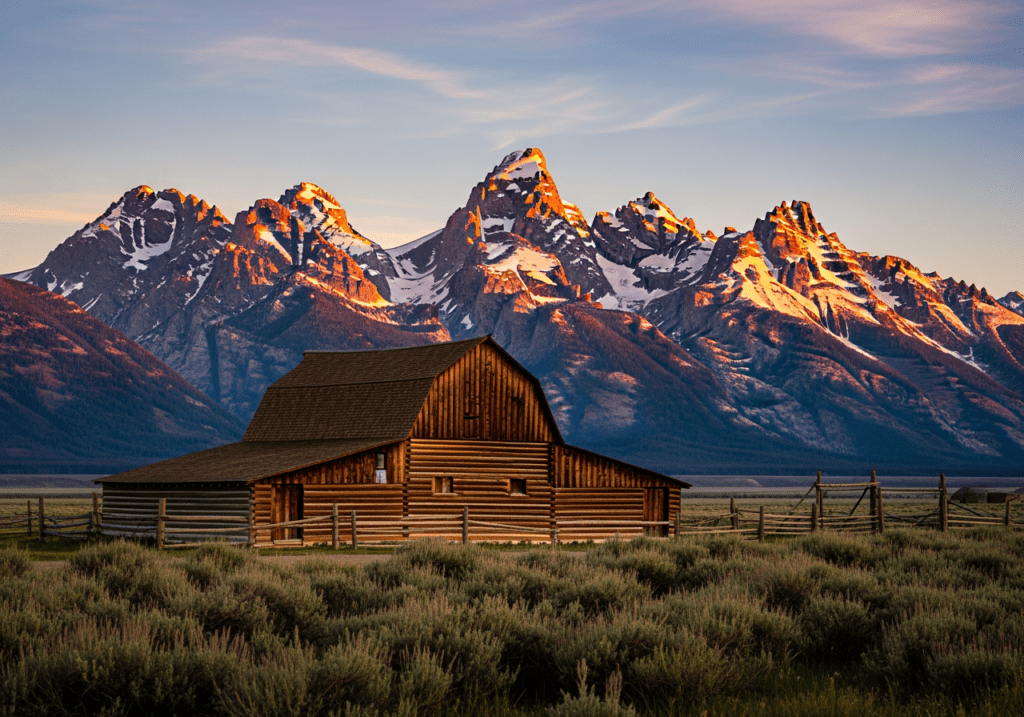
The answer, as always, is light and timing. The alpenglow on the Teton peaks at sunrise — the peaks going from dark silhouette to the deep pink of pre-dawn color to the full warm gold of direct sun in a progression that takes about twenty minutes — is the light window that defines Grand Teton photography. Snake River Overlook for the classic wide composition. Schwabacher Landing, a few miles south along the river, for the reflection photography — the still water of the beaver ponds in the early morning reflecting the peaks above in a composition that rivals the overlook for emotional impact and is consistently less crowded. Mormon Row, the historic homestead site on the Antelope Flats with the weathered Moulton Barns in the foreground and the Teton Range behind — one of the most photographed barns in the American West and still, in the right light, genuinely extraordinary.
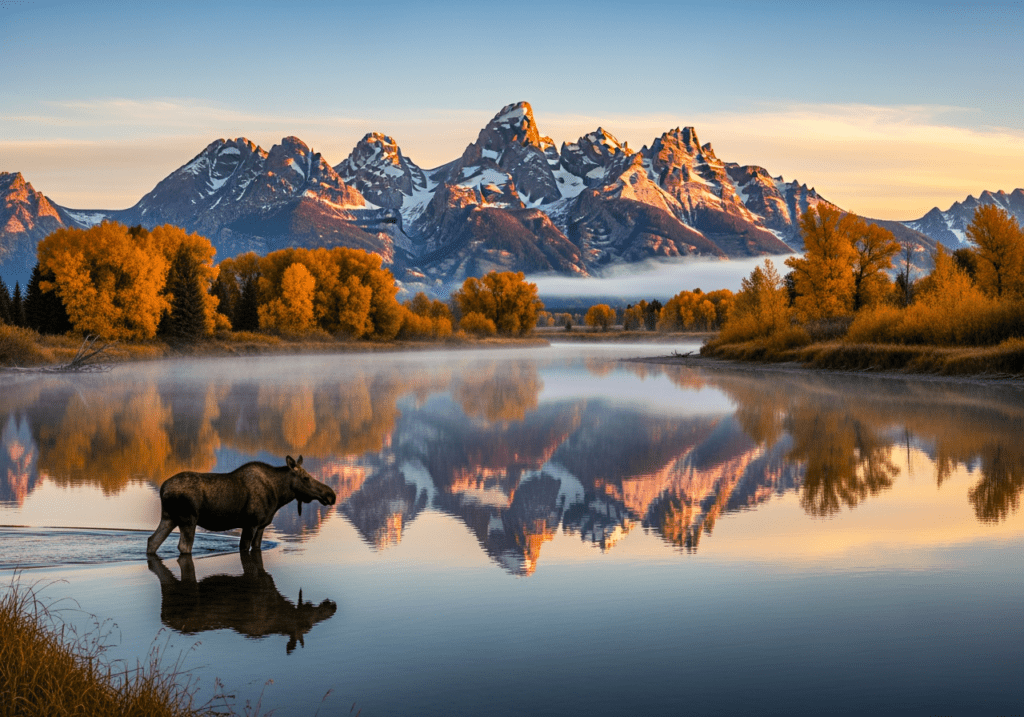
Oxbow Bend is the wildlife photography position — a meander of the Snake River where the still water reflects the peaks and the surrounding cottonwood forest, and where moose, river otters, bald eagles, ospreys, and trumpeter swans are regularly present in the early morning. The fall color at Oxbow Bend in late September and early October, when the cottonwoods go gold and the moose are active in the willows during the rut, produces some of the finest combined wildlife and landscape photography in the national park system. A long lens for the wildlife, a wide angle for the peak reflections, and enough time to let both happen in the same morning.
The Jenny Lake area provides the close-range mountain photography that the valley floor cannot — trails along the lake shore with direct views of the Cathedral Group, the boat ferry across Jenny Lake to the Cascade Canyon trailhead, and the canyon itself winding up into the range with the peaks rising on both sides. The light in Cascade Canyon in the late morning, when the sun has cleared the eastern ridge and the canyon is fully illuminated, is the interior mountain photography that the valley floor overlooks cannot produce.
Visiting the Park
Grand Teton is open year-round, with the primary visitor season running from late May through October. The park does not currently require timed entry reservations, though the most popular pullouts and trailhead parking areas fill early on summer mornings — Snake River Overlook and Schwabacher Landing in particular are full by 6am on clear summer days during peak season. Arriving before first light is the practical solution and the photography solution simultaneously.
September is the photography sweet spot — the fall color peaks in late September along the river corridors, the moose rut brings the bulls into the open in the early morning and evening, the crowds thin noticeably after Labor Day, and the light takes on the low-angle quality that the summer overhead sun cannot produce. The combination of fall color, wildlife activity, and light quality in the last two weeks of September is as complete a photography window as the park offers.
The park shares the Jackson Hole valley with the town of Jackson and the adjacent National Elk Refuge, which adds winter wildlife photography — the elk herd that winters on the refuge, up to 11,000 animals, is one of the largest elk concentrations in North America and accessible by horse-drawn sleigh from December through April. A winter visit to Grand Teton, with snow on the peaks and the elk on the refuge and the valley quiet after the summer crowds, is a completely different park than the one most visitors experience.
Where to Stay
The in-park lodging options at Grand Teton are among the finest in the national park system. Jenny Lake Lodge — a cluster of historic cabins in a meadow at the base of the mountains near Jenny Lake — is the most intimate and most expensive in-park option, with a reputation for exceptional dining and a setting that puts the peaks immediately accessible from the cabin door. The Lodge at Jackson Lake, on the shore of Jackson Lake with direct mountain views, is the grand property — a full resort experience with the Teton Range as the backdrop from the dining room windows.
Signal Mountain Lodge, on the Jackson Lake shoreline south of Jackson Lake Lodge, offers a more moderate price point with comparable lake and mountain access. Colter Bay Village provides cabin and tent camping options at the northern end of the park. All in-park lodging books out for peak season well in advance — the same 13-month booking window applies here as at other concessionaire-operated properties.
Jackson, the gateway town at the southern end of the valley, provides the full range of lodging from budget to luxury and the dining and entertainment infrastructure of a genuine mountain resort town. For photographers, the additional commute from Jackson to the northern park locations — Oxbow Bend, Willow Flats, the Moulton Barns at Mormon Row — adds 20 to 40 minutes each way, which matters when the alarm is set for 4am. In-park lodging earns its premium for the pre-dawn access it provides. For RV travelers, the Gros Ventre, Signal Mountain, and Colter Bay campgrounds offer the most central access to the park’s primary photography locations.
If I Were Planning My First Visit
The first visit has been made, in the best possible company, for all the right non-photographic reasons. I would not trade a single moment of it for a better-exposed image. But the return trip is specifically about the photography that the first visit, full of better things to pay attention to, did not deliver.
Late September. In-park lodging at Signal Mountain or Jenny Lake. Schwabacher Landing before sunrise on the first morning — the beaver pond reflections in the pre-dawn blue hour before the alpenglow begins, then the full progression of color on the peaks as the sun clears the horizon. Mormon Row in the early morning for the Moulton Barns with the Tetons behind them in the first direct light. Oxbow Bend at dawn for the wildlife and the fall color cottonwoods.
And an afternoon in Cascade Canyon — the boat ferry across Jenny Lake, the trail winding up into the range, the mountains closing in on both sides and the light finding the canyon walls in the late morning. The Grand Teton that lives inside the range rather than the one visible from the valley floor.
The memories from the first visit belong to the people who were there. The images from the return belong to the light. Both of those things are true, and neither one diminishes the other.
The Light I’m Curious About
It is the alpenglow on the Cathedral Group — the specific progression of color on the three central Teton peaks as the sun rises behind the eastern ridgeline and the light works its way down the granite faces from the summit to the base.
I saw a version of this on the first visit. I was present for it. I was not, if I am honest, fully paying attention to it in the way a photographer pays attention — camera up, composition set, waiting for the light to move. I was paying attention to the people I was with, which was the right thing to do. The Tetons in alpenglow are extraordinary. The people you are with in that moment are also extraordinary. On the first visit I chose correctly.
The return trip is the one where I choose the camera. Where I am at Schwabacher Landing in the dark, with the tripod in the beaver pond reflection position, watching the peaks above the still water go from the blue of pre-dawn through the pink of first color to the full gold of direct sun. Where I have the composition ready before the light arrives and stay until the progression is complete.
Some lights are worth seeing twice. The Teton alpenglow is one of them — once with the people you love, and once with the camera you’ve been learning to use better ever since.
A Deeper Exploration
This article is part of my ongoing project documenting and photographing all 63 national parks across the United States.
Along the way, I’m creating deeper guides that explore photography locations, travel planning, seasonal light conditions, and personal reflections from the road. Grand Teton is the park in this series where the personal and the photographic are most honestly tangled together — and I decided not to untangle them, because the tangle is true.
Because the best reason to visit a national park is not always the photography. And the best photography often comes from the people who already know what the place means to them before they raise the camera.
One more thing — just between us.
The Snake River Overlook and Schwabacher Landing are full before sunrise on clear September mornings — with good reason, but it means the competition for position is real. Here are three places in and around the Jackson Hole valley where the Teton photography happens without the crowd.
Gros Ventre Road — running east from the main park road through the sagebrush flats and along the Gros Ventre River — is one of the park’s best-kept wildlife secrets. Bison herds, pronghorn, moose in the willows, and the occasional bear, all with the Teton Range in the background and almost no other photographers in the frame. The light on the sagebrush flats in the early morning, with the mountains behind, is a completely different Teton composition from the river reflection shots.
Just outside the park, the National Elk Refuge adjacent to Jackson offers winter wildlife photography — up to 11,000 elk on the winter range, accessible by horse-drawn sleigh from December through April — that the summer park visitor never considers.
And for a quieter version of the classic Teton view, Antelope Flats Road and the Mormon Row area in the early morning — before the tour vans arrive at the Moulton Barns — is the Teton photograph with the weathered homestead in the foreground that most visitors see from a crowded pullout. Get there at first light and you may have it entirely to yourself.