A Photographer’s Return to Colorado’s Darkest Canyon — This Time With More Than One Overlook and Better Light
Every photographer eventually builds a list of places they owe a proper visit. Black Canyon of the Gunnison went on that list on a long drive through Colorado — northern Arizona to Denver, catching a flight, the canyon appearing on the map as something worth a stop without quite registering what kind of stop it deserved.
I pulled off at one overlook. Midday. The sun directly overhead, the canyon below me dropping into a darkness that the flat light could not fully illuminate. I took a few photographs, looked at the screen, understood that something was down there that my images were not capturing, got back in the car, and continued toward Denver.
There has to be more to this park than what I saw. That sentence has been running in the back of my mind ever since, because what I saw — even in the worst possible light, even from a single overlook on a schedule — was extraordinary enough to make clear that the park itself must be something else entirely under the right conditions. The canyon is 2,700 feet deep in places. The walls are so sheer and so dark that sections of the gorge receive less than thirty minutes of direct sunlight per day. The Gunnison River at the bottom carved this through some of the oldest exposed rock on the continent — 1.7 billion year old Precambrian gneiss and schist that is darker and harder than almost any rock in the national park system. I saw the edge of all of that from one overlook at noon. The return trip is about seeing what the light actually does to it.
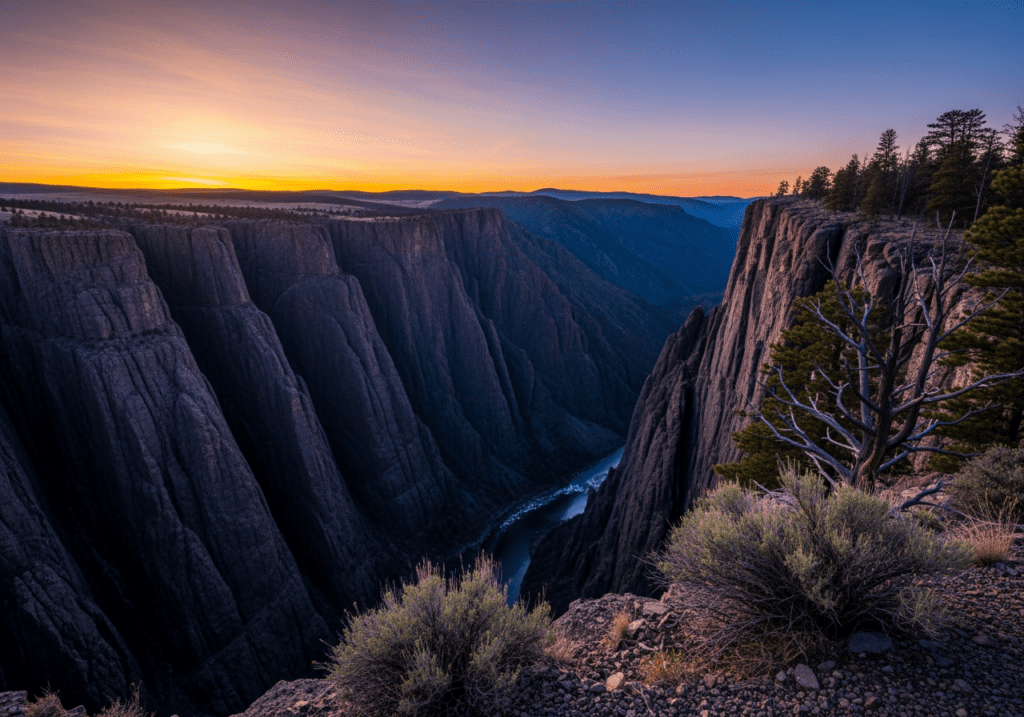
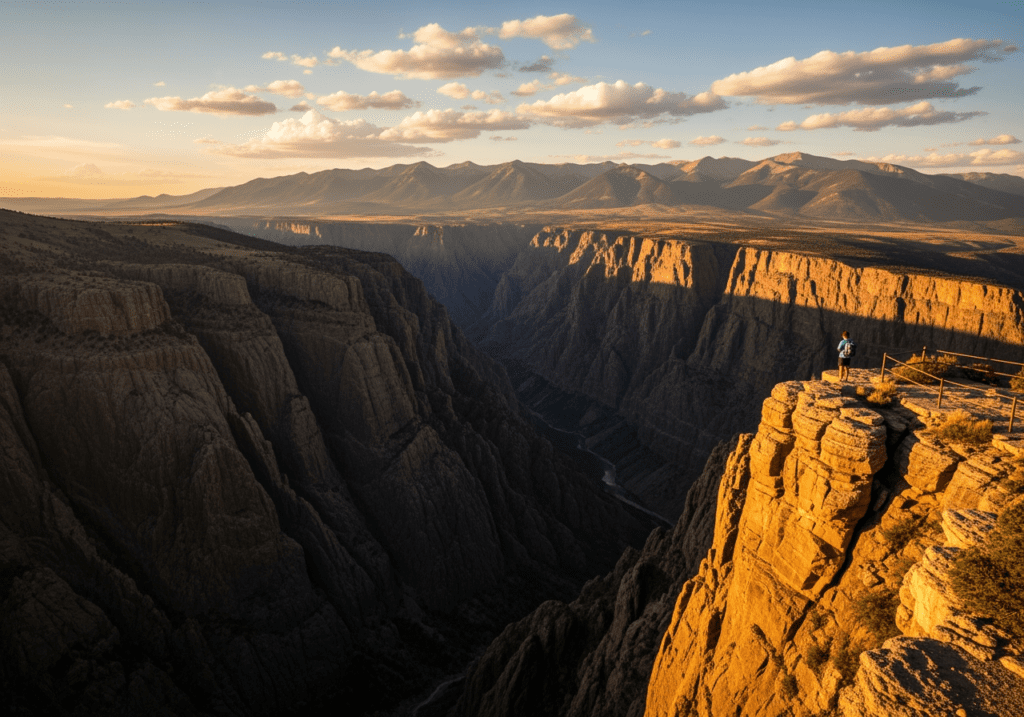
The rim catches the first light while the canyon interior stays in the deep shadow that gives this place its name.
The Landscape That Draws People Here
Black Canyon of the Gunnison is one of the most dramatic and most undervisited parks in the system… overshadowed by its Colorado neighbors, the Rocky Mountain parks and the Mesa Verde cliff dwellings, and not yet discovered by the Instagram traffic that has overwhelmed the more famous western parks. It protects 48 miles of the Gunnison River gorge, of which the national park encompasses the most dramatic 12-mile section where the canyon reaches its maximum depth and its minimum width. At the Narrows, the canyon is 1,100 feet wide at the rim and 40 feet wide at the river… a slot of darkness with 1,730-foot walls on both sides.
The darkness is the defining characteristic. The canyon walls are composed of ancient dark metamorphic rock, the Precambrian gneiss and schist that gives the canyon its name, and the orientation of the gorge means that certain sections receive almost no direct sunlight at any hour of the day. The canyon absorbs light rather than reflecting it. It is, in the truest sense, a black canyon. And the photography challenge and opportunity that creates is unlike anything else in the Colorado Plateau or the Rocky Mountain parks.
The South Rim, where the visitor center and the primary overlooks are located, is the most accessible section. It’s a 7-mile rim road with 12 overlooks ranging from the easy Gunnison Point walk to the more involved Warner Point Trail at the road’s western end. The North Rim, accessible by a longer dirt road, receives far fewer visitors and provides a completely different set of canyon perspectives. And the inner canyon, reached by steep unmaintained routes that require a free permit and genuine wilderness experience, puts you at the river’s edge in a place that very few visitors ever reach.
The Photographer’s Chase
The darkness of the canyon is simultaneously the greatest photography challenge and the greatest photography opportunity at Black Canyon. Midday light — which is what I experienced on the first visit — falls into the canyon from directly above and illuminates the walls in a flat, shadowless way that strips the geological texture of its dimensionality. The canyon in midday light looks deep but not dramatic. It reads as a dark slot rather than the layered, ancient, complex geological story it actually is.
The photography that this canyon produces at the right hour is something different entirely. At sunrise, when the low-angle light catches only the topmost section of the east-facing walls while the depths stay in full shadow, the contrast between the illuminated rim and the darkness below creates a compositional drama that most canyon parks cannot match. The ancient rock goes from near-black to a warm gray-brown in the first direct light, and the Gunnison River in the depths — if it is visible at all from a given overlook — catches a glint of reflected sky that locates it without revealing it. That restraint, the canyon keeping its depth partially hidden even in the photograph, is what makes the Black Canyon images feel different from every other canyon in the park system.
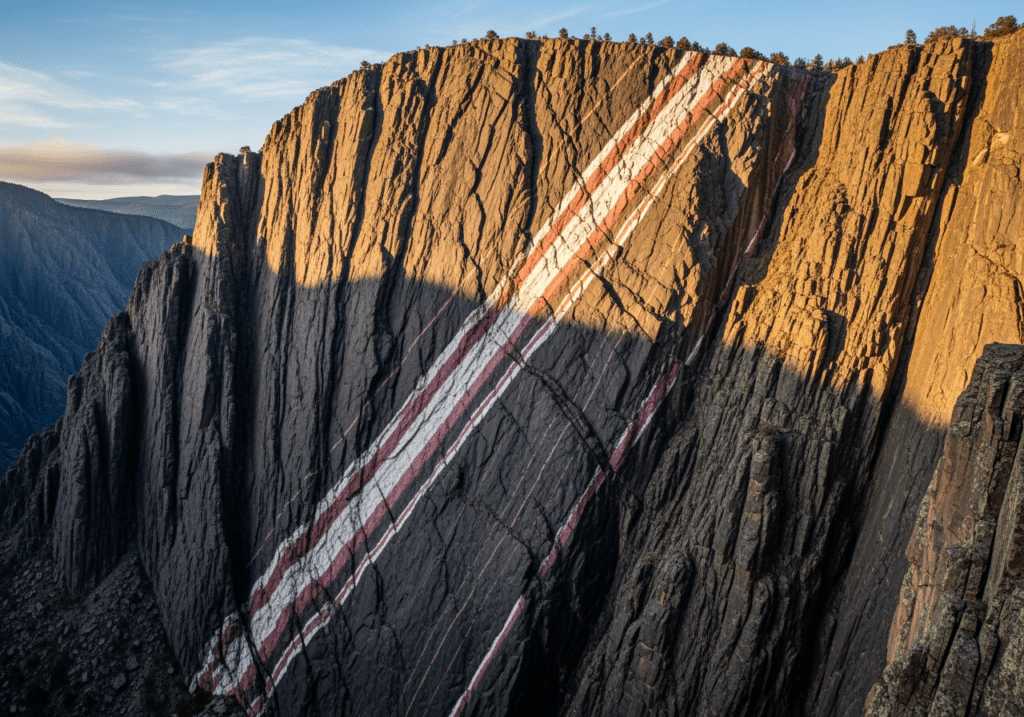
Painted Wall is the canyon’s single most extraordinary photography subject… a 2,250-foot vertical cliff face crossed by diagonal bands of pink pegmatite that intrude through the dark host rock in patterns that look brushed on rather than geological. It is the tallest cliff in Colorado and the pink streaks against the dark background are visible across the canyon with a telephoto lens in a way that the wide-angle overlook shot cannot adequately capture. The Chasm View overlook provides the best direct sightline to Painted Wall; the morning light on the wall’s face, before the sun moves to a direct overhead position, is when the color contrast between the pink intrusions and the dark host rock is at its most saturated.
The Warner Point Trail at the western end of the South Rim road. It’s a 1.5-mile round trip to the highest overlook on the rim providing the most complete view of the canyon’s full depth and width. The late afternoon light from this elevated position, with the canyon in partial shadow below and the Cimarron Ridge visible to the southeast, both help to create an epic wide-landscape Black Canyon photograph that the closer overlooks cannot produce. The trail gains 200 feet of elevation and requires more physical commitment than the pullout overlooks, which means it is also consistently less crowded, even at peak season.
Visiting the Park
Black Canyon of the Gunnison is open year-round, with the South Rim road accessible in all seasons — though winter brings snow and ice that can make the rim overlooks slippery and occasionally closes sections of the road. The North Rim road is unpaved and closes from November through April. Summer is the peak season, but the park’s relative obscurity keeps crowds manageable compared to Colorado’s more famous destinations. The late spring and early fall shoulder seasons offer the best combination of mild temperatures, manageable crowds, and the low-angle light that the canyon’s darkness responds to most dramatically.
No timed entry reservations are currently required. The South Rim visitor center near Gunnison Point is the starting point for orienting to the overlook sequence and understanding the canyon’s orientation relative to the sun at different hours. The rangers here are notably knowledgeable about the geology and the photography conditions — worth a conversation before heading out to the overlooks.
The nearest airport is Montrose Regional Airport, about 15 miles from the park — a small regional airport with connections through Denver. Gunnison-Crested Butte Regional Airport, about 45 minutes east, provides additional access. The park sits between Montrose and Gunnison on Highway 50, making it a natural stop on a San Juan Mountains road trip that might also include Mesa Verde, Durango, and the Million Dollar Highway.
Where to Stay
There is no in-park lodging at Black Canyon. Montrose, the largest city in the area, is 15 miles from the South Rim entrance and provides the full range of chain and independent lodging. It is a functional western Colorado city without much tourism character but perfectly positioned for early morning rim access. The drive from Montrose to the South Rim visitor center takes about 20 minutes — practical for a pre-dawn departure but not the kind of proximity that puts you at the overlook in darkness without planning.
Gunnison, 45 minutes to the east, and Crested Butte, another 30 minutes beyond that, offer more character and the mountain town atmosphere that makes the surrounding region worth lingering in. A stay in Crested Butte with day trips to the canyon adds the alpine mountain context that the canyon visit alone cannot provide — the juxtaposition of the high Colorado mountain town and the dark ancient gorge an hour away captures the full range of what this part of Colorado is.
South Rim Campground inside the park is the closest camping to the overlooks — 88 sites near the visitor center with access to the full rim road. East Portal Campground, at the bottom of a steep road descending to the river, provides the rare in-canyon camping experience and access to the Gunnison River for fishing. RVs are accommodated at South Rim Campground with standard size limits; East Portal Road has a strict vehicle length restriction and is not suitable for larger rigs. Both campgrounds are first-come, first-served outside the reservation window.
If I Were Planning My First Visit
The single overlook at midday on the way to Denver was not a visit. It was a preview. The return trip looks nothing like that.
Two nights based in Montrose or closer. South Rim at dawn on the first morning, at the Gunnison Point or Chasm View overlook before the sun clears the eastern horizon, just in time to watch the first light catch the rim while the canyon stays dark below. Then the Warner Point Trail before the midday heat builds, for the elevated wide view. Then back at the Painted Wall viewpoint in the late afternoon when the light finds the pink pegmatite bands and the telephoto does the work the eye can barely believe.
And I would drive the North Rim. The longer approach, the fewer visitors, the different set of canyon perspectives from a rim that most people skip entirely. The Black Canyon from the north is a different canyon than the one most visitors see, and the difference is worth the drive.
One overlook at noon taught me that something extraordinary was down there. Two full days at the right hours is what it takes to find out what it actually is.
The Light I’m Curious About
It is the transition light… the specific minutes at dawn when the canyon rim catches the first direct sun while the interior stays in a deep blue-gray shadow that the light has not yet reached and may not reach for hours.
I saw a version of this from one overlook at the wrong time of day and understood enough to know that the right version exists. The ancient dark walls of the Black Canyon in that transitional light — the geological age of the rock visible in its near-black color, the pink pegmatite streaks catching the earliest warmth while the depths stay cold and dark, the Gunnison River somewhere below in the darkness doing what it has been doing for millions of years — is the image that the midday visit made me certain existed without being able to show me.
Some parks reveal themselves immediately. Black Canyon of the Gunnison keeps its best light for the people who arrive before the sun does and stay until they understand what they are actually looking at. One overlook at noon is enough to know the place is extraordinary. It is not enough to know why.
A Deeper Exploration
This article is part of my ongoing project documenting and photographing all 63 national parks across the United States.
Along the way, I’m creating deeper guides that explore photography locations, travel planning, seasonal light conditions, and personal reflections from the road. Black Canyon of the Gunnison is the park in this series I feel most certain I underestimated — and most motivated to return to with the time and the light it deserves.
Because a canyon that receives thirty minutes of direct sunlight per day is not withholding its light. It is asking you to be there for the thirty minutes that matter.
One more thing — just between us
Black Canyon is already one of the least crowded dramatic parks in the system, so the insider tip here is less about escaping the crowds and more about going deeper into what the park itself offers beyond the overlooks — plus a couple of nearby places that almost no one connects to this visit.
Within the park, the North Rim is the most underused section of the park — accessed by a longer unpaved road and receiving a small fraction of the South Rim traffic, with canyon perspectives that are completely different from anything the main road offers. Most visitors never make the drive. The canyon from the North Rim feels like a different park.
Also within the park, the East Portal road descends steeply to the Gunnison River at the canyon floor — the only road access to the river in the park. From the river looking up, the scale of the canyon walls is a completely different and more humbling experience than the rim view looking down.
And for something nearby that almost no Black Canyon visitor thinks to add, Curecanti National Recreation Area stretches east along the Gunnison River and Blue Mesa Reservoir immediately adjacent to the park — dramatic canyon and water scenery, almost no crowds, and photography that extends the Black Canyon visual story in a completely different direction. Same drive, extra reward.