A Photographer’s Return to the World’s First National Park — and the Morning the Geyser Basin Was All Mine
Every photographer eventually builds a list of moments they were in exactly the right place. The Old Faithful boardwalk at first light, before anyone else arrived, belongs on that list.
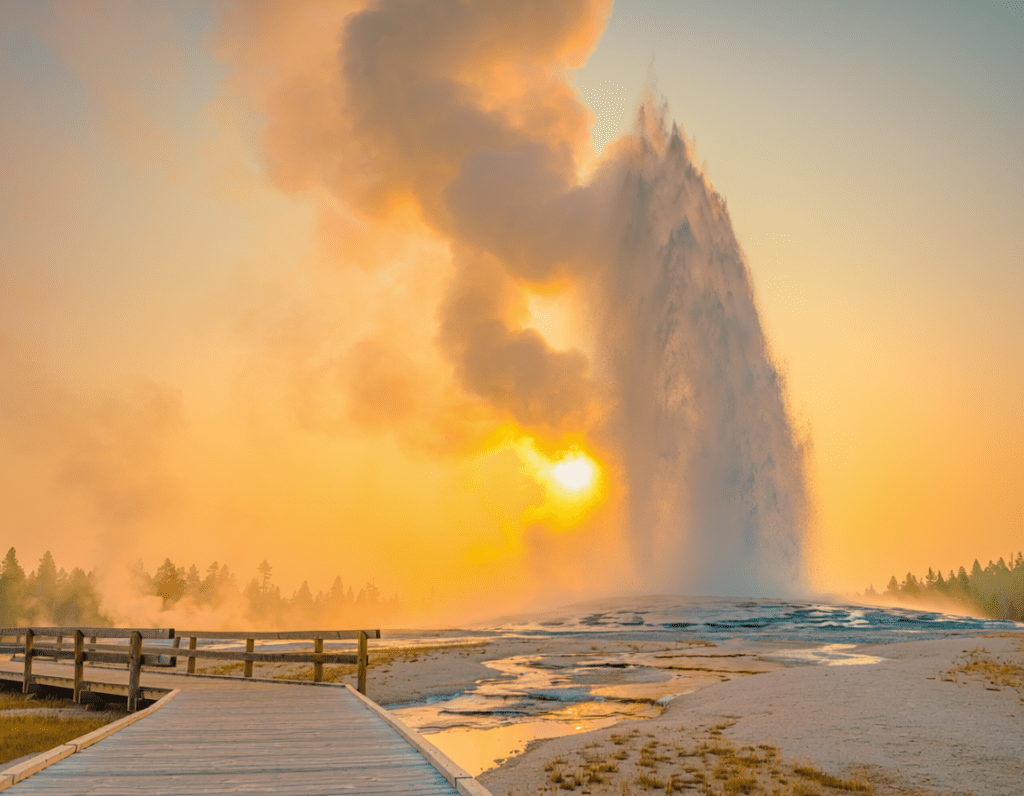
I was there with family on the last visit — staying at the Old Faithful Inn, which put the geyser basin within easy walking distance. The family were late sleepers that morning, which turned out to be the best thing that could have happened for a photographer. I walked out of the lodge in the early quiet, crossed to the boardwalk, and had the entire geyser basin essentially to myself. No crowd jockeying for position at the viewing area. No tour groups. Just the hiss and steam of the thermal features, the low morning light moving across the basin, and the particular silence of a place that is usually anything but silent by mid-morning. When Old Faithful erupted in that light, with no one else in the frame, it was one of those moments that reminds you why staying close to the park and getting up early is always worth it.
Yellowstone is America’s first national park — established in 1872, before the concept of a national park fully existed in law or in public imagination. It is also, by almost any measure, the most geologically extraordinary place on the continent. The supervolcano beneath it drives a hydrothermal system unlike anything else on earth, producing geysers, hot springs, mud pots, and fumaroles across 10,000 individual thermal features. For photographers, it is simultaneously one of the most rewarding and most logistically challenging parks in the system — extraordinary subjects everywhere, and crowds that require either timing or strategy to navigate.
The Landscape That Draws People Here
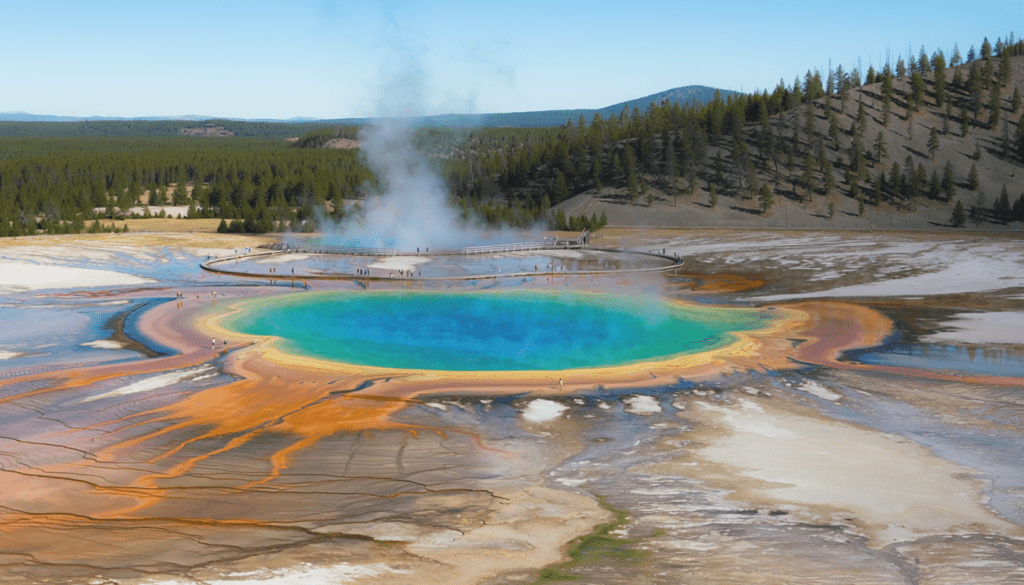
Yellowstone covers 2.2 million acres across Wyoming, Montana, and Idaho — a plateau sitting atop one of the world’s largest active volcanic systems, its surface shaped by the heat below into a landscape that exists nowhere else. The Grand Prismatic Spring, the largest hot spring in the United States, shimmers in concentric rings of blue, green, yellow, and orange from the microbial mats that thrive in its thermal water. The Grand Canyon of the Yellowstone, carved by the Yellowstone River through rhyolite rock weakened by hydrothermal activity, drops 1,000 feet through walls of yellow and orange to the river below. The Lamar Valley in the park’s northeast corner is the wildlife corridor that has made Yellowstone the finest wildlife photography destination in the lower 48 — the valley where the wolf packs were reintroduced in 1995 and where bison, elk, bears, wolves, and pronghorn move through an open landscape with sightlines that forest parks cannot provide.
The Upper Geyser Basin around Old Faithful contains the highest concentration of geysers on earth — more than 150 within one square mile, connected by a network of boardwalks that allow close approach to thermal features that would be genuinely dangerous to approach off-trail. The Grand Geyser, Castle Geyser, Riverside Geyser, and Morning Glory Pool are each extraordinary photography subjects in their own right, and the basin in the early morning light — before the shuttle buses arrive and the boardwalks fill — has a steam-and-silence quality that the midday visitor experience cannot approximate.
The Norris Geyser Basin, the hottest and most dynamic thermal area in the park, offers a different character from the Upper Geyser Basin — rawer, more industrial in feeling, the landscape more visually extreme. Steamboat Geyser, the world’s tallest active geyser, erupts unpredictably from Norris and when it does the eruption reaches 300 to 400 feet. The photography conditions at Norris on a cold morning, when the steam from the thermal features fills the basin and the light moves through it, are some of the most atmospheric in the park.
The Photographer’s Chase
The Old Faithful boardwalk in the early morning is the lesson this park keeps teaching: proximity and timing change everything. The geyser erupts approximately every 90 minutes and the eruption time is predicted within a 10-minute window posted at the visitor center and the lodge. Knowing the predicted time and being in position on the boardwalk 20 minutes before it — before the viewing area fills — is the entire strategy. The eruption in that early light, backlit by the low sun, the steam column catching the color of the sky, with no crowd in the frame, is the Old Faithful photograph that the 11am visitor never sees.
Grand Prismatic Spring is the park’s most visually extraordinary thermal feature and one of its most photographed — but the iconic overhead view that appears in every magazine spread requires elevation. The Fairy Falls Trail provides an overlook above the spring where the full color rings are visible from above — a 5-mile round trip that is one of the most worthwhile hikes in the park for photographers. The colors are most saturated in the morning when the steam is heaviest and the low light catches the edges of the rings. A telephoto from the overlook compresses the color bands in a way that communicates the extraordinary biology of the spring more clearly than a wide angle can.
The Lamar Valley wildlife photography requires an early start and a long lens — the valley is most active in the first and last two hours of the day, and the distances involved make a 500mm or longer focal length the practical minimum for serious wildlife work. The wolf packs are most active in the crepuscular hours, and the spotting scope community that gathers at the Lamar Valley pullouts in the early morning is one of the more unusual and more useful resources in the park — experienced wolf watchers who know where the packs have been and where they are likely to appear. Ask. They will tell you.
The Grand Canyon of the Yellowstone at Artist Point provides the classic lower falls composition — the 308-foot waterfall dropping into the yellow canyon walls, the river visible far below. Morning light from the east illuminates the canyon walls and the falls face simultaneously, which is the window for the full-color canyon photograph. The North Rim trail provides additional elevated perspectives that the South Rim overlooks cannot, and the Uncle Tom’s Trail descends 328 steps to a platform close enough to the falls that the mist reaches the camera lens.
Visiting the Park
Yellowstone is open year-round but the primary visitor season runs from late May through early October, when all roads are open and the full range of park services is available. The park does not currently require timed entry reservations, but the most popular areas — Old Faithful, Grand Prismatic, the Grand Canyon of the Yellowstone — are genuinely crowded from mid-morning through late afternoon during peak summer season. The strategy is consistent: be inside the park and at your primary location before 8am. The park in the early morning, before the day-tripper traffic arrives from gateway communities, is a different place.
Fall — September and October — is the photography sweet spot. The elk rut brings bull elk into the open meadows and creates the bugling behavior that produces the park’s finest wildlife photography of the year. The crowds thin noticeably after Labor Day. The thermal features steam more dramatically in the cooling air. And the light takes on the lower, warmer quality that the summer overhead sun cannot produce. September is arguably the finest month in the park for a photographer with flexibility.
Winter — December through February — opens a completely different Yellowstone. The roads close to wheeled vehicles and the park is accessed by snowcoach and snowmobile tours from the gateway communities. The thermal features steam extravagantly in the freezing air. Bison move through the snow-covered geyser basins. The photography is extraordinary and the access is genuinely limited — book winter tours well in advance through the park’s authorized concessionaire.
Where to Stay
Old Faithful Inn is the crown jewel of Yellowstone lodging and one of the great historic lodge buildings in the national park system — a log structure built in 1903 with a seven-story lobby, balconies overlooking the geyser, and a position that puts Old Faithful literally steps from the front door. The morning walk I described — out of the lodge and onto the boardwalk in the early quiet — is only possible from the Inn or the adjacent Old Faithful Lodge cabins. It books out a year in advance for peak season. If the Inn is the priority, book it the day the reservation window opens.
For the Lamar Valley wildlife photography, the Roosevelt Lodge in the park’s northeast corner is the closest in-park base — rustic cabins in a meadow setting, accessible to the valley’s early morning light without the long drive from Old Faithful or Mammoth. The Lake Yellowstone Hotel on the shore of Yellowstone Lake provides the third in-park option — a grand colonial revival building with lake views and a central position for the southern park features.
Gateway communities — West Yellowstone, Gardiner, Cooke City, and Jackson to the south — provide extensive outside-park lodging. For RV travelers, the park has twelve campgrounds with varying hookup availability; Fishing Bridge RV Park is the only campground with full hookups, reservable through recreation.gov. Madison, Bridge Bay, and Canyon campgrounds are the most centrally located for the primary photography destinations. The park roads accommodate standard RV sizes; check current vehicle restrictions before routing a larger rig through the narrower canyon and geyser basin roads.
If I Were Planning My First Visit
The Old Faithful Inn is the non-negotiable starting point. Book it first, build everything else around it. Being able to walk to the geyser basin in the dark before sunrise — knowing the predicted eruption time, having the boardwalk to yourself in the early light — is the Yellowstone experience that justifies every dollar of the premium and every month of advance planning the reservation requires.
Two mornings at Old Faithful for the geyser basin light. One full day in the Lamar Valley — arriving before dawn, staying through mid-morning, returning for the evening session. The Fairy Falls trail to the Grand Prismatic overlook on a morning when the steam is heavy. Artist Point at the canyon for the falls in the morning light.
And at least one morning where the plan is simply to walk the boardwalk in the quiet before anyone else arrives. Family sleeping. Lodge behind you. The geyser basin doing what it has been doing for millennia, indifferent to schedules and crowds and everything except the heat rising from below. That morning is available to anyone who stays close enough and gets up early enough. It is the best morning in the park.
The Light I’m Curious About
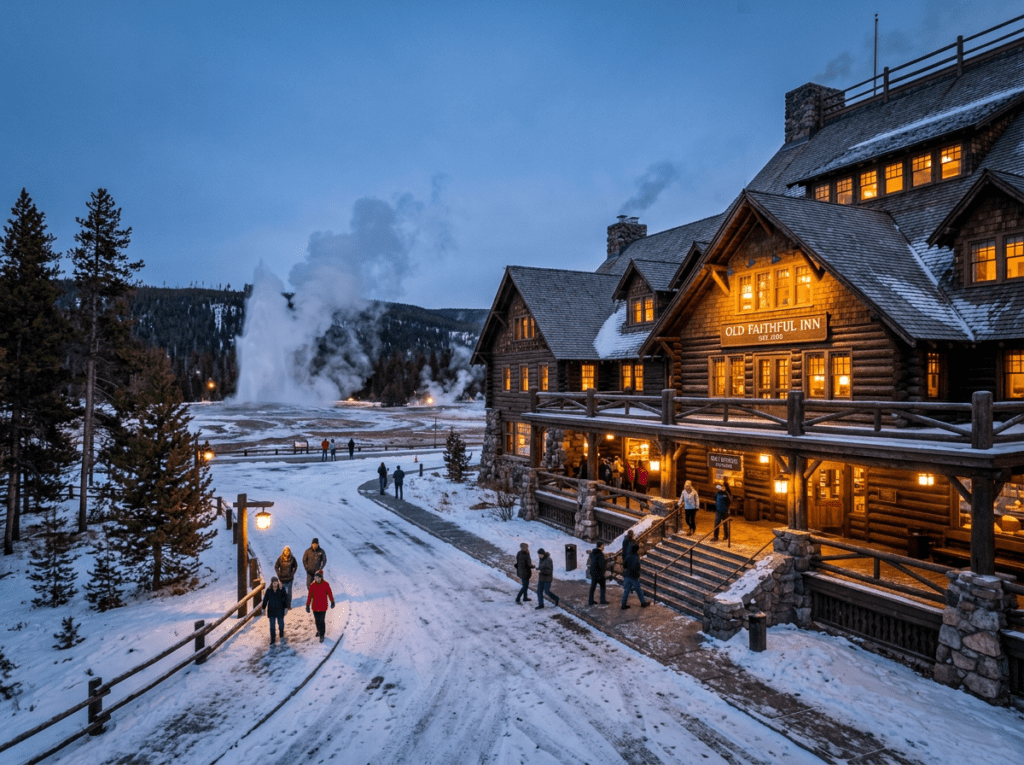
It is the winter light in the geyser basin — the thermal steam in freezing air, the snow-covered boardwalks, the bison moving through the fog of the Upper Geyser Basin in a landscape that looks like the beginning of the world.
I have been to Yellowstone in the summer and I have had the early morning boardwalk to myself and I know what that is worth. The winter version — accessible only by snowcoach, the park quiet in a way that even a 5am summer morning cannot replicate, the thermal features at their most dramatic in the cold air — is the Yellowstone I have not yet experienced. The photographs from the park in winter that I have seen from other photographers are unlike anything from the summer season. A different park entirely, under the same geography.
That is the light worth planning a winter trip for. Old Faithful in January, in the steam and the snow, with no one on the boardwalk because no one can get there without a snowcoach reservation. That version of this park is still waiting.
A Deeper Exploration
This article is part of my ongoing project documenting and photographing all 63 national parks across the United States.
Along the way, I’m creating deeper guides that explore photography locations, travel planning, seasonal light conditions, and personal reflections from the road. Yellowstone is the park that started it all — America’s first, and still in many ways its most extraordinary. The early morning boardwalk taught me something I keep relearning at every park in this series: the best version of any place is the one most people sleep through.
Because the geyser erupts whether you’re watching or not. The light arrives whether you’re there or not. Being there — early, quiet, unhurried — is the whole plan.
One more thing — just between us.
If you’re anything like me, you love this park and slightly dread the mid-morning crowd at Old Faithful. Here are three places worth knowing when you want the Yellowstone experience with a little more breathing room.
Norris Geyser Basin is the hottest and most dynamic thermal area in the park and consistently less crowded than the Upper Geyser Basin — the landscape is rawer, more visually extreme, and Steamboat Geyser when it erupts makes Old Faithful look modest.
Worth the drive north. For wildlife photography away from the Lamar Valley crowds, the Hayden Valley in the park’s center produces bison, grizzly, and wolf sightings with sightlines as good as Lamar and a fraction of the photographer traffic — especially in the early morning.
And just outside the park on the northern boundary, the town of Gardiner, Montana is where the Yellowstone River exits the park through a dramatic canyon that almost no one photographs — the river, the canyon walls, and the Roosevelt Arch framing the park’s north entrance in a composition that the Interior geyser basin crowds never find. A small club. Worth joining.