A Photographer’s Return to the Islands — This Time for the Light That Comes From Below the Earth
Some landscapes carry more personal history than others. Hawai’i is one of those for me — not one visit but several, each belonging to a different chapter. A honeymoon. A family trip with a daughter in her early teens, watching her see the islands for the first time. And then the final state of my 50 at 60 journey, the trip that closed a year of travel through all fifty states — a stay in Waikiki, the most visited corner of the most visited island, surrounded by everything that Hawaiian tourism has built around the experience of being there.
I do not regret the Waikiki choice. There was a lot to see and I saw it. But the Big Island — the island that contains Hawai’i Volcanoes National Park, the most geologically active landscape in the national park system — is the part of Hawai’i I kept considering and kept deferring. The eruptions I have been watching in photographs and video recently have settled the question of when that deference ends.
The lava light. The specific orange-red glow of active lava against a night sky — the earth making new land in real time, the only place on the planet’s surface where that process is consistently and accessibly visible. I have seen those images and they do not look real. They look like something a photographer invented with long exposures and creative processing. They are not invented. They are what happens when you are at Kīlauea on the right night with a camera and the volcano is doing what it has been doing for hundreds of thousands of years — building the island, one eruption at a time.
That light is what this visit is about.
The Landscape That Draws People Here
Hawai’i Volcanoes National Park occupies 335,000 acres of the Big Island’s southeastern flank, from the summit of Mauna Loa at 13,679 feet to the coastline where active lava has historically entered the sea. The park contains two of the world’s most active volcanoes — Kīlauea, one of the most continuously active volcanoes on earth, and Mauna Loa, the most massive volcano on the planet by volume. The landscape they have created is unlike anything else in the national park system: black lava fields extending to the horizon, steam vents rising from cracks in the ground, tree fern forests growing in the older lava flows, and the Kīlauea caldera at the center of it all — a summit crater that has been erupting in various configurations since 1983 and whose activity level changes month to month and year to year in ways that require checking current conditions before every visit.
The Crater Rim Drive circles the Kīlauea caldera and provides the primary overlook access to the volcano — the Jaggar Museum overlook, the steam vents along the road, and the Thurston Lava Tube, a hardened lava tunnel through which visitors walk in the cool dark of a geological structure formed centuries ago. The Chain of Craters Road descends 3,700 feet from the summit caldera to the coast, passing through different eras of lava flows — each flow a different shade of black depending on its age, the oldest flows beginning to show vegetation and the newest completely bare. The visual timeline of geological creation compressed into a single drive.
The park is also a biological treasure — the Hawaiian rainforest that survives in the older sections of the park supports endemic birds found nowhere else on earth, including the ‘apapane, the ‘i’iwi, and the nēnē, the Hawaiian state bird and a goose that was nearly extinct in the mid-20th century and has recovered through conservation efforts centered partly on this park. The Kipukas — islands of older vegetation surrounded by newer lava flows — preserve ecological communities that the surrounding lava cannot touch and support the endemic forest birds in concentrations that make the park one of the finest birding destinations in the Hawaiian archipelago.
The Photographer’s Chase
The eruption photography at Kīlauea is the most time-sensitive and most unpredictable subject in the entire 63-park series — the volcano does what it does on its own schedule, and the photographic conditions range from a dormant caldera with no visible lava to an active lava lake glowing orange against the night sky to surface flows visible from the Chain of Craters Road. Checking the USGS Hawaiian Volcano Observatory website and the park’s own eruption updates before and during any visit is not optional. The conditions on the day you arrive may be completely different from the conditions described in any guidebook or any previous visitor’s account.
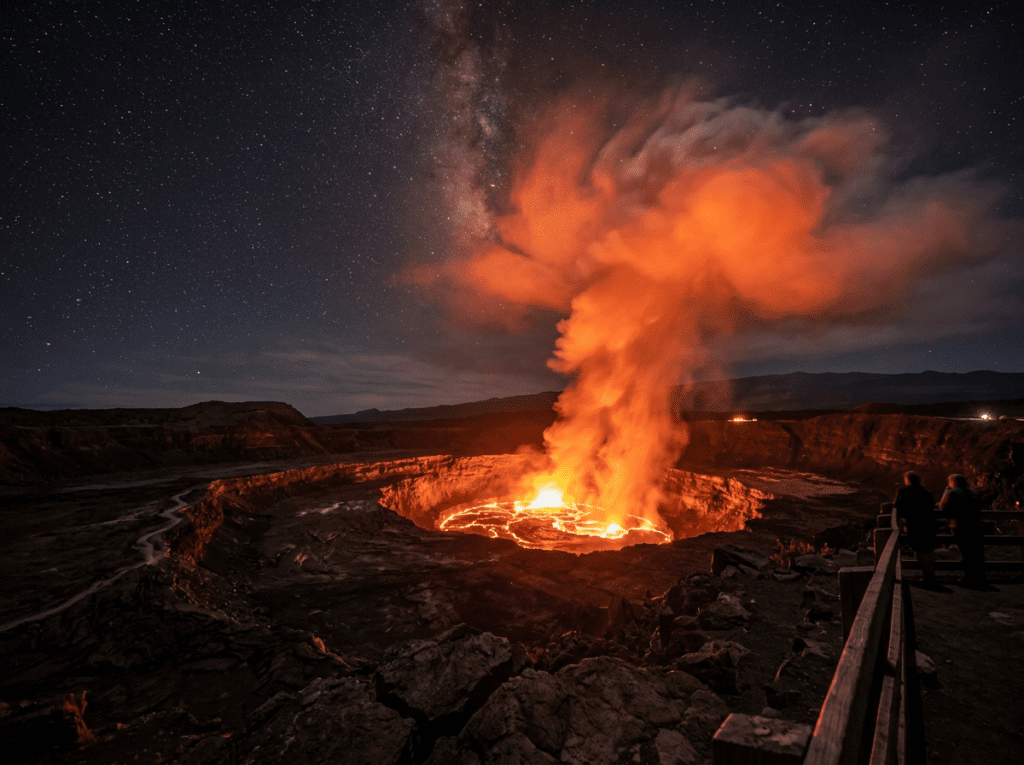
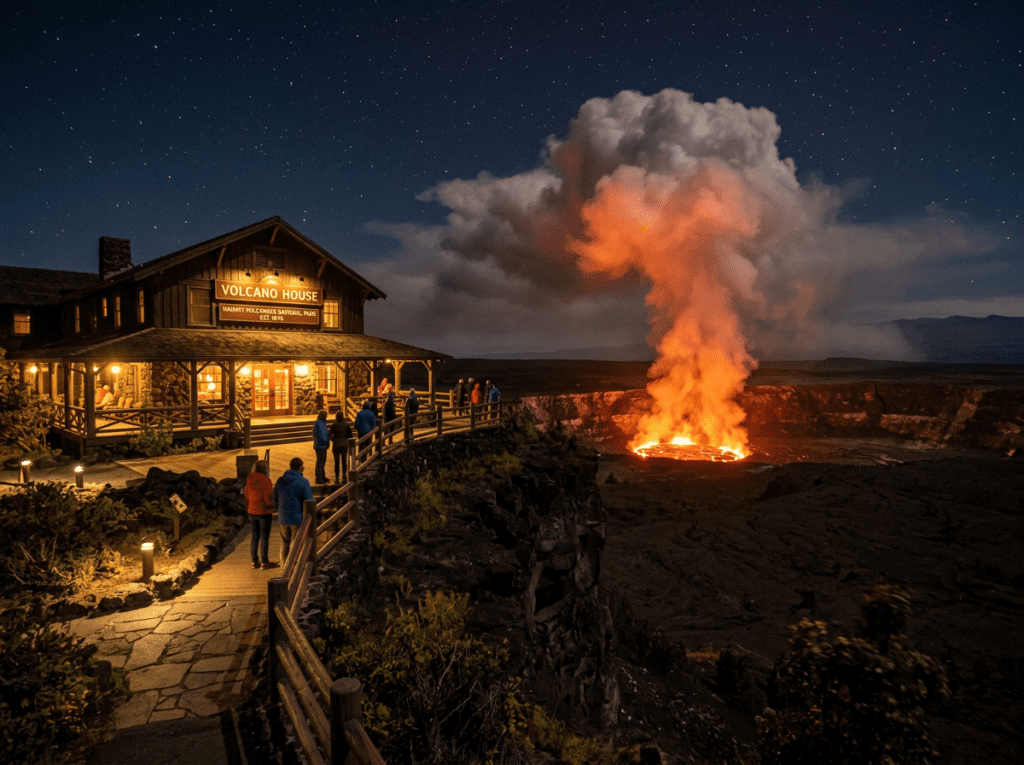
When the volcano is actively erupting — as it has been in various configurations in recent years — the night photography from the Kīlauea overlook is among the most extraordinary available anywhere in the national park system. The lava lake glow illuminates the volcanic gas plume from below, turning the steam cloud orange and red and casting an unearthly light across the caldera rim. A long exposure — 15 to 30 seconds — captures the movement of the plume and the intensity of the glow in a way that communicates the heat and the scale of the activity. A wide angle at the caldera rim, with the glowing crater below and the Milky Way above on a clear night, is the image that the eruption photographs I have been watching were trying to make.
The Chain of Craters Road in the early morning is the above-ground lava field photography — the black lava flows of different ages, the steam rising from the active vents along the road, and the coastline at the road’s end where the lava has historically met the sea. The lava bench and the sea arch at the Hōlei Sea Arch overlook near the road’s end provide the coastal volcanic photography that the summit caldera cannot — the raw black lava meeting the Pacific in wave action that communicates the ongoing collision between geological creation and ocean erosion.
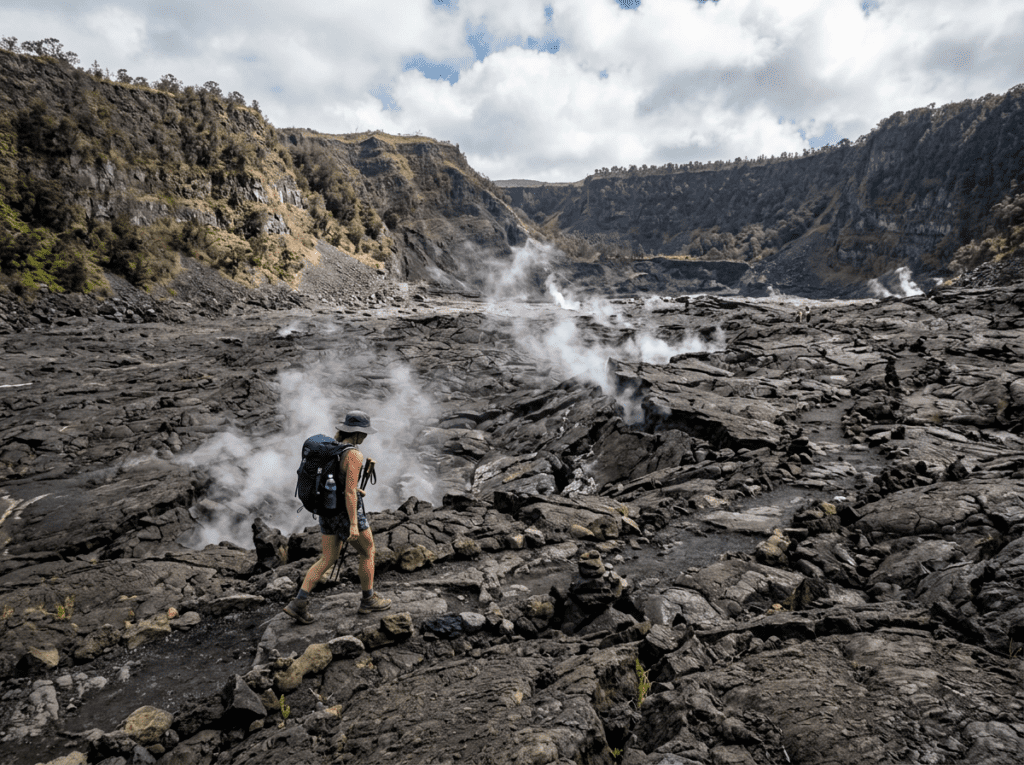
The Kilauea Iki Trail — a 4-mile loop descending into and crossing the floor of the Kīlauea Iki crater, which last erupted in 1959 — provides the intimate ground-level volcanic landscape photography that the rim overlooks cannot. Walking across the hardened lava lake floor, with the crater walls rising 400 feet on all sides and steam vents still active along the trail, is the experience of being inside a volcanic crater rather than looking down into one. The trail crosses the 1959 lava lake surface — solid now, but still warm below — in a landscape that looks like the moon and sounds, when the steam vents are active, like something underground is still working.
Visiting the Park
Hawai’i Volcanoes National Park is open 24 hours a day, 365 days a year — the only national park in the system that never closes, because the volcano does not keep business hours. The night photography window at the caldera overlook requires no special permit or reservation beyond the park entry fee. The park is accessible year-round, though the summit elevations can be surprisingly cool and wet — the park’s location on the windward side of the Big Island means significant rainfall, and layers and rain gear are appropriate regardless of the season.
The current eruption status is the first thing to check before any visit — the USGS Hawaiian Volcano Observatory at hvo.wr.usgs.gov provides real-time updates on eruption activity, lava lake levels, and volcanic gas conditions. The park website at nps.gov/havo posts current conditions and any area closures due to volcanic hazards. Volcanic smog — vog — produced by the eruption can affect air quality throughout the park and the surrounding region; visitors with respiratory conditions should check vog forecasts before planning extended outdoor time.
Flying into Hilo on the Big Island’s eastern side puts you closest to the park — about 30 miles south. Kona on the western side is the larger airport with more flight connections, about 90 minutes from the park. The drive between Kona and the park on Highway 11 passes through the coffee country of the Kona coast and the lava fields of the older flows — a scenic approach that frames the park’s geological context before you arrive.
Where to Stay
Volcano House, perched on the rim of the Kīlauea caldera inside the park, is the only in-park lodging and one of the most dramatically positioned hotels in the national park system. The caldera is visible from the hotel’s dining room and from many guest rooms — on active eruption nights, the glow from the lava lake is visible through the windows without leaving the building. The hotel has been hosting guests on the caldera rim since 1866, making it the oldest continuously operating hotel in Hawai’i. For the eruption photography specifically, being at Volcano House means walking to the caldera overlook at midnight in the dark without a commute. Book it. The caldera-view rooms are worth requesting specifically.
The town of Volcano, immediately outside the park entrance, has a collection of vacation rentals and small inns in the cool, forested atmosphere of the summit elevation. The Kilauea Lodge is the most established property — a former YMCA building converted to a bed and breakfast with a strong local reputation for its dining room. Staying in Volcano village provides the summit elevation coolness that the coast cannot offer and puts the park entrance within minutes.
Nāmakanipaio Campground inside the park offers tent and cabin camping in an ‘ōhi’a lehua forest at 4,000 feet — one of the few campgrounds in the Hawaii state and national park system with a genuinely cool, forested character rather than a coastal tropical one. For RV travelers, the campground accommodates standard rigs and provides the in-park access that makes the late-night caldera sessions practical without a late-night drive. No hookups are available.
If I Were Planning My First Visit
Hawai’i has been part of my personal history in multiple chapters — the honeymoon, the family trip, the final state. This visit is a new chapter and it has a specific photographic intention that the previous visits did not: the eruption light.
Volcano House if available — booked the moment the reservation window opens, caldera view room requested. The eruption status checked before booking and checked again on arrival. The caldera overlook at night on the first evening, with the tripod and the wide angle and whatever the volcano is doing that night.
The Kīlauea Iki Trail on the second morning — down into the crater floor, across the 1959 lava lake, the steam vents and the crater walls and the moonscape that an eruption 60 years ago created and left behind. The Chain of Craters Road in the afternoon, descending to the coast, the lava flows of different ages reading as a geological timeline. And back to the caldera overlook after dark.
Hawai’i has given me a honeymoon, a family memory, and a completed journey. The next visit gives it what it has been waiting for: a photographer who finally came to the Big Island to see the thing that makes it unlike anywhere else on earth.
The Light I’m Curious About
It is the eruption light — the specific orange-red glow of an active lava lake illuminating the volcanic gas plume from below on a clear night at the Kīlauea caldera.
I have watched this light in photographs and video for years. The images from other photographers who have stood at the Jaggar Museum overlook on active nights — the caldera below lit from within, the plume above going from white steam to orange glow as the lava activity intensifies, the Milky Way occasionally visible above the volcanic gas — look like they were made on another planet. They were made in Hawai’i, in a national park, by people who checked the USGS update that morning and drove to the overlook after dark.
That is the most specific and most irreplaceable light in the entire 63-park project. Every other park’s light falls from the sky. This one comes from below the earth. The planet making more of itself, in real time, in the only national park that never closes.
That light is worth every previous visit that took me to Waikiki instead. And it will still be there when I arrive, because the volcano has not stopped since 1983 and shows no signs of beginning to.
A Deeper Exploration
This article is part of my ongoing project documenting and photographing all 63 national parks across the United States.
Along the way, I’m creating deeper guides that explore photography locations, travel planning, seasonal light conditions, and personal reflections from the road. Hawai’i Volcanoes closes a personal circle — the islands that have appeared in three chapters of my life, now finally visited with the intention and the equipment and the specific photographic ambition that the earlier trips did not bring.
Because some light is worth returning to multiple times before you finally chase it properly. The lava light has been there the whole time. I am going to the Big Island to find it.
One more thing — just between us.
The park draws its crowd to the Kīlauea caldera overlooks — rightfully so — but the Big Island rewards the visitor who explores beyond the volcanic centerpiece. Here are three places worth knowing for the trip that takes the time to look around.
Papakōlea Green Sand Beach — about 70 miles southwest of the park near South Point — is one of only four green sand beaches in the world, its color produced by olivine crystals eroded from the surrounding volcanic cinder cone. The 2.5-mile walk across the lava bench to reach it filters out the casual visitor and delivers a landscape photography subject found almost nowhere else on earth. The green sand against the black lava against the blue Pacific is a color combination that requires being there to believe.
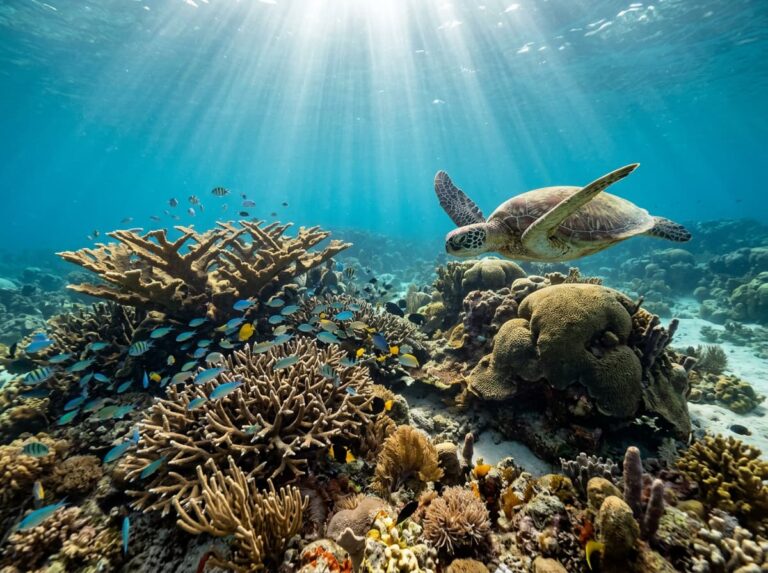
Punalu’u Black Sand Beach — between the park and South Point — is a black volcanic sand beach where Hawaiian green sea turtles regularly haul out to rest on the beach in numbers that make wildlife photography straightforward and extraordinary. The turtles on black sand with the volcanic coastline behind them is the Big Island wildlife image most visitors never plan for.
And within the park itself, the Kipukapualu Bird Park — a kipuka of old-growth forest surrounded by newer lava flows — is where the endemic Hawaiian forest birds concentrate in accessible numbers. The ‘apapane and ‘i’iwi in the native ‘ōhi’a trees, in a forest that the surrounding lava cannot reach, is the birding photography that most volcanic landscape visitors never find because they are looking at the ground rather than the canopy. A very small club. Worth joining.