A Photographer’s Return to the Tallest Trees on Earth — and the Small Saturated World Living at Their Feet
Some landscapes become part of our imagination long before we ever visit them. The redwood coast of northern California is one of those — the photographs of the ancient groves, the shafts of light through the canopy, the trees so large that people standing at their base become suggestions of scale rather than human beings. I had those images in my head before I ever drove Highway 101 through Del Norte County.
I have driven through this park twice. The first time I arrived in pitch darkness, tired from a longer day of driving than I had planned for, the forest invisible on both sides of the road, talking to myself to stay awake through the curves. I did not stop. There was nothing to photograph in the dark except my own poor planning. The second time was better — I found a specific place in the forest that stopped me completely and made me understand what this park actually is. But I moved through it too quickly, the way I have moved through too many places on trips where the ambition of the route outpaced the time available for any single stop.
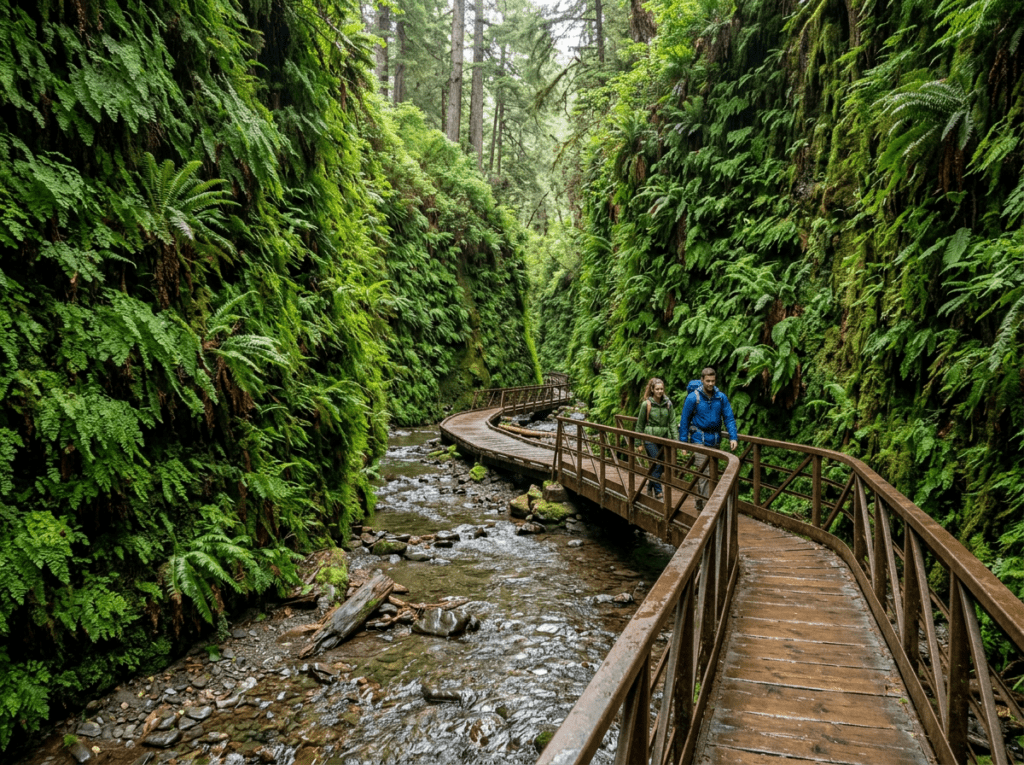
The place that stopped me was Fern Canyon — a slot canyon carved by Home Creek through the coastal bluffs of Prairie Creek Redwoods State Park, its walls rising fifty feet on both sides and covered floor to ceiling in five-spot ferns, the canyon floor crossed by a series of metal and wooden bridges that were carried into that remote location piece by piece, by hand, through miles of old-growth forest. I remember standing in that canyon looking at the bridges and thinking about the people who carried every beam and bracket and bolt down that trail and assembled them in the cool green dark of a fern-covered gorge. A story in itself, and a place unlike anything I had seen.
The return trip is about what I have been thinking about since: the juxtaposition of the immense and the intimate. The tallest trees on earth, and the small saturated world of fern and moss and lichen living in the permanent cool shadow at their feet. Both subjects. Both scales. Enough time to find the light that connects them.
The Landscape That Draws People Here
Redwood National and State Parks is a complex of four parks managed jointly by the National Park Service and California State Parks — Redwood National Park, Prairie Creek Redwoods State Park, Del Norte Coast Redwoods State Park, and Jedediah Smith Redwoods State Park. Together they protect about 45 percent of the remaining old-growth coast redwood forest on earth. The coast redwood — Sequoia sempervirens — is the tallest living thing on the planet, with the current record holder measuring 380 feet. The trees here are not remarkable for their width or their mass, the way the giant sequoias of the Sierra Nevada are. They are remarkable for their height, and for the particular character of a forest that has been growing in this coastal fog belt for millions of years.
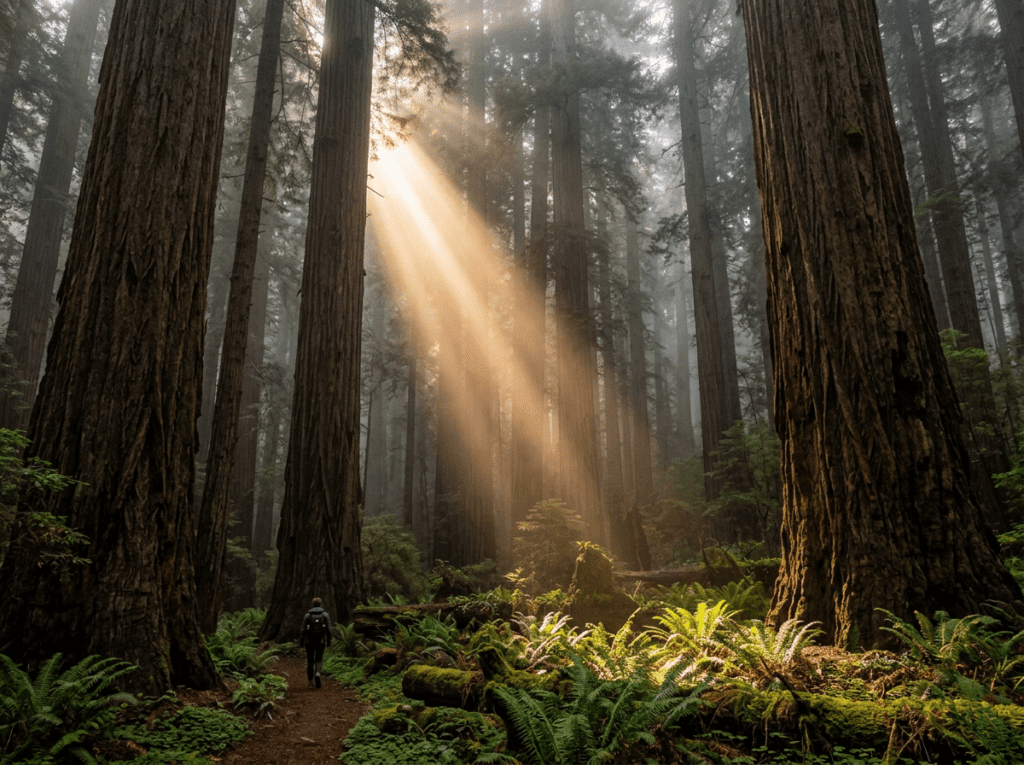
The fog is the defining ecological condition of the redwood coast — the marine layer that rolls in from the Pacific and keeps the forest cool and moist throughout the summer dry season, providing the moisture the trees depend on through foliar uptake when the rain has stopped. The fog also creates the photography conditions most associated with the redwood forest: shafts of light penetrating the canopy where the fog and the direct sun meet at the right angle, the forest floor illuminated in patches while the surrounding forest stays in cool green shadow. That light — the god rays through the redwood canopy — is the image most associated with this park and the one that is most time-dependent, most weather-dependent, and most worth planning specifically for.
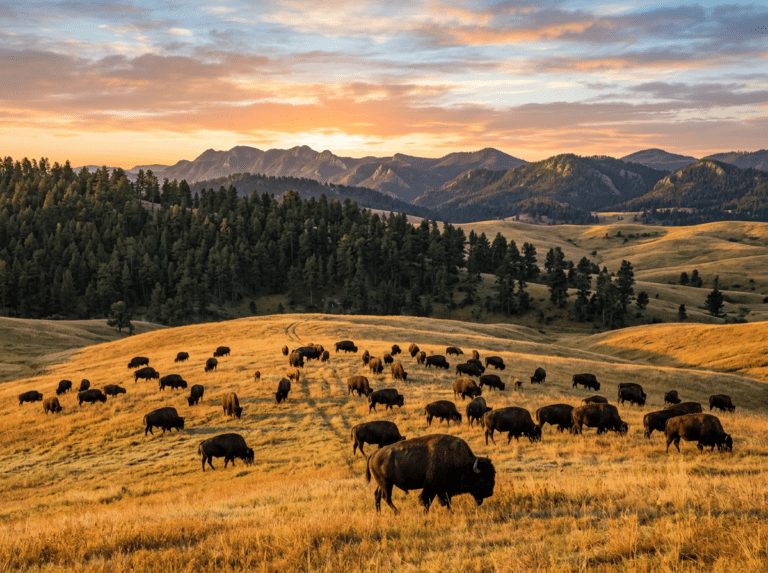
The park complex extends from the Klamath River area south of Crescent City down to the Orick area near Humboldt Bay — a 50-mile stretch of coastal northern California where the redwood forest meets the Pacific in sea cliffs and the rivers run cold and clear through old-growth groves to the ocean. The Roosevelt elk herds that roam the prairies of Prairie Creek Redwoods are the wildlife photography subject most overlooked in a park system that tends to be defined entirely by its trees.
The Photographer’s Chase
The redwood forest presents a fundamental photography challenge that the other tall-tree parks share: the trees are too large. A wide angle from the base of a 350-foot redwood cannot communicate scale the way a wide angle at the Grand Canyon communicates depth, because the eye has no reference point for the upper canopy — it simply disappears into the forest ceiling. The scale solution is the same as in the giant sequoia forest: put a person at the base of the tree and shoot from enough distance that the full height is visible and the human figure is reduced to the small thing it actually is in this context.
The light shaft photography is the iconic image and it requires specific timing. The shafts appear when the fog is present but the sun is at an angle that allows direct light to penetrate the canopy — typically in the morning hours when the fog is still in the forest but the sun has climbed enough to find gaps in the canopy. This window can be as short as twenty minutes. The Tall Trees Grove and the Lady Bird Johnson Grove are the most consistently recommended positions for this light, but any grove with a clearing that allows the sun to enter from a specific angle is a potential shaft-light location. Research the orientation of the grove you are targeting before arrival — which direction does the morning sun come from relative to the canopy gaps?
Fern Canyon is the intimate counterpoint to the cathedral tree photography — and the place that made me stop and pay attention on the second visit. The canyon walls rise fifty feet in near-vertical green on both sides, and the light that finds its way into the canyon in the middle of the day is diffused and cool and saturates the fern green to a depth that direct sun cannot produce. The metal bridges across the canyon floor — each piece carried in by hand through the old-growth forest, a logistical commitment that speaks to how seriously the people who manage this place take access to its extraordinary corners — provide the human-made geometry that anchors the composition in a space where everything else is organic. Fern Canyon is accessible via a dirt road that can be muddy after rain; a high-clearance vehicle is recommended. It is worth whatever the road asks of you.
The macro world at the base of the redwoods is the photography subject I most want to explore properly on the return visit. The forest floor in an old-growth redwood grove is a complete ecological system — sorrel and oxalis carpeting the ground in bright green, sword ferns uncurling in the spring, banana slugs moving across the nurse logs, mushrooms and shelf fungi on the fallen trunks that can be hundreds of years into their decomposition. A macro lens at ground level in that environment, with the vast columns of the redwood trunks rising out of frame above, produces the scale juxtaposition that wide-angle tree photography cannot: the immense implied by the intimate.
Visiting the Park
The redwood park complex requires more navigation planning than its geography suggests. The four parks — two national, two state — are managed jointly and the boundaries between them are not always obvious on the ground. The Thomas H. Kuchel Visitor Center near Orick is the southern starting point and the best orientation stop for first-time visitors. The Crescent City area in the north provides access to the Jedediah Smith and Del Norte groves. Understanding which grove you are targeting and which road serves it before you leave the highway saves the kind of driving-in-darkness confusion I experienced on the first visit.
Spring and fall are the strongest photography seasons. Spring brings the new fern growth and the best moisture levels for the forest floor macro photography, and the fog is frequently present in the morning before burning off midday. Fall brings lower crowds, the possibility of dramatic coastal weather moving through, and the Roosevelt elk rut in September and October — bulls in the Prairie Creek prairies in the morning light, antlers catching the low September sun, is wildlife photography that most visitors focused entirely on the trees never find.
Summer brings the tourist peak and the most reliable fog conditions, but also the most crowded parking at Fern Canyon and the Tall Trees Grove. The Tall Trees Grove requires a free permit for vehicle access — available at the visitor centers on a first-come, first-served basis on the day of your visit. Get the permit early. The grove road is unpaved and requires a vehicle capable of managing the conditions.
Where to Stay
Crescent City, the largest town in the area, anchors the northern end of the park complex and provides the most complete lodging and services. It is a working coastal town without much tourism polish, which gives it a genuine character that the more developed California coastal towns do not have. The proximity to the Jedediah Smith Redwoods — the northernmost and arguably the most beautiful of the grove areas — makes Crescent City the right base for the northern section of the park.
Trinidad, south of the park near Arcata and Eureka, is a small coastal town with genuine charm and some of the finest lodging options in the region — the Trinidad Bay Bed and Breakfast perched above the cove is a standout for photographers who want a dramatic coastal view to return to after long days in the forest. Eureka, farther south, provides the full range of chain lodging and the airport connections that make it the hub for fly-in visits.
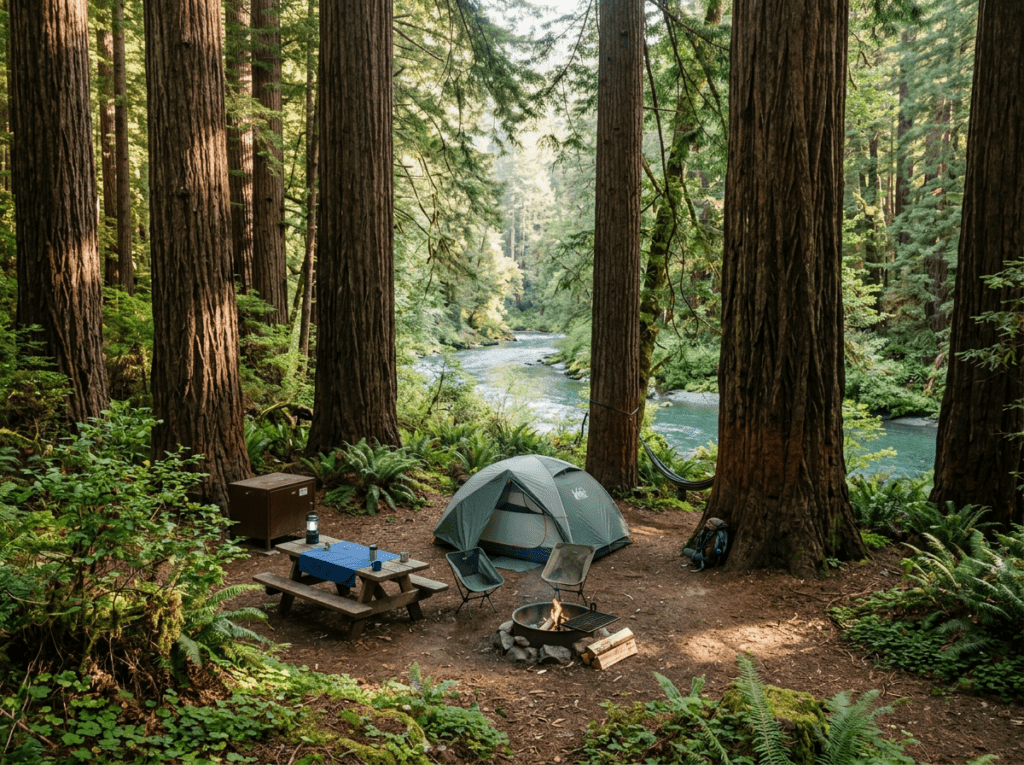
For campers, Jedediah Smith Campground sits in an old-growth grove directly on the Smith River — campsites surrounded by ancient redwoods with the sound of the river present at all hours. It is one of the most beautiful campground settings in the national park system, period. Elk Prairie Campground in Prairie Creek Redwoods puts you in the meadow area where the Roosevelt elk are regularly present at dawn. Both fill quickly for summer season; book through recreation.gov as early as possible. RVs are accommodated at both, though the forest roads have size restrictions that larger rigs should confirm before routing.
If I Were Planning My First Visit
Two visits down, neither of them adequate. The third visit has a plan.
A base in the Crescent City or Trinidad area. Arrival in the afternoon with time to scout the grove I want to be in before dawn — understanding the orientation, finding the canopy gaps, deciding the position before the light arrives rather than looking for it after. The Lady Bird Johnson Grove or the Tall Trees Grove for the morning shaft light, with the tripod set and the composition decided in the dark.
Fern Canyon in the middle of the day on an overcast morning — the flat light that most visitors wait out is exactly what saturates the fern walls to their full intensity. A wide angle for the canyon walls, a macro lens for the individual fronds and the water droplets and the moss at the canyon base. An hour in Fern Canyon with no agenda beyond the green is the photography I most want from this park.
And an early morning at Elk Prairie before the sun is up, watching the meadow in the pre-dawn light, waiting for the elk to move into the open. Most people who visit the redwoods never think to look for elk. The trees demand all the attention. But the Roosevelt elk in the morning fog of a September prairie, with the old-growth forest behind them, is one of the Pacific Northwest’s finest wildlife photography subjects and it is available in a park most people walk through looking straight up.
The Light I’m Curious About
It is the macro light at the base of the largest trees on earth.
The shaft-of-light-through-the-canopy image is the redwood photograph everyone knows. It is extraordinary and I want to make it properly. But what I keep thinking about is the other scale — the camera at ground level in the sorrel and oxalis, looking up the column of a redwood trunk that disappears into the canopy 300 feet above, with the forest floor life in sharp focus in the foreground and the tree implied rather than shown. The immense communicated through the intimate. The tallest tree on earth reduced to a vertical shape at the edge of a frame full of small green things living in its permanent shadow.
That is the juxtaposition I have been thinking about since I stood in Fern Canyon and looked at those hand-carried bridges and understood that the people who built them wanted others to experience something specific and worth the effort. The redwood forest at both scales — the one that makes you feel small, and the one that reveals what is living in the smallness. Both images. Same forest. Enough time to find them both.
A Deeper Exploration
This article is part of my ongoing project documenting and photographing all 63 national parks across the United States.
Along the way, I’m creating deeper guides that explore photography locations, travel planning, seasonal light conditions, and personal reflections from the road. Redwood has been visited twice and properly seen once, briefly, in a canyon with hand-carried bridges and fifty-foot fern walls. The third visit is the one where I stop moving fast enough to miss things.
Because the tallest trees on earth have been standing here for two thousand years. They are not in a hurry. The least I can do is arrive without one.
One more thing — just between us.
The redwood parks are already quieter than most California destinations, but Fern Canyon and the Lady Bird Johnson Grove draw the bulk of the visitors. Here are three places in and around the park complex that most people drive past without stopping.
Jedediah Smith Redwoods State Park — the northernmost unit of the park complex near Crescent City — is consistently the quietest of the four parks and contains some of the finest old-growth groves in the entire system. The Howland Hill Road through the heart of the Jedediah Smith grove is a narrow unpaved road through ancient forest that feels genuinely remote, and the Smith River running alongside it is one of the clearest rivers in California. Worth building an extra day around.
Just outside the park near Orick, Gold Bluffs Beach is a stretch of wild Pacific coast accessible through Prairie Creek Redwoods where Roosevelt elk regularly graze on the beach with the ocean behind them and the redwood forest at their backs — one of the more improbable and more extraordinary wildlife photography compositions in the park system. The same dirt road that leads to Fern Canyon passes right through it.
And for an experience completely outside the park, Trinidad — the small coastal town south of the park near Arcata — has a harbor, sea stacks, dramatic bluff overlooks, and the kind of authentic northern California fishing village character that makes it worth an evening and a camera. The light on Trinidad Head at sunset, with the harbor below and the Pacific beyond, is the coastal California image that the redwood narrative almost always leaves out.