A Photographer’s Return to the Great One — This Time Closer, This Time by Air
When planning a visit to America’s national parks, some destinations carry a weight that the others do not. Denali is one of those. The highest peak in North America — 20,310 feet of granite and ice rising from the Alaska Range — has a presence that is felt before it is seen, a scale that the photographs suggest but cannot fully communicate, and a name that carries its own history.
The name question first, because I kept asking it during my visit and the answer is worth knowing: the mountain is Denali. It was always Denali to the Athabascan people who lived in its shadow — the word means simply the High One, or the Great One — and in 2015 the federal government officially restored that name, retiring the Mount McKinley designation that had been imposed in 1917. The park had been called Denali since 1980. The mountain finally caught up. Both names appear in older maps and older conversations, which can create confusion; the correct current name for both the mountain and the park is Denali.
I was in the park during a period when a road closure — a landslide that had compromised the park road deep in the backcountry — prevented the shuttle buses from reaching the sections I most wanted to photograph. The classic Denali views from the road’s deeper reaches, where the mountain fills the frame across the tundra, were not accessible. I kept thinking: is that as close as I’m going to get to the Great One? I did some hiking, caught some genuinely good evening light, found a moose in the willows and the remnants of a beaver dam, and made the drive to Talkeetna on the way out — which turned out to be one of the better decisions of the trip.
The return trip has a clearer plan, and part of it involves a small plane and a glacier.
The Landscape That Draws People Here
Denali National Park covers six million acres of interior Alaska — a landscape of tundra, glaciers, braided river valleys, and the Alaska Range rising along the park’s southern edge. There is one road into the park: the 92-mile Denali Park Road, which begins at the park entrance near the town of Healy and winds west into the backcountry. Private vehicles are restricted beyond the first 15 miles at Savage River; beyond that, access is by park shuttle bus, bicycle, or foot. The shuttle system is the mechanism through which most visitors experience the park’s interior, and the depth to which you can penetrate into the backcountry determines how close you get to the mountain.
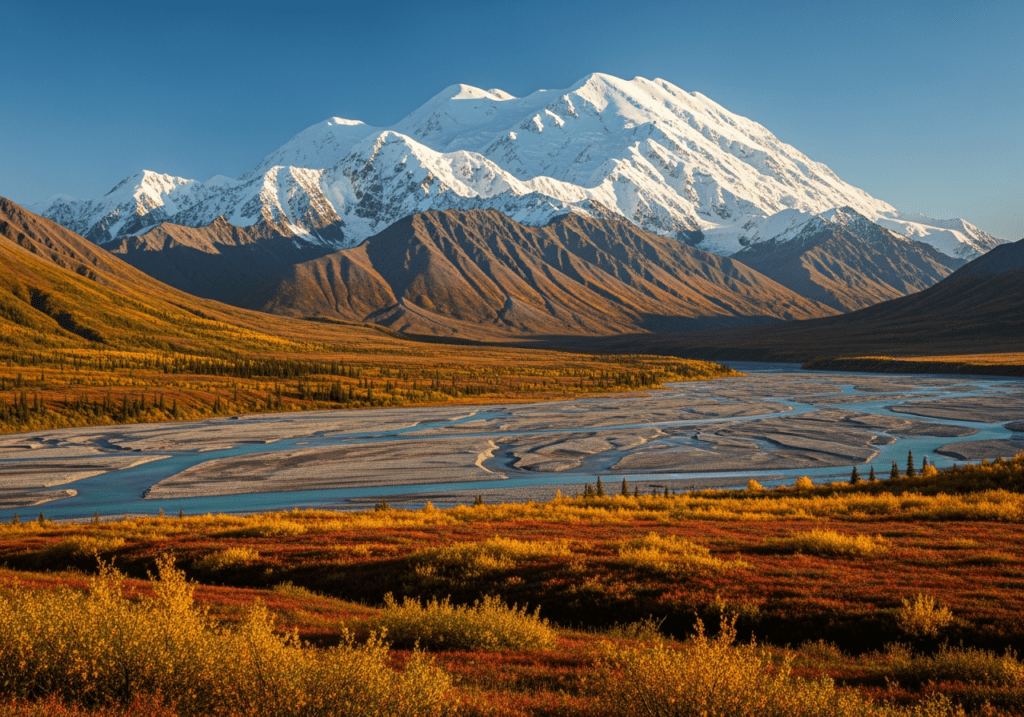
The mountain itself is visible from the park road on clear days — which is not as reliable as it sounds. Denali generates its own weather system, and the summit is obscured by cloud cover roughly 70 percent of the time during the summer visitor season. Seeing the mountain clearly is genuinely a matter of weather luck, and the photographers who get the classic tundra-foreground-mountain-background images are the ones who either time their visit for the clearest weather windows or stay long enough to wait the clouds out. Early morning in June and July, before the convective cloud development that the afternoon brings, is statistically the best window.
The park’s wildlife is extraordinary and consistently more visible than the mountain. Grizzly bears on the open tundra — the treeless landscape provides sightlines that forest parks cannot offer, and bear activity is visible from the road at distances that would be impossible in the lower 48. Caribou herds move through the park in patterns that the ranger stations track; knowing which drainages the herds have been using in the days before your visit allows positioning that luck alone cannot provide. Dall sheep on the high ridgelines, wolves in the river valleys, and the moose in the willow thickets along the drainages complete a wildlife portfolio that no other park in the system can match for sheer diversity and visibility.
The Photographer’s Chase
The shuttle bus is both the access mechanism and the photography platform for most Denali visitors. The buses stop on request when wildlife is sighted, and the drivers and naturalist guides know the road well enough to position the bus for the best light angles at the major overlooks. Photographing from a moving bus window requires fast shutter speeds and image stabilization — the bears and caribou that appear along the roadside do not wait for the bus to fully stop. A 400mm or longer lens gives the reach for the wildlife distances that the open tundra produces; a 70-200mm covers the mountain compositions and the wider landscape shots.
The Eielson Visitor Center at mile 66 of the park road is the primary mountain viewpoint destination — on a clear day, Denali fills the southern sky from this position in a way that the closer road sections cannot produce because the foothills block the lower mountain. The braided channels of the Thorofare River in the foreground, the open tundra, and the full massif above — that is the classic composition. It requires a clear day, a bus reservation deep into the park, and the patience to wait at Eielson for the cloud cap to lift if the mountain is obscured when you arrive. Bring food, warm layers, and the willingness to sit with the landscape for several hours.
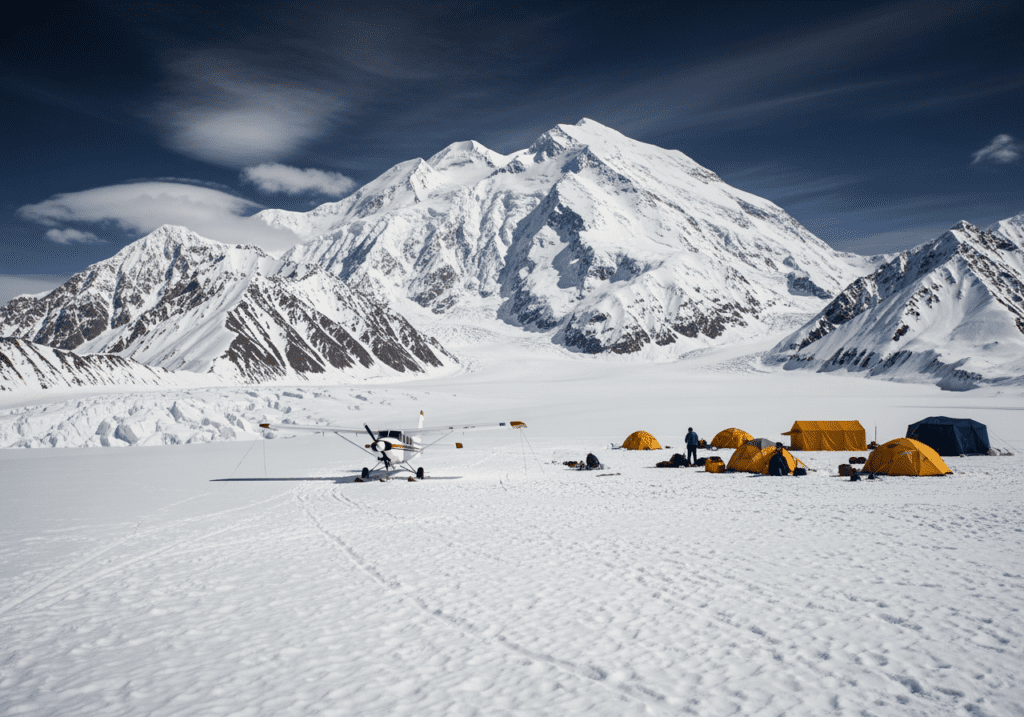
The flightseeing from Talkeetna is the photography experience that the park road cannot provide and that I have been thinking about since I made the drive there on my first visit. The small air taxi operators — Talkeetna Air Taxi, K2 Aviation, and others — fly glacier landing tours onto the Kahiltna Glacier on the south side of the Alaska Range, setting down on the ice at 7,200 feet with the full Denali massif rising directly above. The south face of the mountain — the face visible from the Kahiltna, which is the route most climbing expeditions use — is not visible from the park road at all. It is a completely different mountain from a completely different angle, and the scale of it from the glacier surface, with the ice around you and the summit 13,000 feet above, is an experience that no road-based photography can approximate.
The evening light I caught on the first visit — the low Alaska summer sun staying above the horizon until 11pm and painting the tundra in the warm golden tones that the overhead afternoon light cannot produce — is the light I most want to return for with a clearer plan. The open tundra in that evening light, with the mountain either present or implied behind the clouds, and the wildlife moving through the golden hour before the brief Alaska darkness — that is what this park looks like when everything aligns.
Visiting the Park
The park is open year-round but the primary visitor season runs from late May through early September, when the park road is fully operational and the shuttle buses run the full length to Kantishna. Shuttle reservations — available through recreation.gov beginning in December for the following summer season — are essential for the deep road access and sell out quickly for peak season dates. The deeper into the park the bus goes, the earlier the reservation sells out; Eielson Visitor Center and Wonder Lake reservations are gone within hours of the booking window opening.
The road closure that affected my first visit is worth checking before any trip — the Denali Park Road has experienced multiple landslide events in recent years that have altered shuttle access beyond certain mileposts. Check current road conditions at nps.gov/dena before finalizing trip dates, and build flexibility into the itinerary to accommodate the road status on arrival.
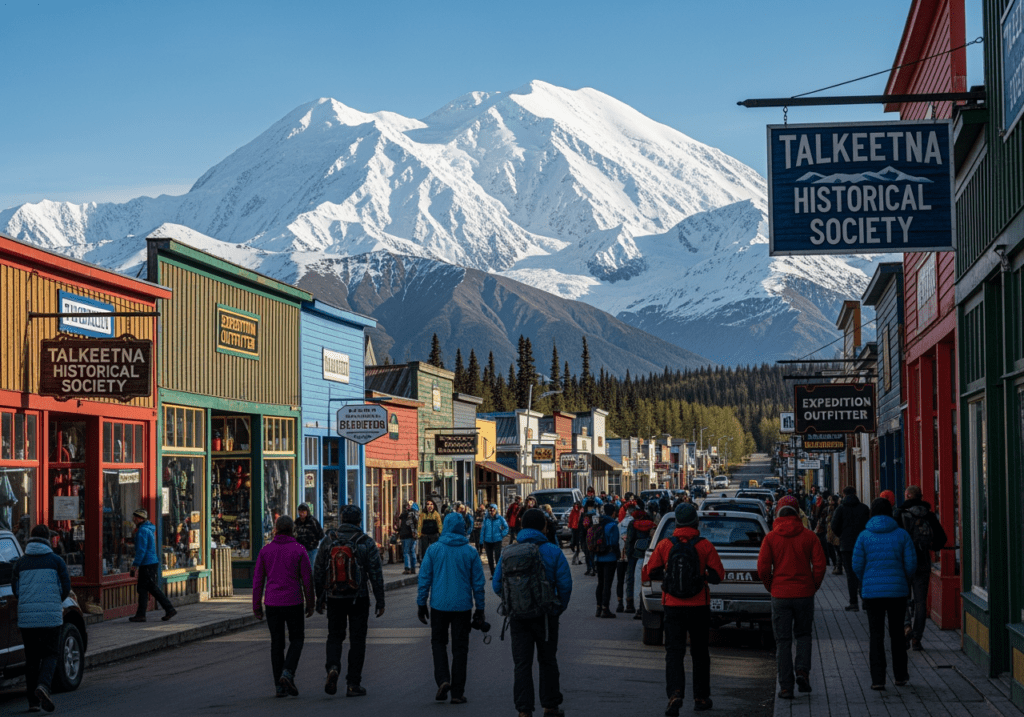
Talkeetna, 100 miles south of the park entrance on the Parks Highway, is worth building into any Denali itinerary regardless of flightseeing plans. The small mountain town at the confluence of three rivers has been the base camp for Denali climbing expeditions for decades and has the atmosphere of a place that takes the mountain seriously — gear shops, expedition services, the historic Talkeetna Roadhouse, and the air taxi operators that fly the glacier tours. An evening in Talkeetna after a park road day is the kind of Alaska experience that makes a trip feel complete.
Where to Stay
The park entrance area near Healy has developed a substantial lodging cluster in recent years — the Denali Park Village, Grande Denali Lodge, and a range of smaller properties sitting just outside the park boundary with mountain views and shuttle access to the visitor center. The positioning allows early morning park entry without a long commute and late evening return after the golden hour tundra light has faded. Healy itself, five miles north, is a working Alaska town with more modest and more affordable lodging options.
Inside the park, the backcountry lodges at Kantishna — at the western end of the park road, 92 miles in — are the most immersive option and accessible only by the park shuttle or by small plane. Camp Denali and North Face Lodge are the established properties, both with deep wilderness setting and mountain views that the entrance area lodges cannot match. Both are expensive and book out a year in advance; they represent the serious Denali photography investment for those committed to the deep park experience.
For campers, Riley Creek Campground near the entrance is the most accessible, with some hookup sites for RVs. Savage River Campground at the end of the private vehicle road is the farthest in that self-contained campers can reach without the shuttle. Teklanika River Campground at mile 29 requires a minimum three-night stay and allows private vehicles for the duration — one of the few ways to have a personal vehicle deeper in the park. The campground sits in open tundra with mountain views and genuine wilderness access.
If I Were Planning My First Visit
The first visit was made under the constraint of the road closure and I made the best of it — the evening light was real, the moose was real, Talkeetna was a genuine discovery. The return trip builds on all of that.
Shuttle reservations booked in December for an early June window — the period with the longest daylight hours and the statistically best mountain visibility before the summer convective cloud development peaks. An Eielson Visitor Center destination on the first bus day, positioned at the viewpoint for the full morning, waiting for whatever the mountain decides to show. A long lens for the wildlife that appears along the road. Patience for the clouds.
And a glacier landing from Talkeetna. I drove through that town on the first visit and looked at the air taxi signs and kept moving. I am not keeping moving next time. A small plane, the Kahiltna Glacier, the south face of the mountain from 7,200 feet — that is the Denali photograph that the park road cannot produce and that no amount of patience at Eielson can substitute for. Some places require getting off the ground to understand what they actually are.
The Light I’m Curious About
It is the evening light on the open tundra — the specific quality of the Alaska summer light at 9 or 10pm when the sun is still above the horizon and the angle is so low that it rakes across the tundra surface and turns the dwarf birch and the sedge grass gold, and the mountain, if it is showing, catches that same low light on its upper ice fields and goes from white to the warm amber of alpenglow.
I caught a version of this on the first visit, imperfectly, from a position I had not scouted in advance. The moose in the willows in that light was a gift rather than a plan. The return is about having the position ready before the light arrives — knowing which drainage, which ridgeline, which section of tundra faces the right direction at the right hour of the long Alaska evening.
And somewhere in there is the glacier landing — the south face of the Great One from the ice, in the morning light before the clouds build, with the plane on the glacier surface and the summit impossibly far above and the silence of a high glacier in Alaska that no road and no shuttle bus can bring you to. That is the light I cannot get from the road. Some photographs require getting off the ground.
A Deeper Exploration
This article is part of my ongoing project documenting and photographing all 63 national parks across the United States.
Along the way, I’m creating deeper guides that explore photography locations, travel planning, seasonal light conditions, and personal reflections from the road. Denali is the park that most clearly reminded me of what this project is actually about — not the parks I visited perfectly the first time, but the ones that showed me enough to know I needed to come back with a better plan.
Because the Great One is still there. It is not in a hurry. And next time I am bringing a plane ticket to Talkeetna.
One more thing — just between us.
The Denali park entrance area concentrates most visitors near the visitor center and the first few miles of the park road. Here are three ways to extend the Alaska experience well beyond that corridor.
Talkeetna — the small mountain town 100 miles south where climbing expeditions have been launching for decades — deserves more than a drive-through. The historic Talkeetna Roadhouse, the air taxi operators flying glacier tours onto the Kahiltna, and the confluence of three rivers at the edge of town make it one of the most authentically Alaskan communities accessible from the Parks Highway. Build in at least a full day.
For wildlife photography beyond the park road, the Denali State Park — immediately south of the national park along the Parks Highway — provides some of the finest accessible mountain views in the entire region, including the famous Reflection Pond at Byers Lake where Denali reflects in still water with almost no visitors nearby. It is the classic mountain reflection shot most people don’t realize exists outside the national park.
And for a broader Alaska context, Matanuska Glacier — about two hours south of the park on the Glenn Highway — is one of the most accessible glaciers in Alaska, walkable from the road with no special equipment, and a dramatic ice photography subject that the Denali park road cannot provide.