A Photographer’s First Look at Nevada’s Most Remote National Park — and One of the Darkest Skies on Earth
When planning a visit to America’s national parks, Nevada is not usually the first state that comes to mind. Las Vegas dominates the state’s identity in the American imagination, and the landscape between the casinos and the California border — the vast, dry, sparsely populated Great Basin — tends to read as something to drive through rather than something to stop for.
The closest I have been to Great Basin National Park is Burning Man — the annual art and music event held in the Black Rock Desert about 200 miles northwest of the park. That experience, whatever else it is, does give you an understanding of what Nevada remoteness actually feels like: the open sky in every direction, the silence that is not quite silence, the particular quality of desert air at night when the temperature drops and the stars appear in numbers that the populated world cannot produce. I remember standing at Burning Man and looking up and thinking that this was the most sky I had ever seen at once.
Great Basin National Park has even more sky. And none of the art installations.
The park sits in the Snake Range of eastern Nevada, about 300 miles from Las Vegas and 70 miles from the Utah border — as geographically isolated as any park in the contiguous United States. It receives fewer than 130,000 visitors a year, making it one of the least visited parks in the system. The nearest towns are tiny. The nearest city with an airport is hours away. The isolation that discourages most visitors is precisely what makes it extraordinary for photographers — specifically for the one thing Great Basin does better than almost any place in the continental United States: the night sky.
The Landscape That Draws People Here
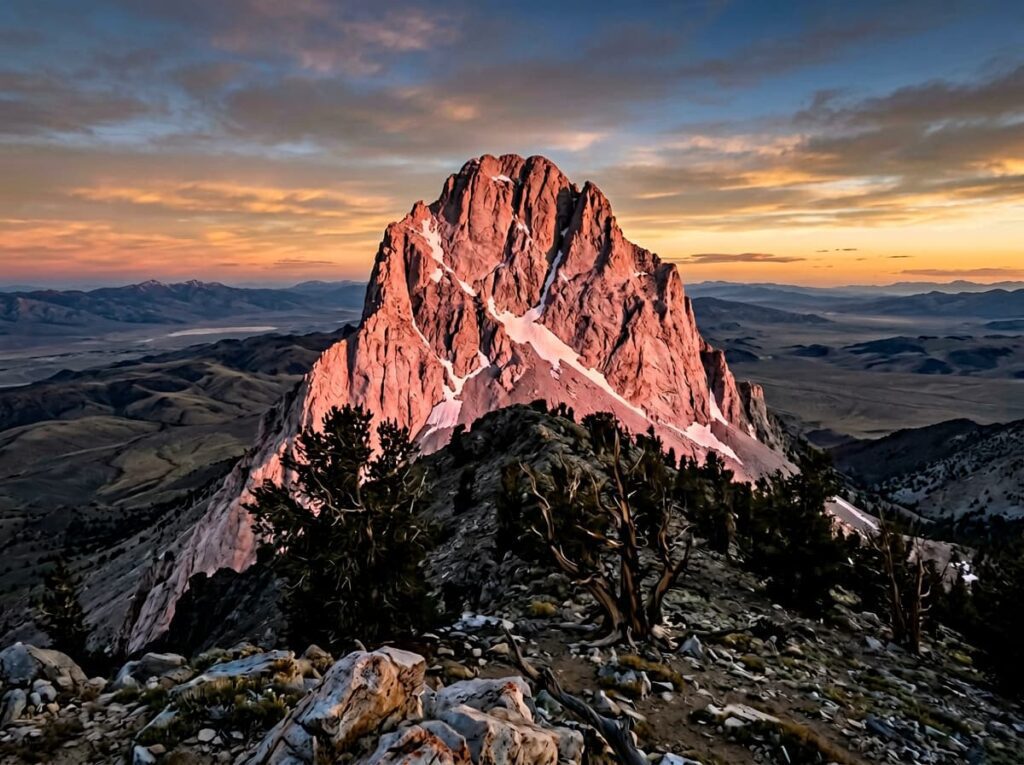
Great Basin National Park is named for the Great Basin — the vast hydrological region of the American West where no water flows to the ocean, all drainage collecting in internal basins and evaporating. The park itself sits in the Snake Range, where Wheeler Peak rises to 13,063 feet from the surrounding desert floor in one of the most dramatic single-mountain elevation rises in the western United States. The park contains five life zones compressed into that vertical rise — from the Great Basin Desert scrub at the base through pinyon-juniper woodland, mountain mahogany, limber pine, and subalpine bristlecone pine forest to the alpine tundra near the summit.
The bristlecone pines are the park’s most extraordinary living subjects — ancient trees growing at the treeline on Wheeler Peak’s slopes that are among the oldest living organisms on earth. The Prometheus tree, a bristlecone pine that was cut down by a researcher in 1964 before its age was fully appreciated, was subsequently determined to be approximately 4,900 years old — the oldest known non-clonal living organism on earth at the time of its death. The remaining bristlecone grove contains trees that are 3,000 to 4,000 years old, gnarled and wind-sculpted into forms that look more like sculpture than botany, their wood so dense and so resinous that fallen specimens persist for thousands of years after death.
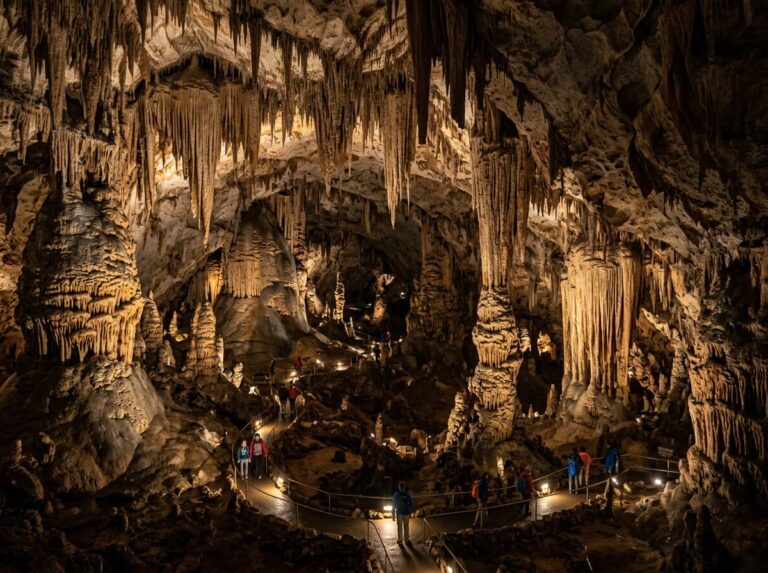
Lehman Caves, at the park’s base elevation, is one of the finest cave systems in the Great Basin — a marble cave decorated with stalactites, stalagmites, helictites, and the rare cave formation called shields, which are flat circular discs of calcite projecting from the cave walls in formations that scientists still do not fully understand. The cave tours range from a 60-minute walk to a 90-minute tour covering the full decorative complexity of the cave, and the photography inside — particularly of the shields under the tour lighting — is the close-range geological detail work that the mountain and the night sky cannot provide.
The Photographer’s Chase
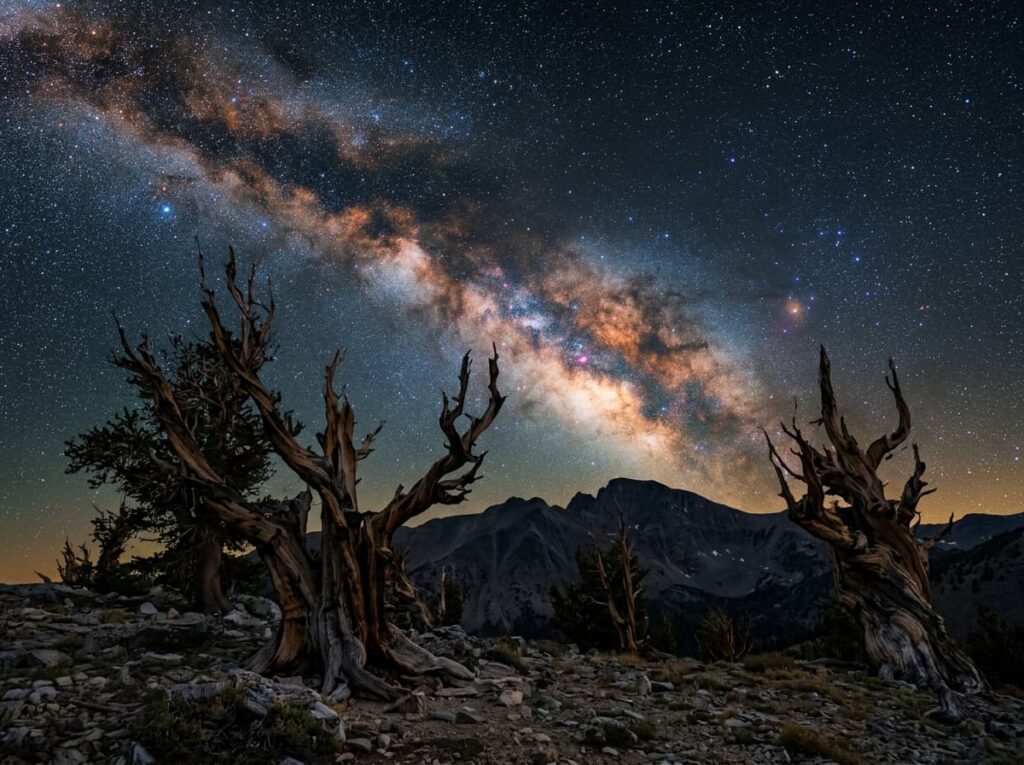
The dark sky is the primary photography target and the reason Great Basin’s remoteness is an asset rather than a liability. The park is designated as an International Dark Sky Park and sits in one of the lowest light pollution zones in the continental United States — the nearest significant city light source is hours away in every direction. On a moonless night, the Milky Way is not a faint suggestion above the Nevada desert. It is a presence that fills the sky from horizon to horizon, the core rising above Wheeler Peak in a display that the populated West cannot replicate. The bristlecone pines on the Wheeler Peak slopes, silhouetted against the galaxy above them, are the astrophotography foreground subject that most photographers who know Great Basin specifically come to make.
The Astronomy Festival that the park hosts each fall is the annual gathering of dark sky photographers and astronomers who understand what the Great Basin sky offers — a weekend of ranger programs, telescope sessions, and the kind of community of people who drove four hours from Salt Lake City or Las Vegas specifically to see what this sky looks like. The festival dates are worth checking at nps.gov/grba and building into the trip plan if the timing aligns.
The bristlecone pine photography on the Wheeler Peak Scenic Drive and the Alpine Lakes Loop trail is the daytime photography that rewards the most careful attention. The trees at treeline on Wheeler Peak’s slopes are 3,000 to 4,000 years old and their forms are the result of millennia of wind, ice, and the particular stress of surviving at the limits of what living things can endure. A macro lens on the wood grain of a living bristlecone — the dense, resinous wood that resists decay so completely that fallen specimens persist for thousands of years — communicates the age of the tree more honestly than any wide-angle composition. The gnarled summit forms against the Nevada sky, with the Great Basin desert floor visible thousands of feet below, are the elevated landscape compositions that the park road provides access to.
The Wheeler Peak glacier — one of only five remaining glaciers in the Great Basin, a remnant cirque glacier on the peak’s north face — is accessible via the Alpine Lakes Loop trail and is worth the hike specifically for its documentary significance. Like the Grinnell Glacier at Glacier National Park, this ice is retreating and will likely not exist in its current form for future generations. Photographing it now is an act of documentation as much as landscape photography — the cirque lake below it, the moraine, and the ice face in the summer afternoon light when the blue of the glacier is most saturated.
Visiting the Park
Great Basin is open year-round, though the Wheeler Peak Scenic Drive — the 12-mile road climbing from the visitor center to the treeline at 10,000 feet — closes with the first significant snowfall in October and reopens in late spring when the road is cleared. The cave tours operate year-round; the Lehman Caves visitor center is the park’s hub in all seasons.
Summer — June through September — is the primary season when the full park is accessible, the bristlecone grove is snow-free, and the Alpine Lakes Loop is walkable. The dark sky photography is excellent year-round but summer and fall provide the Milky Way core positioning above the horizon during the dark hours. Spring brings wildflowers to the lower desert elevations and the mountain snowmelt waterfalls, but the upper road may not be open until June.
No timed entry reservations are required — the park’s low visitation makes them unnecessary. Cave tour tickets should be purchased in advance at recreation.gov for peak summer season as the tours have limited capacity. The nearest airports are Salt Lake City (SLC), about 230 miles north, and Las Vegas (LAS), about 290 miles southwest. Both require a significant drive across Nevada on US-93 and US-50 — the latter called the Loneliest Road in America for good reason. Allow the drive time rather than rushing it; the Nevada basin and range landscape along US-50 is itself a photography subject.
Where to Stay
The town of Baker, Nevada — the park’s gateway community — has a population of approximately 68 people and the full range of amenities that 68 people can support. The Border Inn, straddling the Nevada-Utah state line on US-50, is the primary lodging option — a motel, restaurant, and gas station in one building, the kind of place that exists specifically because there is nothing else for 50 miles in any direction. It is what it is, and for photographers targeting the night sky it provides a bed close enough to the park that the drive to the dark sky positions after dinner is practical.
Ely, Nevada — about 70 miles north on US-93 — is the nearest town with a broader lodging range. The Hotel Nevada and Gambling Hall in Ely is a 1929 historic property that has been housing travelers on the Nevada mining frontier for nearly a century, and it adds the ghost town character of a Nevada silver boom town to a visit that the park alone cannot provide. For photographers, Ely also offers the Nevada Northern Railway Museum — a complete historic railroad complex with operating steam locomotives that is one of the finest railroad photography subjects in the American West.
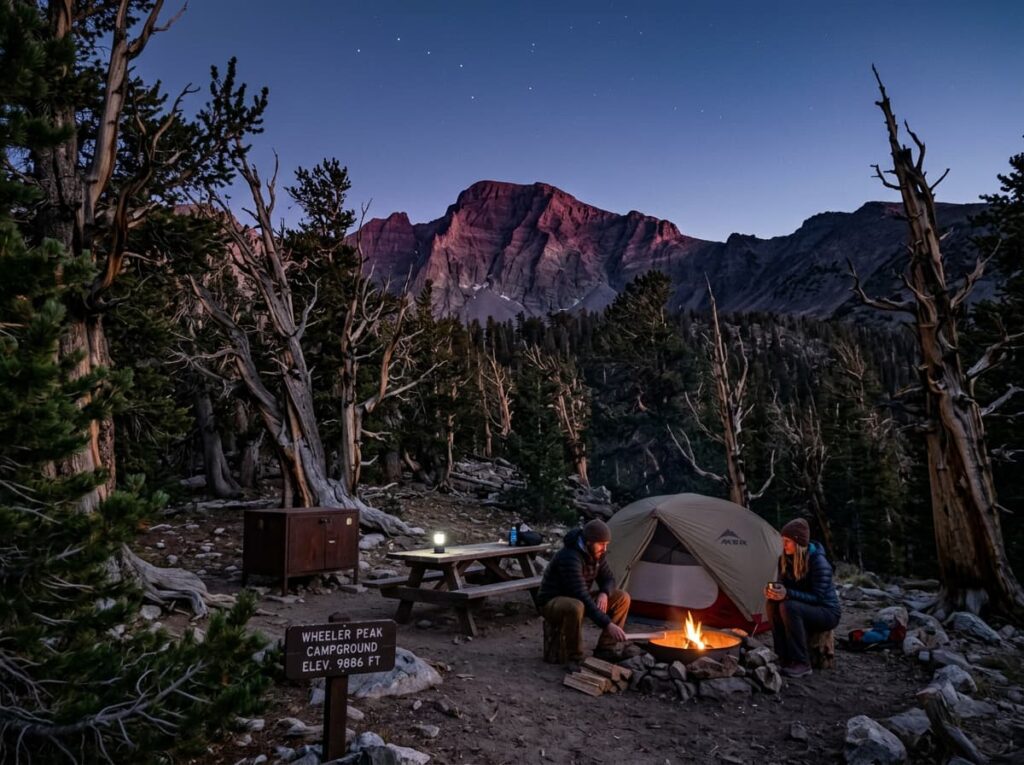
For campers, Wheeler Peak Campground at 9,886 feet is the prime in-park option — in the bristlecone zone, at the trailhead for the Alpine Lakes Loop and the glacier hike, and at an elevation that is dark enough for serious Milky Way photography without the drive back down the mountain. Lower Baker Creek and Upper Lehman Creek campgrounds provide lower-elevation options closer to the cave visitor center. All campgrounds are first-come, first-served. RVs are accommodated at the lower campgrounds; Wheeler Peak Campground has size limitations due to the mountain road.
If I Were Planning My First Visit
Late August or September — the Wheeler Peak Scenic Drive fully open, the bristlecone grove accessible, the Milky Way core still well-positioned above the southern horizon during the dark hours, and the first suggestion of fall color in the aspen groves below the treeline.
Wheeler Peak Campground for the in-park base — at 9,886 feet among the bristlecones, at the trailhead for the morning hike to the glacier and the Alpine Lakes. The Lehman Caves tour on the first afternoon — the shields formation specifically, the cave photography that the mountain and the night sky cannot offer.
And at least one full moonless night outside with the camera pointed at the galaxy. The bristlecone silhouettes as foreground. Wheeler Peak as background. The Milky Way doing what it does above one of the darkest pieces of sky in the continental United States — the same sky I stood under at Burning Man 200 miles northwest of here and thought was the most sky I had ever seen at once. Great Basin’s sky is darker still. I am going to find out what that looks like through a lens.
The Light I’m Curious About
It is the night sky — specifically the Milky Way above the bristlecone pines on a moonless September night at 10,000 feet in one of the darkest places in the continental United States.
I stood at Burning Man once and looked up and thought I understood what a dark sky was. The Black Rock Desert is not close to this. Great Basin National Park sits in a zone of darkness that most Americans never experience — the kind of sky where the Milky Way casts a shadow, where the air glow of the galaxy is bright enough to navigate by, where the difference between the lit areas of the sky and the dark nebulae within the galaxy is visible to the naked eye.
Standing under that sky beside a 4,000-year-old tree — a tree that was alive when the Egyptians were building the pyramids, that has survived 4,000 winters at the edge of what living things can endure — and pointing a camera at the galaxy above it is the photograph I am most curious about in the entire remaining half of this project. Some images require going somewhere genuinely remote to find. The Great Basin night sky is one of them.
A Deeper Exploration
This article is part of my ongoing project documenting and photographing all 63 national parks across the United States.
Along the way, I’m creating deeper guides that explore photography locations, travel planning, seasonal light conditions, and personal reflections from the road. Great Basin is the park that most clearly embodies the project’s central argument: that the least visited places sometimes have the most to offer, and that the isolation most visitors treat as a deterrent is exactly what makes the experience worth having.
Because the Loneliest Road in America leads somewhere. And what it leads to, on a clear September night, is one of the finest views of the galaxy available to anyone standing on this continent.
One more thing — just between us.
Great Basin already sees fewer than 130,000 visitors a year — crowd management is not the challenge here. The insider tip is about extending the Nevada isolation experience into the surrounding landscape that most park visitors never explore.
The Nevada Northern Railway Museum in Ely — 70 miles north — is one of the finest intact historic railroad complexes in the United States, with operating steam locomotives that run excursion trips on the original 1906 track. The Ghost Train of Old Ely, a candlelight Halloween excursion, is one of the more atmospheric railroad photography events in the West.
For the dark sky photography that extends the Great Basin experience, US-50 through central Nevada — the Loneliest Road in America — passes through a series of small former mining towns, each with its own ghost town photography potential and each sitting under the same extraordinary dark sky as the park. Austin, Eureka, and Ely along this route have the atmospheric character of places that the 20th century largely bypassed.
And for the experience of genuinely empty Nevada desert, Cave Lake State Park — just outside Ely — offers a quiet reservoir lake in a pinyon-juniper canyon with trout fishing, primitive camping, and the same dark sky quality as the national park without the drive. A small club knows this road. Now you do too.