A Photographer’s First Look at New Mexico’s Underground Cathedral — Where the Camera Matters More Than the Lens
When planning a visit to America’s national parks, it is worth clarifying something first: Carlsbad Caverns National Park is in New Mexico. Carlsbad, California — a pleasant coastal city north of San Diego — shares nothing with it except the name. I have been to Carlsbad, California. I have been to Laurel Caverns in Pennsylvania, which gave me an early understanding of what cave photography demands. I have not been to Carlsbad Caverns National Park, which is a different category of cave experience entirely.
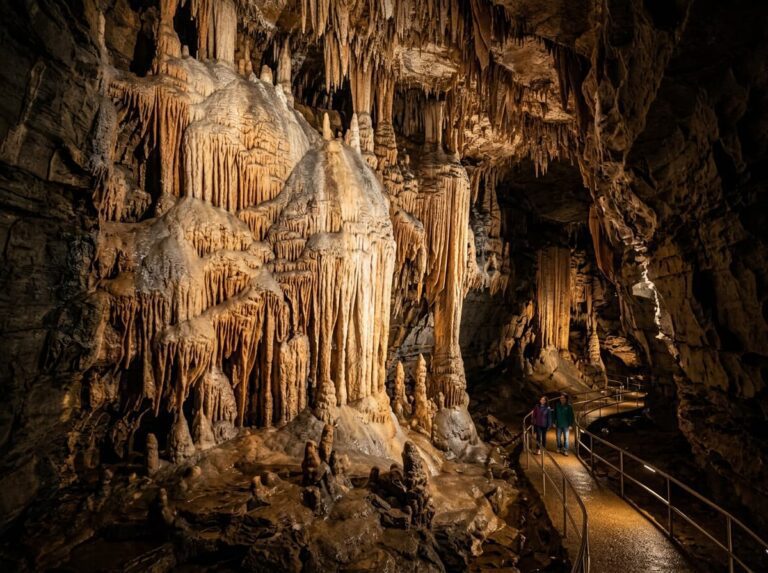
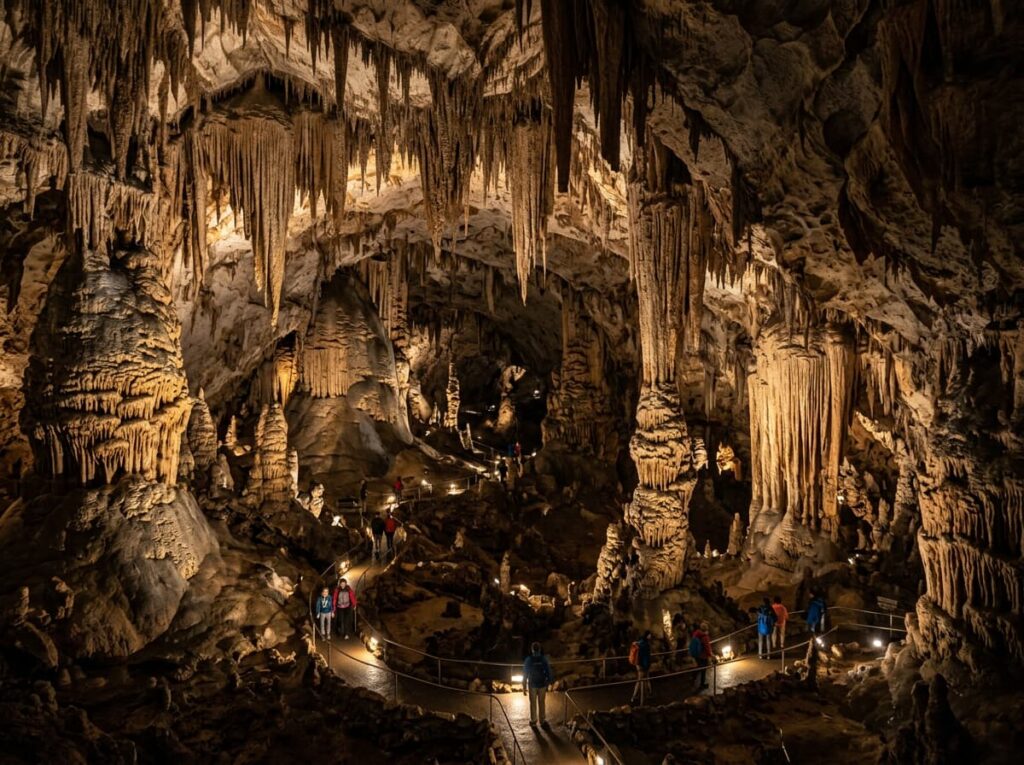
The caverns sit beneath the Chihuahuan Desert of southeastern New Mexico, and what is underground there is not a modest geological curiosity. The Big Room — the main chamber of Carlsbad Cavern — is one of the largest cave chambers in North America, covering 8.2 acres at its widest and reaching 255 feet at its highest point. It contains stalactites, stalagmites, columns, draperies, popcorn formations, and cave pearls in a density and a variety that makes Laurel Caverns, wonderful as it is, feel like a preview of what a cave can actually be.
The photography question going in is already answered: the Sony performs well in dark environments, handles high ISO gracefully, and the image stabilization allows handholding at shutter speeds that would require a tripod from most cameras. Carlsbad Caverns is one of the few national parks where the camera body is the most important piece of equipment rather than the lens. The light inside the cavern is artificial, directional, and dramatic — the NPS lighting system illuminates the formations specifically to reveal their scale and their detail, and a fast mirrorless body that can push ISO 6400 or higher without unacceptable noise is the right tool for the conditions. The Sony was made for this.
The Landscape That Draws People Here
Carlsbad Caverns National Park protects more than 119 known caves beneath the Chihuahuan Desert in the Guadalupe Mountains of southeastern New Mexico. The Guadalupe Mountains are an ancient reef — formed from a massive fossil reef that grew at the edge of an inland sea approximately 265 million years ago, then buried under evaporite deposits and later uplifted and exposed by the same geological forces that shaped the surrounding basin and range landscape. The caves were dissolved from that ancient reef limestone by sulfuric acid rising from below — a formation process called hypogenic speleogenesis that is different from the typical cave formation process and produced the extraordinary scale and variety of formations visible today.
The cave is accessed two ways. The natural entrance — a massive opening in the desert hillside through which the evening bat flight emerges each summer dusk — descends via a 1.25-mile switchback trail through the twilight zone and into the cave’s deeper sections. The elevator, from the visitor center directly to the Big Room 750 feet below the surface, provides immediate access to the main chamber without the descent. For photographers, the natural entrance trail is the more rewarding approach — the transition from desert light to cave twilight to the cave’s artificial illumination is a gradual calibration that the elevator cannot provide, and the formations visible along the descent include some of the most dramatic in the entire cave system.
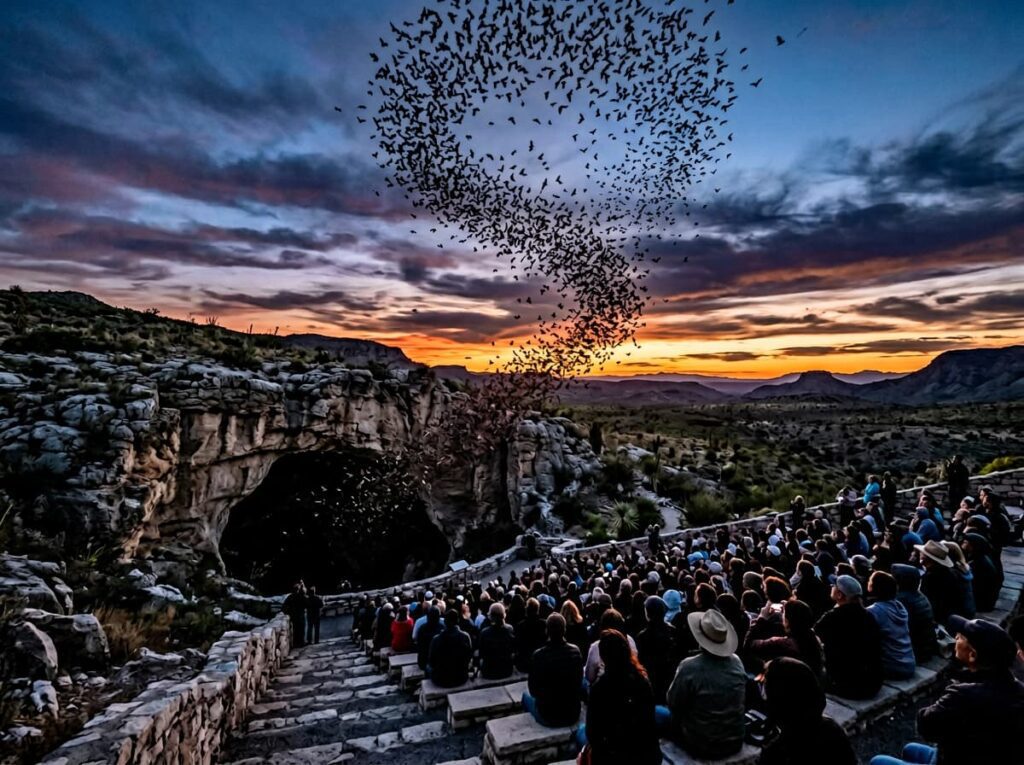
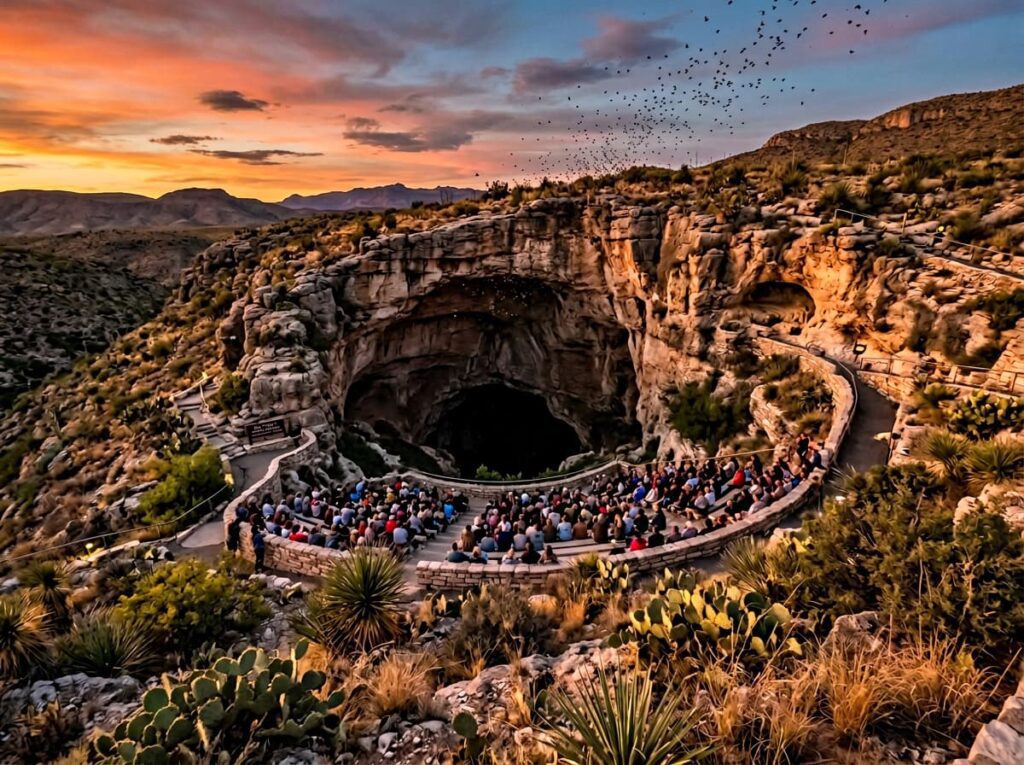
The bat flight is the above-ground spectacle that Carlsbad Caverns produces that no other national park can match — from late May through October, between 200,000 and 400,000 Brazilian free-tailed bats emerge from the natural entrance each evening at dusk in a continuous spiral column that can last over an hour. The NPS hosts a ranger program at the outdoor amphitheater at the cave entrance during the bat flight; the photography of the emergence — the bats against the sunset sky, the column spiraling upward from the cave entrance — is a wildlife photography subject that is specific to this place and unlike anything else in the park system.
The Photographer’s Chase
Cave photography at Carlsbad operates on completely different principles from every other park in this series — there is no golden hour, no waiting for clouds, no sunrise or sunset to time. The light is entirely artificial and entirely controlled by the NPS illumination system, which is designed to reveal the formations dramatically rather than illuminate them neutrally. That design works in the photographer’s favor: the directional lighting creates shadow depth and texture in the formations in a way that flat even lighting cannot, and the color temperature of the artificial light — warm in some areas, cooler in others — produces a variety of tonal quality within the cave that makes different sections of the Big Room feel distinct from each other.
The Sony’s high ISO capability is the enabling technology for handheld cave photography. A tripod is not permitted on the self-guided routes through the Big Room — the NPS restricts tripods to protect the cave floor and to keep the paths clear for other visitors. Handheld photography at ISO 3200 to 6400 with image stabilization engaged is the practical approach, using a wide aperture and the slowest shutter speed that the stabilization allows without subject blur. The formations are static, which means camera shake is the only motion concern — the stabilization manages that, and a modern mirrorless sensor at high ISO produces acceptable noise at this light level.
The natural entrance descent is the photography approach that rewards the most patient work. The trail switchbacks down through the twilight zone — the area near the cave entrance where natural light still penetrates and creates the most dramatic interplay between the outdoor sky visible above and the cave darkness below. The bats roosting on the ceiling in the upper sections of the natural entrance, the silhouette of the cave opening against the desert sky above, and the transition zone where the formations first become visible in the dimming natural light are all photography subjects specific to the natural entrance approach that the elevator cannot access.
The bat flight photography from the outdoor amphitheater requires a completely different setup from the cave interior work — a wide angle to capture the column emerging from the cave entrance and spiraling skyward, a fast shutter speed to freeze individual bat motion, and the patience to be in position before the emergence begins. The timing varies daily based on light levels; the ranger program announces the approximate emergence time each evening. The shot from behind the amphitheater audience, with the crowd silhouetted against the cave entrance and the bat column above, is the human-scale photograph that communicates the spectacle in a way that close-up bat shots cannot.
Visiting the Park
Carlsbad Caverns is open year-round, with the self-guided Big Room tour available daily. The natural entrance trail and the elevator both provide access to the Big Room; the natural entrance trail closes earlier in the day to allow visitors time to exit before the bat flight, and the last elevator entry is timed accordingly. Check current operating hours at nps.gov/cave before planning — the hours shift seasonally and the bat flight schedule changes with the season and the bat population’s migration status.
The bat flight occurs from late May through October, when the bats are in residence before their winter migration to Mexico. The peak emergence — the largest number of bats and the most dramatic spectacle — typically occurs in August and September. The ranger program at the amphitheater before the flight provides context for the photography; arriving early enough to claim a good position at the amphitheater rim is essential on summer evenings when the crowd is largest.
The Slaughter Canyon Cave tour — a more primitive cave accessible by a separate entrance 23 miles from the visitor center — provides a ranger-led experience in a cave that has no improved trails or artificial lighting beyond the ranger’s lantern. The photography in Slaughter Canyon Cave, entirely by lantern light, is the most challenging and most atmospheric cave photography in the park. Advance booking through recreation.gov is required; the tour is physically demanding and involves off-trail scrambling.
Where to Stay
There is no in-park lodging at Carlsbad Caverns. The city of Carlsbad, New Mexico — about 27 miles north of the park on US-62/180 — is the gateway city and provides the full range of chain and independent lodging. White’s City, a small commercial complex immediately outside the park entrance, has basic motel accommodations and a gas station — convenient for early morning cave entry and evening bat flight attendance without the Carlsbad commute.
The park sits naturally within a broader Guadalupe Mountains circuit that also includes Guadalupe Mountains National Park in Texas, about 35 miles southwest — the two parks together cover the full extent of the ancient Capitan Reef and provide a complete geological story. Spending two or three days based in White’s City or Carlsbad and dividing time between the two parks makes the most of the regional geology and the dramatically different above-ground landscapes — Carlsbad’s Chihuahuan Desert scrub and Guadalupe Mountains’ pine-forested high country in combination.
For RV travelers, the Carlsbad KOA and several private campgrounds in and around Carlsbad provide full hookup options. There is no in-park RV camping at Carlsbad Caverns, though backcountry camping is available for hikers in the above-ground park with a free permit from the visitor center.
If I Were Planning My First Visit
The Sony fully charged and the high ISO settings tested before arrival. A wide zoom for the Big Room scale shots and a moderate prime for the formation detail work — the 35mm or 50mm equivalent at f/1.8 or f/2 is the fastest practical option for handheld cave photography in the available light.
The natural entrance descent on the first morning — in the cave before the crowd builds, moving slowly down the switchbacks through the twilight zone, calibrating the eye to the cave light before reaching the Big Room. The full Big Room self-guided loop, unhurried, stopping at the major formation clusters for the close-range photography that the moving tour cannot accommodate.
And the bat flight on the first evening — in position at the amphitheater well before the estimated emergence time, wide angle ready, the sunset behind the cave entrance framing the column as it begins to spiral upward. That is the photograph that exists nowhere else in the national park system, and it is available every evening from late May through October to anyone who shows up before dark and points a camera at the sky.
The Light I’m Curious About
It is the NPS lighting on the Hall of Giants — the section of the Big Room where the largest stalagmites in the cave rise from the floor in formations that reach 62 feet tall, illuminated from below by the directional lighting system in a way that creates theatrical shadow depth and communicates scale through the contrast between the lit formation faces and the darkness behind them.
Cave photography with artificial light is not the same as landscape photography with natural light — the light source is fixed, the color temperature is controlled, and the photographer’s job is to find the position and the framing that works with what the NPS has already designed rather than waiting for atmospheric conditions to change. That is a different creative challenge from every other park in this series, and the Sony’s ability to resolve detail in near-darkness without introducing unacceptable noise is what makes it the right tool for this specific creative challenge.
Laurel Caverns gave me the first understanding of what a cave looks like photographically. Carlsbad Caverns is the graduate course — larger, more dramatically lit, with formations that have been growing in the dark for 265 million years and a bat colony that uses the cave as casually as a subway station. The Sony and I are going to New Mexico.
A Deeper Exploration
This article is part of my ongoing project documenting and photographing all 63 national parks across the United States.
Along the way, I’m creating deeper guides that explore photography locations, travel planning, seasonal light conditions, and personal reflections from the road. Carlsbad Caverns is the park in this series where the photography is most purely about the camera rather than the landscape — the first park where I have said out loud that a specific piece of equipment is the enabling factor. The Sony handles this. I intend to find out exactly how well.
Because the light underground at Carlsbad has been the same since the NPS installed the system. It is not waiting for a clear morning or a storm break or a specific season. It is just there, 750 feet below the New Mexico desert, illuminating formations that grew in complete darkness for longer than humans have existed. All it requires is a camera that can see in the dark. Fortunately, I have one.
One more thing — just between us.
Carlsbad Caverns draws its crowd to the Big Room, which is the right call — it is extraordinary. But here are three places worth knowing for the visit that wants to go beyond the main attraction.
Guadalupe Mountains National Park — 35 miles southwest in Texas — is the natural companion to Carlsbad and shares the same ancient reef geology above ground. Guadalupe Peak, the highest point in Texas at 8,751 feet, provides the elevated desert and mountain photography that the cave cannot, and the El Capitan formation above the highway is one of the most dramatic cliff faces in the Southwest. The two parks in combination tell the complete Capitan Reef story.
Within the Carlsbad park, the Slaughter Canyon Cave tour is the primitive lantern-lit alternative to the Big Room — entirely ranger-led, physically demanding, and producing cave photography by lantern light that the NPS-illuminated Big Room cannot replicate. Book it through recreation.gov well in advance.
And for the Chihuahuan Desert above-ground photography that most cave visitors ignore entirely, the Rattlesnake Springs picnic area — a desert oasis in the park’s lower elevations fed by a natural spring — is one of the finest birding locations in New Mexico, attracting species that the surrounding desert cannot support. Early morning at Rattlesnake Springs during migration season produces bird photography that cave visitors in the park for the formations never think to look for. A very small and very rewarding club.