A Photographer’s First Look at America’s Smallest National Park — and Its Most Surprising One
When planning a visit to America’s national parks, most people think in terms of landscapes — canyons, mountains, coastlines, forests. Hot Springs National Park in Arkansas does not fit that template at all, and that is precisely what makes it worth understanding.
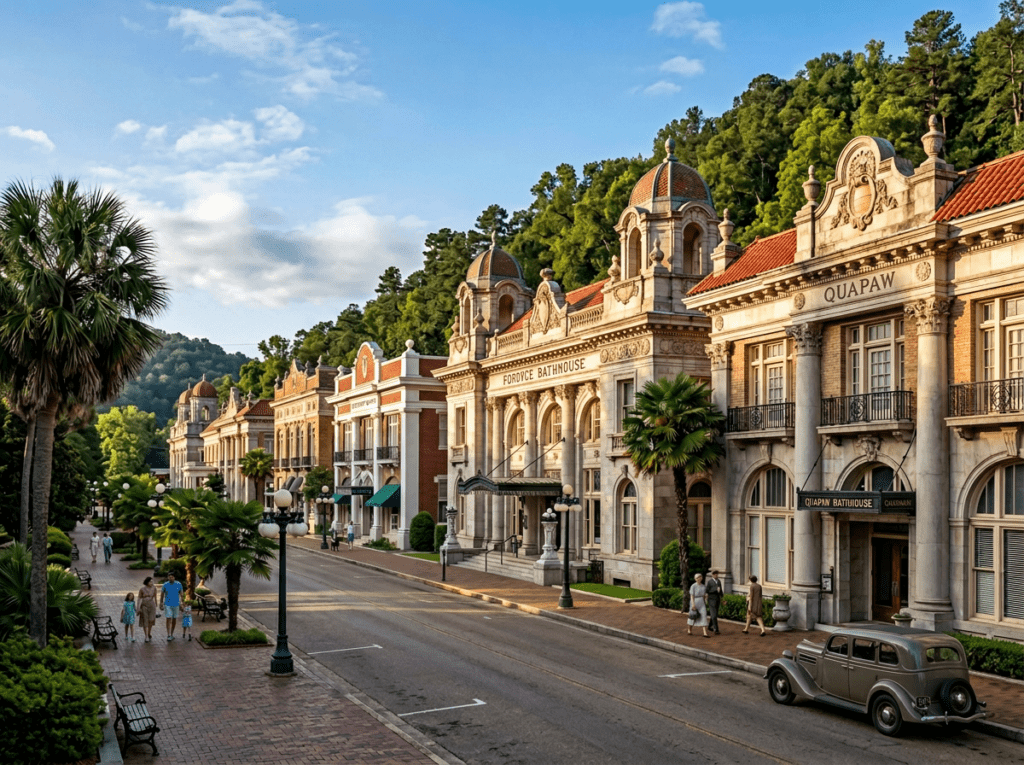
Hot Springs is the smallest national park in the system and the oldest protected federal land in America — designated a federal reservation in 1832, decades before Yellowstone established the national park concept in 1872. It sits not in a remote wilderness but in the middle of a small Arkansas city, also called Hot Springs, where the historic bathhouses of Bathhouse Row line Central Avenue in a grand procession of early 20th-century architecture. The park is the city and the city is the park, intertwined in a way that exists nowhere else in the national park system.
Forty-seven natural springs emerge from the western slope of Hot Springs Mountain, flowing at a constant 143 degrees Fahrenheit — water that fell as rain on the Ouachita Mountains 4,400 years ago and has spent the intervening millennia percolating through the earth, collecting heat, and rising through a fault in the rock to the surface. For photographers accustomed to chasing geological drama and atmospheric spectacle, Hot Springs requires a complete reset of expectations. The subject here is not scale. It is intimacy, architecture, history, and the quiet strangeness of thermal water emerging from the ground in the middle of an American town.
The Landscape That Draws People Here
Bathhouse Row is the visual heart of the park — eight historic bathhouses built between 1892 and 1923, when Hot Springs was the spa capital of America and the wealthy, the athletic, and the infirm came from across the country to take the thermal waters. The architecture is remarkable: beaux arts and Spanish colonial revival facades in a continuous block along Central Avenue, the hot spring water still flowing beneath them through a system of pipes and reservoirs. The Fordyce Bathhouse, the grandest of the eight, is now the park visitor center and museum; the Buckstaff continues to operate as a traditional bathhouse offering thermal baths to visitors; others have been repurposed as a brewery, a spa, and an art gallery.
Behind and above Bathhouse Row, the park extends into the wooded Ouachita Mountains — a network of forested hiking trails covering the ridge above the city, with overlook views across the Hot Springs valley and the surrounding forested hills. The combination of urban historic architecture at the base and quiet forest trails immediately above is one of the more unusual experiential contrasts in the park system. You can photograph the ornate facade of the Fordyce Bathhouse in the morning and be alone on a forested ridge trail twenty minutes later.
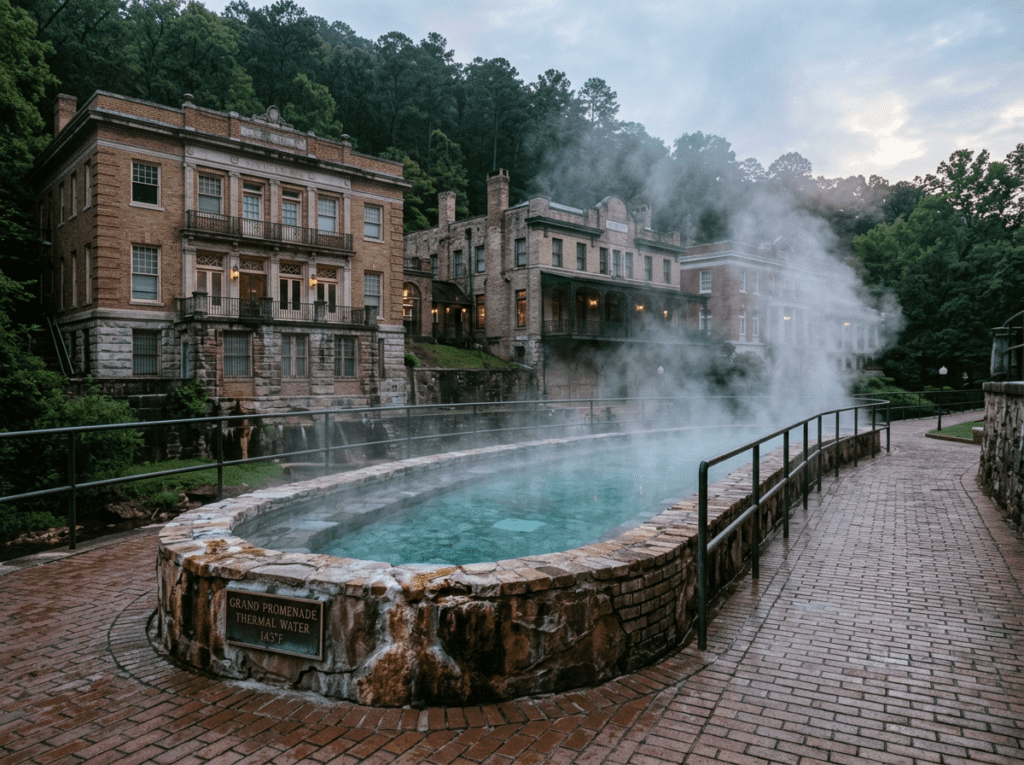
The display springs along the Grand Promenade — a brick walkway behind Bathhouse Row where several springs flow into open collection pools — offer the closest access to the thermal water itself. Steam rises from the pools in the cool morning air, the water a clear blue-green over the mineral-stained basins, and the brick promenade and the back facades of the bathhouses provide the architectural framing that makes this a genuinely distinctive photography location.
The Photographer’s Chase
Hot Springs demands a different kind of photographer’s eye than any other park in this series. There are no grand vistas to chase, no atmospheric windows measured in minutes before the light shifts. The photography here is architectural, intimate, and detail-oriented — and it rewards the photographer who slows down and looks carefully at the surfaces and layers that a decade of casual visitors walk past without noticing.
The Fordyce Bathhouse interior is the most extraordinary single photography subject in the park — a stained glass ceiling in the main hall, ornate tile work in the bathing rooms, cast iron fixtures and marble surfaces that speak to an era when Americans came to these springs the way Europeans traveled to Baden-Baden or Bath. The building is open for self-guided tours and the interior photography, on an overcast morning when the light through the stained glass is soft and even, produces images that have nothing to do with the national park genre and everything to do with the history of a place that took the waters seriously.
The display springs on the Grand Promenade are best photographed in the early morning — cool air temperature maximizes the steam rising from the thermal pools, and the low-angle morning light on the brick promenade and the back of the bathhouses creates the warm, layered architectural light that the midday overhead sun eliminates. A macro lens on the mineral deposits around the spring outlets — the calcium carbonate formations, the iron staining, the blue-green of the thermal algae that live in water too hot for most life — produces close-range images specific to this geology and available nowhere else in the park system.
The forested ridge trails above the city provide the landscape photography counterpoint to the architectural work below. Hot Springs Mountain Tower offers the elevated view across the Ouachita forest and the city below — not a dramatic vista by national park standards, but a quieter, more intimate panorama that communicates the unusual relationship between this park and the community it surrounds.
Visiting the Park
Hot Springs is a year-round park with no timed entry requirements and no crowd problem of any consequence by national park standards. It is also one of the most accessible parks in the system — the city of Hot Springs, Arkansas, is a comfortable drive from Little Rock, about an hour to the east, and the park’s central location in the mid-South makes it a practical addition to a broader regional trip.
Spring and fall are the most pleasant seasons for the combination of outdoor ridge hiking and architectural photography. Summer in Arkansas is genuinely hot and humid — the thermal springs feel less dramatic when the ambient temperature is already pushing 95 degrees — but the early morning photography window is still productive and the park is rarely crowded regardless of season. Winter is mild by national park standards and occasionally brings frost on the Ouachita ridges above the city, which produces the only dramatic natural light condition the park offers.
The Fordyce Bathhouse museum is free and open during park hours. The Buckstaff Bathhouse offers traditional thermal baths by reservation — a genuinely unusual experience that connects the photography trip to the actual history of the place. For photographers who want to understand what they are photographing, taking the waters at the Buckstaff before or after a morning shoot on the promenade is worth the two hours it requires.
Where to Stay
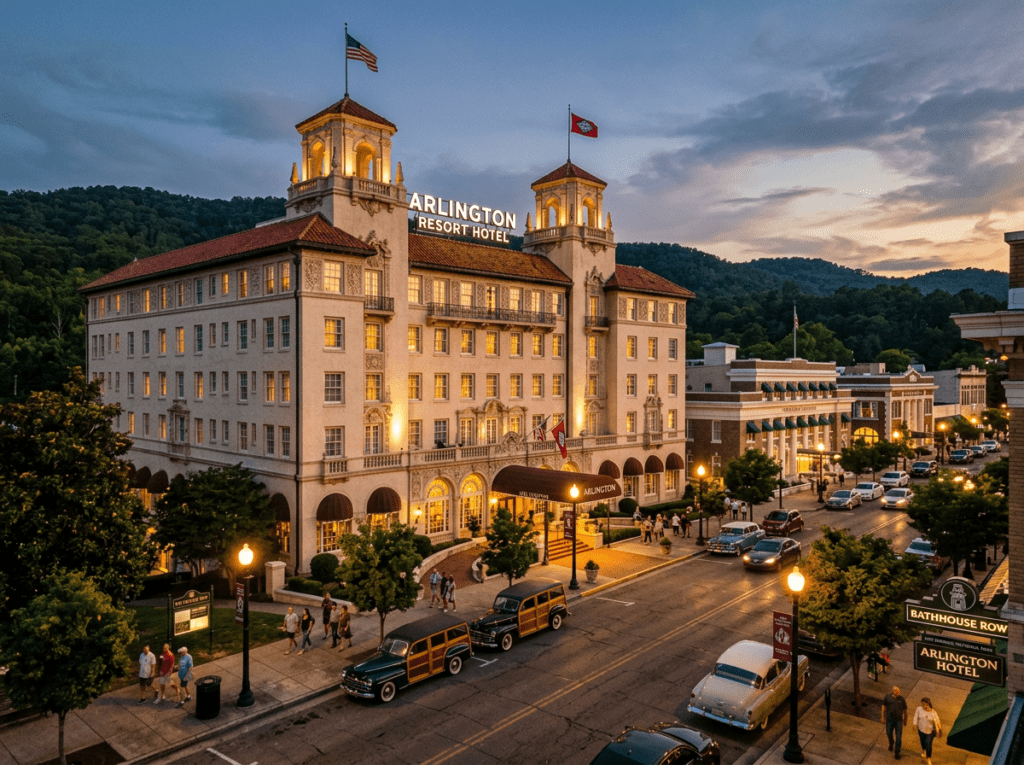
The city of Hot Springs offers the full range of lodging within walking distance of the park. The Arlington Resort Hotel and Spa — a grand historic hotel directly across Central Avenue from Bathhouse Row — is the landmark lodging choice. Built in 1924 and operating continuously since, it sits so close to the park that the distance between a room and the Grand Promenade is measured in steps. For a photography trip built around architectural and morning spring light, being that close to the subject matters.
The city also has a range of independent inns, bed and breakfasts in the Victorian neighborhoods above Bathhouse Row, and modern hotels along the lake corridor to the east. Lake Hamilton and Lake Catherine, just outside the city, add a water recreation element that some visitors combine with a park visit — the lake lodges and resorts along their shores provide a different kind of base camp for those who want more than the city center.
There is no camping inside the park itself, but Gulley Park Campground and several private campgrounds in the Hot Springs area accommodate RV travelers. The city is entirely walkable from most central lodging, which is unusual for a national park visit and worth taking advantage of — leaving the vehicle parked and walking the promenade and Bathhouse Row on foot produces a fundamentally different and more photographic experience than driving between pull-offs.
If I Were Planning My First Visit
I would stay at the Arlington or as close to Bathhouse Row as I could manage, and I would walk to the Grand Promenade before sunrise on the first morning. Cool air, maximum steam from the thermal pools, the promenade quiet and empty, the back facades of the bathhouses catching the first light. That is the photograph that most Hot Springs visitors never make because they arrive mid-morning after the steam has dissipated and the light has gone overhead.
I would spend a morning inside the Fordyce — not rushing through the museum exhibits but moving slowly through the bathing rooms and the stained glass hall with a camera, looking for the details that the restoration has preserved. The tile work. The cast iron. The particular quality of light through art glass in a room that was designed for bodies immersed in thermal water. That is a completely different photography experience from anything else in the 63 parks project.
And I would hike at least one of the ridge trails above the city — not primarily to photograph, but to stand above Hot Springs and understand the geography of it. The springs emerge from the mountain. The city grew around the springs. The park grew around the city. Standing on the ridge and looking down at all of it in context is the moment the place makes complete sense.
The Light I’m Curious About
It is the stained glass light inside the Fordyce.
The main hall of the Fordyce Bathhouse has a stained glass ceiling — a canopy of colored light over a room that was designed in 1915 for the ritual of bathing, for rest and recovery, for the belief that thermal water could heal what ordinary life had damaged. On an overcast morning, when the light through the glass is soft and diffused and the colors spread evenly across the marble and tile below, the room holds a quality of light that is specific to this building and this history and nothing else in the national park system.
That is the image I am most curious about at Hot Springs. Not the springs themselves, not the architectural exterior, not the forested ridge. The interior light of a room built for healing, in a park built around water that has been rising through the earth for longer than human civilization has existed. The scale is intimate. The history is deep. The light, on the right morning, is extraordinary.
That is what this project keeps teaching me: the most interesting light is not always the most dramatic. Sometimes it is the quietest light in the smallest park, in a room most visitors walk through without stopping, at an hour when the building is still and the color comes through the glass and lands on the floor the way it has been landing for a hundred years.
A Deeper Exploration
This article is part of my ongoing project documenting and photographing all 63 national parks across the United States.
Along the way, I’m creating deeper guides that explore photography locations, travel planning, seasonal light conditions, and personal reflections from the road. Hot Springs closes the Eastern cluster — five parks that together cover the full range of what the eastern park system offers, from the Atlantic granite of Acadia to the thermal springs of the Arkansas Ouachitas.
Because sometimes the most interesting national park is the one nobody thinks to put on the list — and the light inside it has been waiting a hundred years for someone to notice.
One more thing – just between us.
Bathhouse Row and the thermal water experience are the core of any Hot Springs visit and they deliver what they promise — but the park and the surrounding Ouachita Mountain region reward the visitor who looks beyond the historic district.
The Hot Springs Mountain Tower at the summit of Hot Springs Mountain above Bathhouse Row provides the elevated view across the Ouachita Mountains and the city of Hot Springs that the street level cannot — the forested ridgelines extending in every direction and the thermal steam visible rising from the hillside below are the landscape photography that most visitors to the bathhouses never find.
For the most authentic thermal experience in the park, the Buckstaff Bathhouse is the only bathhouse on Bathhouse Row still operating in its original therapeutic tradition — no spa treatments, no renovation aesthetics, just the 1912 building and the 143-degree thermal water cooled to bathing temperature and the experience of doing exactly what visitors have been doing here since the 1800s. Worth doing before photographing.
And for the broader Ouachita Mountain landscape that surrounds the park, Lake Ouachita — about 15 miles west — is one of the clearest lakes in the United States, set in the Ouachita National Forest with the same forested ridgeline character as the park. The lake at dawn with the forest reflected in the still surface is the Arkansas landscape photography that the Hot Springs urban park context cannot provide.