A Photographer’s Return to the High Desert — at the Hour It Actually Deserves
Some landscapes become part of our imagination long before we ever visit them. Joshua Tree is one of those — the surreal silhouettes of the trees against a fading sky, the stacked boulder formations that look arranged rather than geological, the sense of a landscape that operates by rules different from anywhere else. I had seen those images for years before I finally drove through the park.
Drove through. That is the precise and damning description of what I did.
I was on a longer California photography trip and Joshua Tree was on the route. I entered from the south, drove through at midday, stopped at a few pullouts in the harshest light of the day, and exited the north entrance a couple of hours later. I remember being struck by the strangeness of the Joshua trees — I grew up in Florida, where the plant life runs to palms and mangroves and sea grapes, and nothing in my botanical experience had prepared me for a tree that looks like it was designed by someone who had only heard trees described but never actually seen one. But I did not stay. I did not come back at dusk. I did not return before dawn. I did not see what this place actually is when the light is right.
The return trip has three specific targets: night, dawn, and storm. Joshua Tree is one of the finest dark sky parks on the continent. Its desert boulder formations at first light are among the most distinctive landscape photography subjects in the American West. And the desert in a storm — rain on the dry pan, clouds building over the Little San Bernardino Mountains, the Joshua trees standing in the strange light of a weather system moving through — is the image I keep thinking about when I think about what I missed.
The Landscape That Draws People Here
Joshua Tree National Park sits at the convergence of two distinct desert ecosystems — the higher, wetter, cooler Mojave Desert in the park’s western half, where the Joshua trees grow, and the lower, hotter, drier Colorado Desert in the eastern half, where the cholla cactus gardens and the ocotillo and the creosote dominate. The transition between them, visible as you drive east through the park, is one of the more remarkable ecological shifts in the national park system. The landscape changes character completely within a few miles.
The Joshua tree itself is not a tree — it is a yucca, a member of the agave family, and it grows only in the Mojave Desert at elevations between 2,000 and 6,000 feet. The branching form that gives it its distinctive silhouette begins only after the plant flowers for the first time, which can take decades. A mature Joshua tree may be 150 years old. The largest specimens in the park approach 40 feet in height and have the kind of presence — the sense of a living thing with genuine age and character — that most plants in most landscapes do not project. Coming from Florida, where the oldest trees tend to be live oaks draped in Spanish moss, the Joshua tree reads as something from a different planet entirely.
The Wonderland of Rocks in the park’s northwest section is the other defining landscape feature — a 12-square-mile maze of monzogranite boulders, some the size of houses, jumbled and stacked by millions of years of geological uplift and erosion. Hidden Valley, Barker Dam, and the areas around Skull Rock concentrate the best of this boulder landscape and provide the foreground subjects that transform a Joshua tree photograph into a Joshua tree and boulder photograph — which is the image most specific to this place.
The Photographer’s Chase
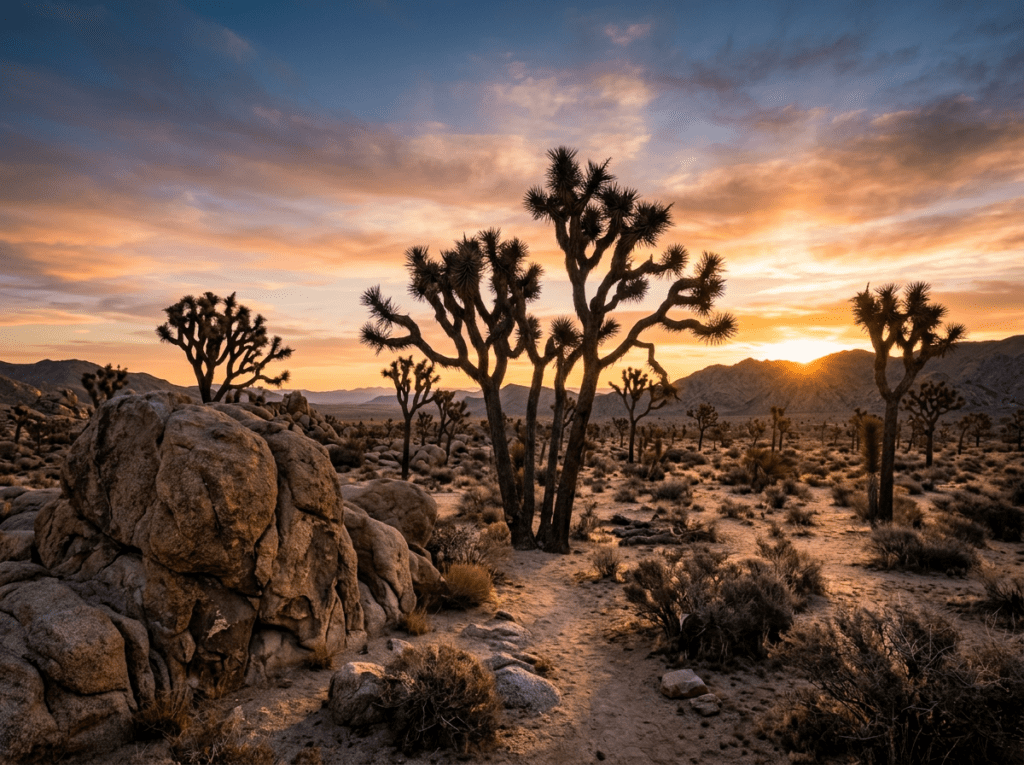
Midday in the Mojave Desert is not a photography proposition. I know this now in a way I did not fully internalize on the first visit — the overhead sun at 5,000 feet of desert elevation is flat, harsh, and does nothing interesting to the boulders or the trees. It washes the warm tones out of the granite and turns the Joshua trees from sculptural silhouettes into ordinary shapes. Everything that makes this landscape extraordinary disappears between 10am and 4pm. The photography here belongs entirely to the golden hours and the dark sky.
Dawn is the primary window. The Mojave Desert in the first light of morning — when the low sun rakes across the boulder fields and builds shadow and dimension into the granite surfaces, and the Joshua trees cast long shadows across the desert floor, and the air is still cool enough to be comfortable — is the Joshua Tree that most daytime visitors never experience. Keys View, the elevated overlook above the Coachella Valley, is spectacular at sunrise when the valley below catches the first light while the mountains to the east are still in shadow. The boulder formations around Skull Rock and in Hidden Valley, photographed from low among the rocks in the early morning with a wide angle and a long foreground, produce the intimate boulder-and-tree composition that is the park’s most distinctive photographic subject.
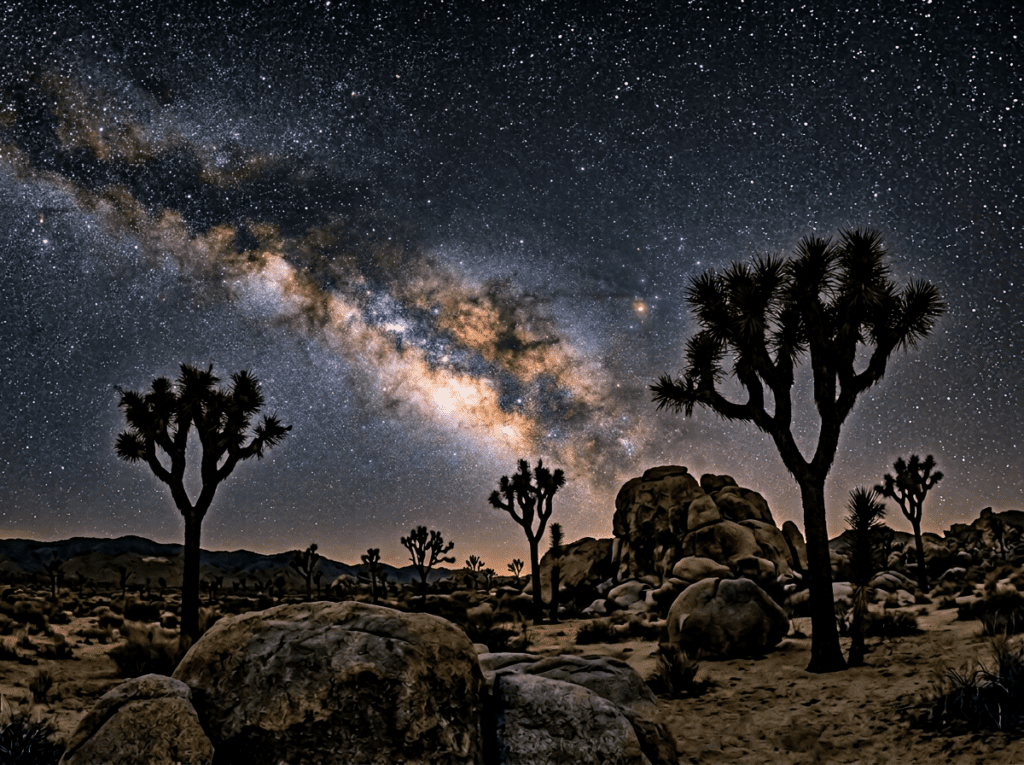
The dark sky photography is the target I most regret missing. Joshua Tree is an International Dark Sky Park, designated for its exceptionally low light pollution, and the night sky above the boulder formations is extraordinary. The Milky Way arching over a grove of Joshua tree silhouettes — the twisted forms of the yuccas against the galaxy above them — is one of the most recognizable astrophotography compositions in the American Southwest. The boulder formations provide the foreground depth that flat desert cannot. Parking near Skull Rock or at the Cholla Cactus Garden on a moonless night in spring or fall, setting up a wide angle at 14mm or shorter, and shooting thirty-second exposures while the galaxy moves overhead — that is the image this park is most famous for producing and the one I have not yet made.
Storm light is the third target and the least predictable. The Mojave Desert receives most of its rainfall between November and April, and the winter and early spring storms that move through the park produce a light quality the dry season cannot — dramatic cloud formations over the boulder fields, rain on the dry pan of the valley visible from Keys View, the Joshua trees standing in the strange diffused light that precedes a weather system and the sharp, washed clarity that follows one. Desert storm photography requires flexibility and patience — you cannot schedule a storm, only be there when one arrives and be ready when the light breaks through.
Visiting the Park
Joshua Tree’s peak visitation has shifted dramatically in recent years — the park’s proximity to Los Angeles and Palm Springs, combined with its Instagram-famous landscape, has pushed visitor numbers to levels that would have been unimaginable a decade ago. Weekends from October through May can bring crowds that fill the parking areas at the major boulder locations by mid-morning. The solution is identical to every busy park in this project: arrive before sunrise, and the park is a different place entirely.
The shoulder seasons — October through November and March through April — are the photography sweet spots. October brings cooler temperatures, lower crowds than the spring peak, and the possibility of dramatic cloud formations as the summer monsoon pattern gives way to the fall weather systems. March and April bring the desert wildflower bloom in years with adequate winter rainfall — a bloom year at Joshua Tree, when the desert floor goes orange and purple with poppies and phacelia, is one of the most extraordinary natural events in Southern California and worth planning a trip around when the conditions align.
No timed entry reservations are currently required for general park access, though the NPS has been monitoring the situation as visitor numbers grow. Check current entry requirements at nps.gov/jotr before planning. The park has two main entrances — the west entrance off Highway 62 near Joshua Tree town, and the north entrance at Twentynine Palms — and a south entrance from I-10 near Chiriaco Summit. The north and west entrances access the Mojave Desert section where the Joshua trees grow; the south entrance enters the Colorado Desert section.
Where to Stay
There is no in-park lodging at Joshua Tree. The gateway communities along Highway 62 — Joshua Tree town, Twentynine Palms, and Yucca Valley — provide the full range of lodging options from budget motels to the boutique desert properties that have made the area a destination in its own right. The 29 Palms Inn, an adobe bungalow property with a natural oasis on its grounds near the north entrance, has been a Joshua Tree photographer’s base camp for decades — close to the park, full of character, and the kind of place that feels connected to the landscape it sits in.
The vacation rental market in the area has expanded significantly, and the design-forward desert homes scattered through the communities around the park — many with outdoor soaking tubs and unobstructed dark sky views — are among the most distinctive lodging options in the national park system. For astrophotography trips specifically, a rental property with a dark sky view and outdoor space for a pre-dawn setup is a meaningful upgrade over a motel room.
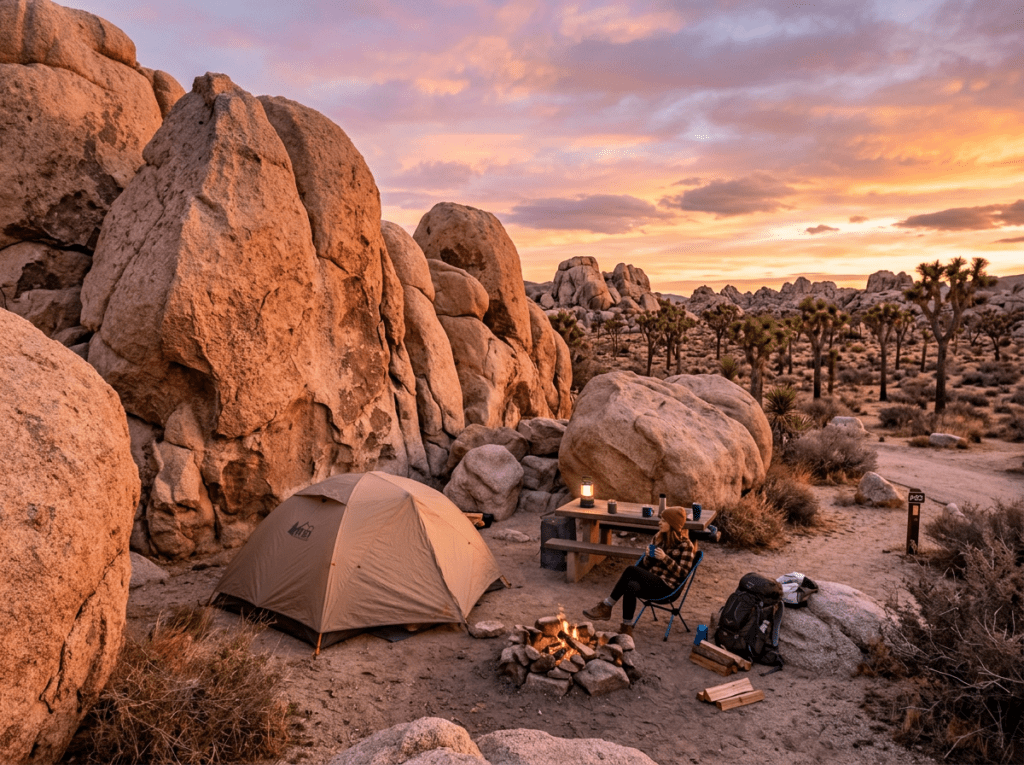
For campers, Jumbo Rocks Campground is the most photogenic inside the park — set directly among the boulder formations in the heart of the Wonderland of Rocks, with campsites surrounded by the granite that defines the landscape. Hidden Valley Campground is the most centrally located. Both are first-come, first-served and fill quickly on fall and spring weekends. Black Rock and Cottonwood campgrounds accept reservations through recreation.gov. RVs up to 35 feet are accommodated at most campgrounds, though some sites in the boulder areas have size restrictions.
If I Were Planning My First Visit
I would arrive in the late afternoon and drive the park road from west to east — not to photograph yet, but to see it. To understand the layout, to find the boulder formations I want to return to before dawn, to let the strangeness of the plant life settle in. The Joshua trees at their most surreal in the low afternoon light, before I have put a camera to any of them. The first look deserves to be just a look.
I would be at Skull Rock or Hidden Valley before first light the next morning — among the boulders with a wide angle and a low position, waiting for the sun to clear the Pinto Mountains to the east and begin raking across the granite. Then Keys View at sunrise for the valley below. Then back to the desert for the cholla cactus garden in the morning light — the teddy bear cholla backlit by the low eastern sun is one of the more extraordinary plant photography subjects in the park, the fine spines catching the light and turning each cactus into something that glows.
And on a moonless night I would stay in the park after dark. Jumbo Rocks, away from the highway, with the boulder formations as foreground and the Milky Way building overhead. That is the image I drove past without making on the first visit. It is the image this park is waiting for me to come back and make properly.
The Light I’m Curious About
All three of them, if I am honest about it.
The Milky Way over the Joshua trees is the iconic image and I want to make it properly — wide angle, long exposure, the twisted silhouettes against the galaxy, the boulders as foreground weight. That image exists in a hundred photographers’ portfolios and I want to understand from inside the making of it what those hundred photographers understood.
The dawn light on the boulder fields is the one I am most technically curious about — the way the low sun builds texture and shadow into granite that the midday light makes completely flat. I drove through this park at the worst possible hour and saw the flat version. The textured version, in the first thirty minutes of direct light, is what I am going back for.
And the storm light is the one I cannot plan for, only hope for. Rain on a Mojave Desert landscape that receives less than five inches a year. The Joshua trees in the strange pre-storm light, the granite boulders going dark under a cloud bank, and then the break — the sun finding a gap and illuminating a section of the desert while the storm moves east. Growing up in Florida, I am not unfamiliar with dramatic weather. But dramatic weather over a landscape this alien and this spare is something I have not experienced. I am looking forward to finding out what it looks like.
A Deeper Exploration
This article is part of my ongoing project documenting and photographing all 63 national parks across the United States.
Along the way, I’m creating deeper guides that explore photography locations, travel planning, seasonal light conditions, and personal reflections from the road. Joshua Tree sits at the intersection of two deserts and two very different photography moods — the intimate boulder-and-tree work of the Mojave section and the spare, open expanse of the Colorado Desert to the east. One park, two landscapes, and a dark sky above both of them that I have not yet given the time it deserves.
Because some parks do not reveal themselves to people driving through at midday. They save their best light for the photographers who come back at the right hour and stay long enough to earn it.
One more thing – just between us.
Joshua Tree’s reputation for boulder photography and dark sky work draws a knowledgeable crowd to the main park roads and the established astrophotography positions. Here are three places where the park reveals something different.
The Lost Palms Oasis trail — a 7.5-mile round trip from the Cottonwood Spring trailhead in the park’s southern section — reaches the largest group of native California fan palms in the park, tucked into a canyon that the surrounding desert gives no indication exists. The palms in the canyon in the morning light, with the desert floor above and the palm fronds catching the low sun from below the canyon rim, is the Joshua Tree image that the boulder fields and the yucca trees cannot provide.
For the desert wildflower superbloom that the park occasionally produces in years of exceptional winter rainfall, the Cholla Cactus Garden near the park’s center — a dense concentration of teddy bear cholla cacti in a flat wash — catches the backlit morning light in a way that makes each cactus appear to glow from within. The cholla in backlight at 7am, with the Pinto Mountains behind and the desert floor surrounding the dense cluster, is one of the park’s most distinctive and most underutilized photography compositions.
And for the Joshua Tree experience that most visitors organized around Palm Springs never explore, the small community of Joshua Tree town on the park’s northern edge has developed into a genuine desert arts community — independent galleries, the Integratron sound bath experience, and the high desert character that Palm Springs resort culture cannot offer. Worth an afternoon and a camera on the drive in or out.