A Photographer’s First Look at America’s Tallest Monument — and the City Park That Became a National Park
Some landscapes become part of our imagination long before we ever visit them. The Gateway Arch is one of those — a structure so familiar from photographs and highway views and the St. Louis skyline that it has become part of the American visual vocabulary in a way that makes actually visiting it feel like confirming something you already know.
Except that is not quite right. The photographs do not prepare you for the scale of it. The Arch rises 630 feet from the Mississippi riverfront — as tall as it is wide, a perfect catenary curve in stainless steel that from a distance looks almost delicate and up close is simply enormous. Eero Saarinen designed it in 1947 as a monument to westward expansion, to the role St. Louis played as the gateway through which the country moved itself across a continent. It was completed in 1965 and became a national park unit — the Gateway Arch National Park — in 2018, making it one of the newest parks in the system and one of the most unusual: a monument, a museum, and a stretch of urban riverfront all contained within the boundaries of a major American city.
I have not visited Gateway Arch as a national park. I have seen it from a distance — from a highway, from across the river, the way most people encounter it. Seeing it properly, on foot, with a camera and an intention to understand what it actually is as a photography subject, is a different proposition. This is the park in the 63-park series that most challenges the conventional definition of what a national park is supposed to be — and that challenge is worth engaging honestly.
The Landscape That Draws People Here
Gateway Arch National Park occupies 91 acres of St. Louis riverfront — the smallest national park in the system by area and the only one located entirely within a major urban center. The park contains the Arch itself, the Museum at the Gateway Arch beneath it, and the grounds extending to the Mississippi River. The view from the Arch grounds looking west toward the St. Louis skyline, and looking east across the river to Illinois, constitutes the park’s primary landscape.
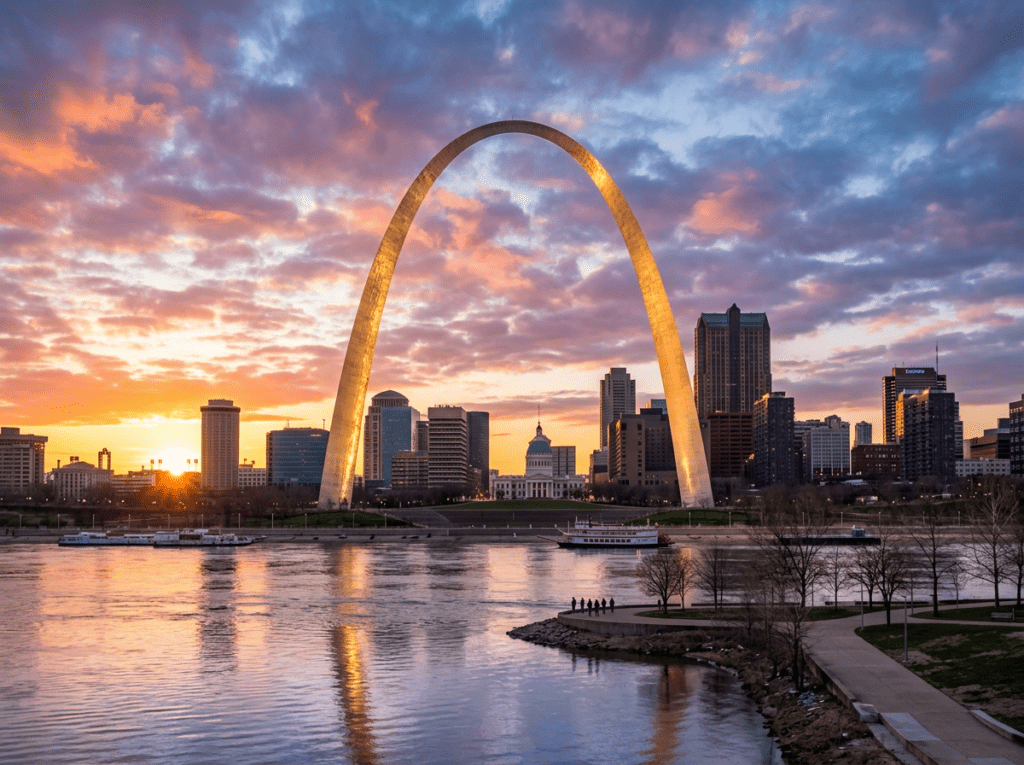
The Arch is an architectural photography subject more than a landscape one — which makes it genuinely unusual in a series focused on natural light and geological drama. But architectural photography has its own light logic, and the Arch engages that logic in ways that are specific and remarkable. The stainless steel surface reflects the sky and the surrounding environment continuously — the Arch in morning light looks different from the Arch at midday looks different from the Arch at sunset looks different from the Arch in a thunderstorm. The structure changes color and character with the sky above it, which means the photography changes completely depending on when you are there.
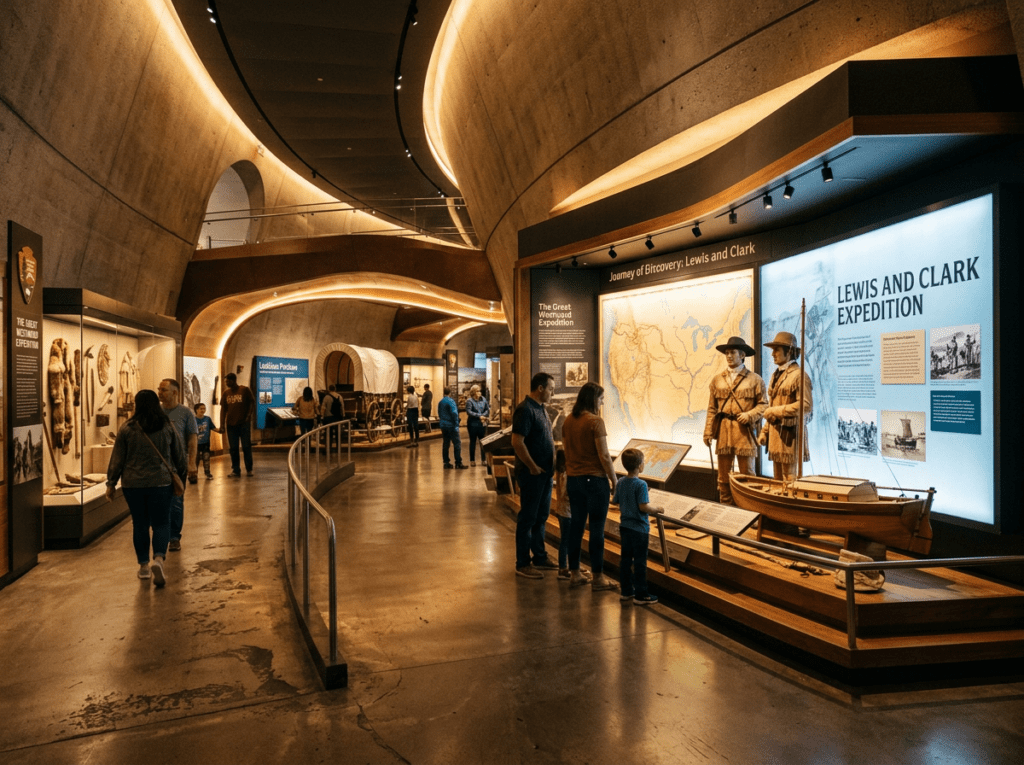
The Museum at the Gateway Arch, beneath the structure, is one of the finest history museums in the national park system — a complete redesign opened in 2018 that tells the story of westward expansion, the Lewis and Clark Expedition, the displacement of Native peoples, and the role of St. Louis in American history with a depth and honesty that the monument above earns rather than assuming. Spending two hours in the museum before going above ground to photograph the Arch changes what you see when you look at it — the same way that understanding Mesa Verde’s archaeology changed what I saw at the cliff dwellings.
The Photographer’s Chase
The Arch is a subject that rewards multiple visits at different times of day — and given its urban location and the absence of any timed entry requirement, multiple visits in a single trip are entirely practical. The photography priorities change by the hour in ways that most natural landscape parks do not.
Sunrise from the east bank of the Mississippi — from the Illinois side, looking west across the river — is the classic architectural composition. The Arch catches the morning light on its eastern face, the St. Louis skyline fills the background, and the river provides the foreground. The Malcolm W. Martin Memorial Park in East St. Louis provides this view from a slight elevation that makes the full Arch visible above the river surface. It is a five-minute drive across the Poplar Street Bridge and it delivers the photograph that the western bank cannot — the Arch in morning light with the city behind it, framed by the river.
From the park grounds on the western bank, the close-range Arch photography is about geometry and scale. Looking straight up from the base of either leg, the curve of the stainless steel rising to its apex 630 feet above produces a vertiginous upward perspective that communicates the structure’s scale in a way no distant shot can. A wide angle — 16mm or wider — from the base of a leg, pointed straight up at the apex, with the sky framed inside the curve, is the intimate Arch photograph that the riverfront wide shot cannot produce.
The tram ride to the Arch summit — a four-minute journey in a pod-shaped tram through the structure’s interior — reaches a viewing area 630 feet above the riverfront with windows on both sides. The views from the top are extraordinary and the photography is challenging — the windows are small, the crowds press against them, and the light is rarely ideal. But the perspective of St. Louis spreading westward from the summit, and the Mississippi River and the Illinois floodplain spreading eastward, communicates the gateway concept in a way that no ground-level photograph can. The summit is the view the monument was designed to provide. Worth experiencing even when the photography is imperfect.
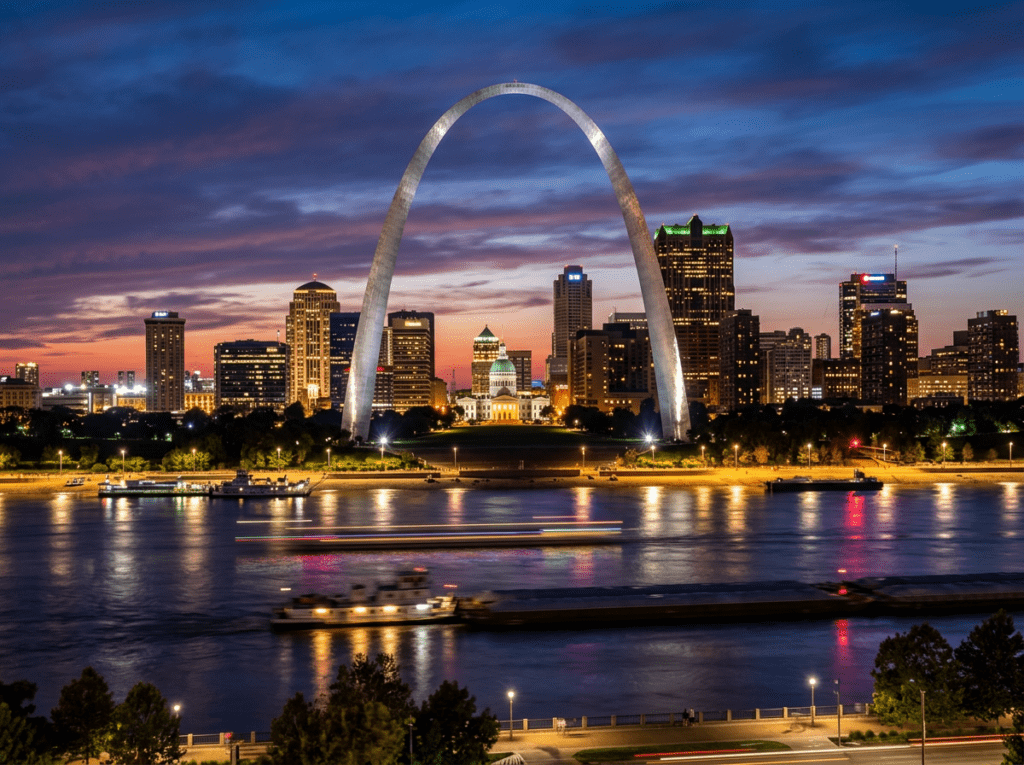
The Arch at night is the photography subject that most visitors overlook and that is arguably the most visually distinctive condition the structure offers. The stainless steel reflects the city lights — the St. Louis skyline, the bridge lights, the reflected glow of the urban environment — in a way that the daylight hours cannot produce. A long exposure from the riverfront at blue hour, when the sky retains enough color to balance with the artificial light on the structure, produces an image of the Arch that looks nothing like any daylight photograph and is entirely specific to this setting in this city.
Visiting the Park
Gateway Arch National Park is open year-round and free to enter the grounds — the park entry itself has no fee. The Museum at the Gateway Arch has an admission fee, and the tram ride to the summit requires a separate timed ticket purchased through the park’s ticketing system at gatewayarch.org or on-site. Tram tickets sell out on busy summer and holiday weekends; booking in advance is recommended for those who want the summit experience.
The park is accessible year-round and the photography conditions change meaningfully by season. Summer brings the dramatic thunderstorms that move across the Missouri and Mississippi river valleys — the Arch in a storm, with dark clouds building behind the stainless steel and lightning visible over the Illinois flatlands, is one of the most dramatic architectural weather photographs available in the national park system. Fall brings the clearest air quality of the year and the best light for the sunrise compositions from the east bank. Winter reduces the crowds and occasionally brings snow to the riverfront, with the Arch against a gray winter sky in a way that has its own spare beauty.
St. Louis is easily accessible — Lambert-St. Louis International Airport is a major hub with direct flights from most American cities. The park is about 15 minutes from the airport and walkable from several downtown hotels. A Gateway Arch visit combines naturally with a broader St. Louis experience — the city has genuinely excellent food, the City Museum, Forest Park and the St. Louis Art Museum, and the Anheuser-Busch Brewery tour for those who want a full day or two beyond the park.
Where to Stay
Downtown St. Louis hotels put the park within walking distance and eliminate any transportation complexity around the early morning sunrise shoots or the blue hour evening sessions. The Hilton St. Louis at the Ballpark and the Marriott St. Louis Grand both sit within a short walk of the park grounds. The Angad Arts Hotel in the Grand Center arts district is the most characterful option in the city — an art hotel with individually designed rooms and a position in the city’s creative neighborhood.
For photographers specifically, a riverfront hotel — the Hyatt Regency St. Louis at The Arch sits immediately adjacent to the park — provides the most direct access to the pre-dawn riverfront positions. Being able to walk out of the hotel at 5am and be at the east bank viewing position before sunrise is the same practical advantage as staying at a rim lodge in a natural park. Proximity changes the photography.
There is no camping at Gateway Arch — this is an urban national park and the overnight experience is entirely hotel-based. RV travelers will find campgrounds in the broader St. Louis metro area; the KOA St. Louis West in Eureka is about 30 miles from the park with full hookups and a manageable drive to the riverfront. For a park visit that is primarily a day trip within a broader road trip itinerary, St. Louis fits naturally into a Midwest routing without requiring an overnight stay.
If I Were Planning My First Visit
Two full days in St. Louis, based downtown within walking distance of the park. The first morning: east bank before sunrise, camera on a tripod at the Malcolm W. Martin Memorial Park in East St. Louis, waiting for the light to hit the Arch’s eastern face. The first afternoon: the museum, unhurried, two hours minimum to understand what the monument is actually commemorating. Then the tram to the summit before the last light leaves the city.
The first evening: blue hour from the riverfront. Tripod on the grass, long exposure, the city lights coming up on the Arch surface and the river picking up the color of the sky. Staying until the light is completely gone.
The second day for the close-range geometry work — the upward wide angle from the base of the leg, the abstract curve of the stainless steel against the sky, the human figures at the base for scale. And if the weather threatens storms in the afternoon, staying for them. The Arch in a Missouri thunderstorm is a photography condition that no clear-sky visit can replicate.
The Light I’m Curious About
It is the storm light — the specific condition of a Missouri Valley thunderstorm building over the Illinois flatlands while the Arch stands in the last direct sun before the front arrives.
The stainless steel surface of the Arch reflects whatever the sky is doing, which means a dramatic sky produces a dramatic structure in a way that clear blue sky cannot. The dark anvil cloud of a Midwest thunderstorm reflected in 630 feet of polished steel, with the last warm light of the pre-storm sun illuminating the Arch’s western face while the eastern face goes dark under the approaching front — that is the Gateway Arch photograph that does not appear in any tourism brochure. It requires being there when the weather arrives rather than retreating to the hotel when the forecast looks uncertain.
This is an urban national park, which means the photography is architectural rather than natural — but the light that falls on the Arch is the same light that falls on every other park in this series. It changes by the hour, by the season, by the weather. The Arch in the right light is as compelling as any landscape I have planned to photograph in this project. I am going to find out what that light looks like in person.
A Deeper Exploration
This article is part of my ongoing project documenting and photographing all 63 national parks across the United States.
Along the way, I’m creating deeper guides that explore photography locations, travel planning, seasonal light conditions, and personal reflections from the road. Gateway Arch is the park that most challenges the definition of what this project is about — and the challenge is worth taking seriously. Light falls on stainless steel the same way it falls on sandstone. The photography is different. The intention is the same.
Because every park in this series is asking the same question: what does this place look like when the light is right? The Arch has an answer. I am going to St. Louis to find it.
One more thing — just between us.
Gateway Arch is an urban park and the crowds are baked into the setting — but here are three ways to find your own version of the St. Louis riverfront experience with a little more room to work.
The Malcolm W. Martin Memorial Park in East St. Louis on the Illinois side of the river is where the serious Arch photographers set up for sunrise — the west-facing view of the Arch with the St. Louis skyline behind it, across the Mississippi, is the composition the park grounds themselves cannot provide. It is a five-minute drive across the bridge and almost always empty at 5am.
For something completely different in the same city, Forest Park — larger than Central Park, free to enter, and home to the St. Louis Art Museum, the Missouri History Museum, and the Jewel Box greenhouse — is the city park that most visitors to the Arch never find. The park in fall color at golden hour is a genuinely strong landscape photography subject within a major American city.
And for a riverfront experience with a completely different character, the Cahokia Mounds State Historic Site — 15 minutes east of St. Louis in Illinois — is a UNESCO World Heritage Site protecting the remains of the largest pre-Columbian city north of Mexico, inhabited by up to 20,000 people at its peak around 1100 AD. The Monks Mound at sunrise, with the St. Louis skyline visible on the western horizon, is the ancient American history photograph that almost no one thinks to make on a Gateway Arch trip. A small club. Worth joining.