A Photographer’s First Look at Minnesota’s Water Wilderness — Boats, Northern Lights, and the Landscape That Moves by Paddle
Every photographer eventually builds a list of parks they have confused with each other. Voyageurs National Park and Isle Royale National Park share enough surface characteristics that the confusion is understandable and common. Both sit at the top of the Midwest. Both require a boat to access the interior. Both have the mosquitoes that the northern lake wilderness produces in June and July. Both sit under dark skies that produce the aurora photography that brings serious photographers to the upper Midwest specifically.
The distinction worth understanding before arrival is one of character. Isle Royale is a wilderness island you earn through logistical commitment and demanding travel. Voyageurs is a waterway you explore — a network of four large lakes connected by portages and channels along the Minnesota-Canada border, more accessible overall, and organized around a water travel culture that the island park cannot offer. Where Isle Royale feels like a remote wilderness destination that selects for serious commitment, Voyageurs feels like a northern lake landscape you can enter at different levels of ambition — from a day trip powerboat tour to a multi-day canoe expedition to a houseboat rental that puts a floating home at the center of the lake system for a week.
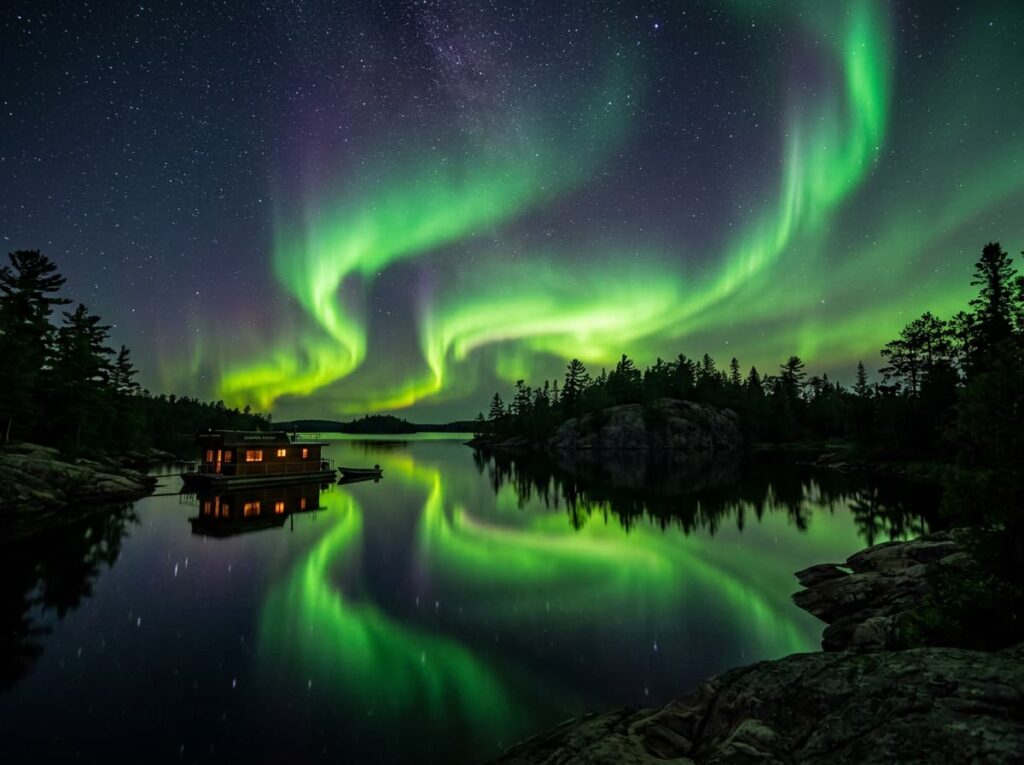
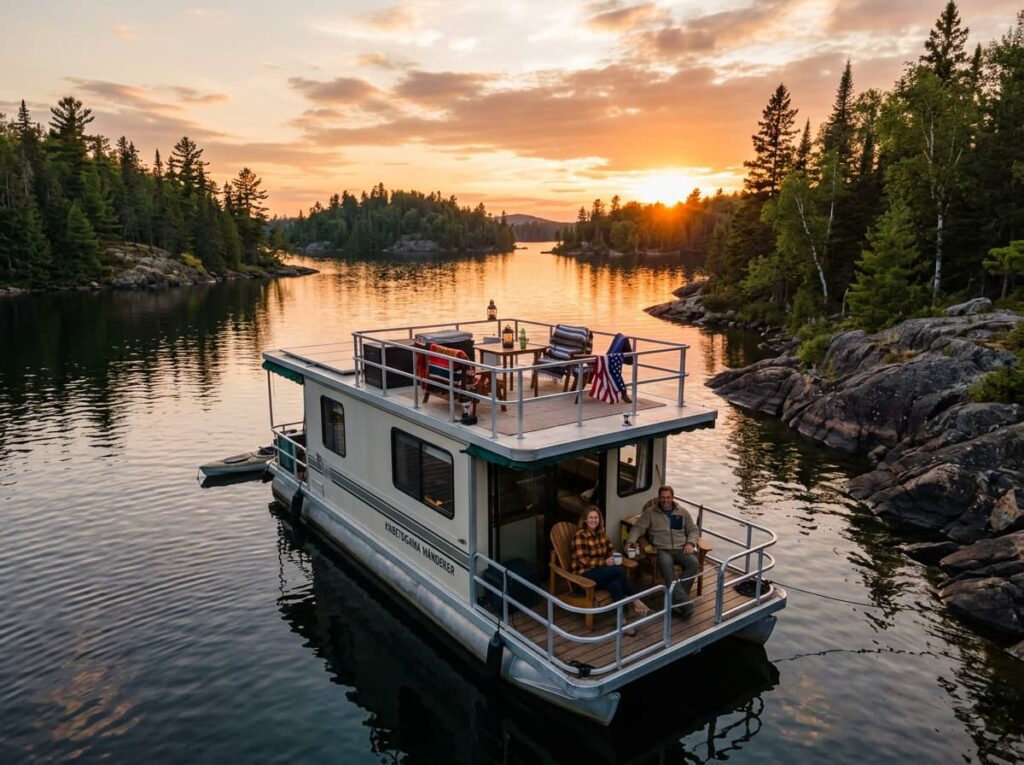
The houseboat is the specifically Voyageurs experience that no other national park in the system offers. Renting a houseboat and living on the lake for several days — moving between anchorages, watching the aurora from the deck at night, photographing the sunrise over the Canadian Shield rock formations from the water — is the Voyageurs visit that photographers who know the park describe as one of the most distinctive experiences in the national park system. It is also the experience that the mosquito concern cannot diminish, because you are on the water and the insects are on the shore.
The Landscape That Draws People Here
Voyageurs National Park covers 218,000 acres of the Rainy Lake watershed in northern Minnesota, immediately south of the Ontario border. The park is named for the French-Canadian voyageurs who paddled the fur trade routes through this lake system in the 18th century, carrying trade goods and beaver pelts in birchbark canoes along the same water corridors that park visitors travel today. The landscape they moved through is essentially unchanged — the ancient Canadian Shield rock of the Precambrian basement exposed at the surface, the boreal forest of spruce, fir, and aspen covering the islands and the mainland, and the lake system that connects it all.
The four main lakes — Rainy Lake, Kabetogama Lake, Namakan Lake, and Sand Point Lake — are accessible by car to the four visitor centers on the park’s southern shore. From those visitor centers, all further access is by water. The park contains more than 500 islands and 900 miles of shoreline, the majority of it accessible only by boat or canoe. The Kabetogama Peninsula, the large land mass at the park’s center, has no roads and no trails accessible from outside the water — it is a genuine roadless wilderness at the heart of an otherwise accessible park.
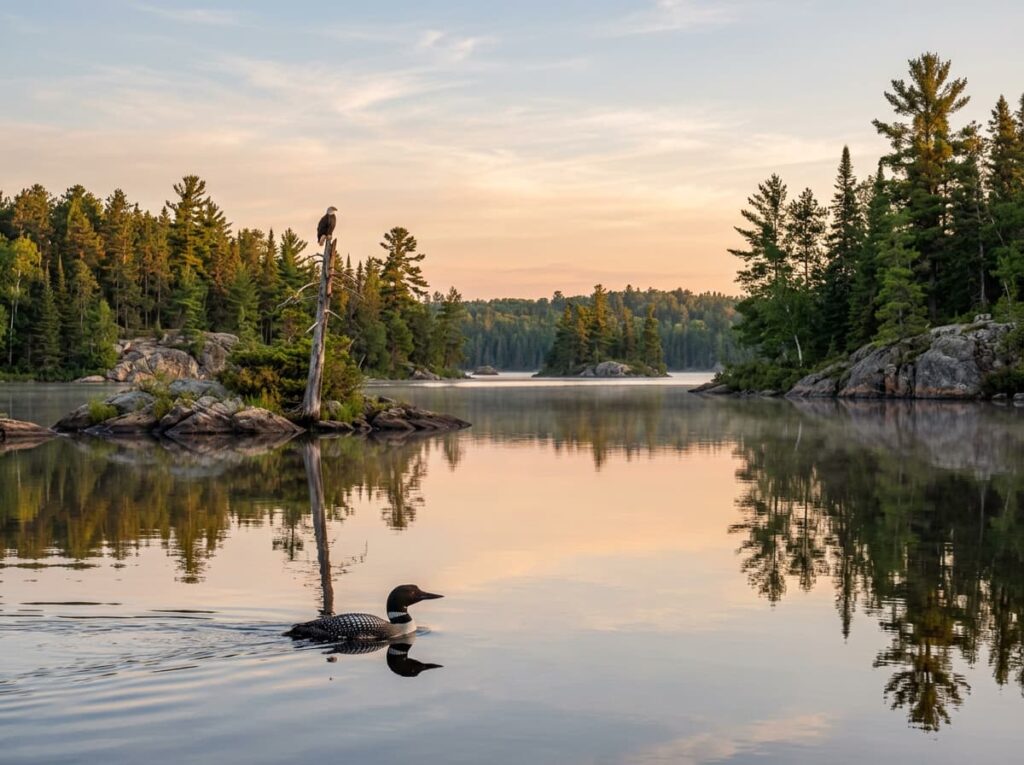
The wildlife is the full northern lake portfolio — the common loon calling across the water at dawn in densities that rival Isle Royale, bald eagles nesting in the tall white pines along the shoreline, osprey fishing the clear lake water, black bears on the islands, white-tailed deer on the mainland shores, and the wolves of the Kabetogama Peninsula that are heard more often than seen. The moose population, while smaller than in Isle Royale or the Boundary Waters to the east, is present in the park and visible from the water in the lake shallows where they feed in the early morning.
The Photographer’s Chase
The aurora photography is the primary reason photographers travel specifically to Voyageurs, and the houseboat is the platform that makes it most accessible. Anchored in an open bay away from the visitor center shoreline lights, lying on the houseboat deck at midnight with the lake surface still below and the northern lights building above the Canadian tree line, is the Voyageurs photography experience that the park’s proximity to the Minnesota-Canada border and the dark sky quality of the lake system enables. The Kp index forecasting that applies to Isle Royale applies equally here — a Kp of 4 or higher is the threshold for visible aurora at Voyageurs’ latitude, and the lake surface provides the reflection element that makes the photograph more than a sky shot.
The water level photography is the discipline that distinguishes Voyageurs from every land-based park in this series. A camera at water level from a kayak or a canoe in the early morning, shooting across a still lake surface toward the sunrise and the boreal forest reflected in the water, produces a compositional intimacy with the landscape that no shoreline position can match. The Canadian Shield rock formations along the waterline — the ancient pink and gray granite, 2.7 billion years old, polished by glaciation to smooth curves at the waterline — are the geological foreground subject that the water level reveals and the land approach cannot.
The loon photography at Voyageurs is among the finest available in the national park system. The park’s loon nesting density is exceptional, and the early morning lake, before the powerboat traffic develops, provides the calm surface and the quiet that produces the loon pair reflections that have defined the visual identity of the Minnesota north woods for generations. A 500mm or longer lens from a stable kayak position, shooting toward a loon pair in the blue-gold light of early morning with the boreal forest reflected below them, is the image that requires exactly the patience and the water access that Voyageurs provides.
The winter photography at Voyageurs is the season that very few visitors ever see and that produces some of the most distinctive images in the park’s visual catalog. When the lakes freeze — typically by January — the park operates an ice road system across the frozen lake surface, and the landscape transforms from water wilderness to frozen plain with the boreal forest islands standing above the ice. The aurora above the frozen lake, with the ice road tracks visible on the surface and the tree line dark against the northern lights, is a Voyageurs image that the summer visit cannot produce.
Visiting the Park
Voyageurs is accessible by car to the four visitor centers on its southern boundary — the Rainy Lake Visitor Center near International Falls, the Kabetogama Lake Visitor Center, the Ash River Visitor Center, and the Crane Lake access point. All four are reachable by paved road from US-53, the primary highway connecting the park to Duluth and the Twin Cities. The drive north from Minneapolis to International Falls takes about four hours and passes through the transition from agricultural Minnesota to boreal lake country in a progression that is worth watching.
The primary season runs from late May through September when the water is open, the NPS boat tours operate, and the houseboat rentals are available. June and July bring the maximum wildlife activity and the maximum mosquito activity simultaneously. August and September provide the transition to fall — the blueberries ripening on the islands, the first fall color beginning in the aspen groves, the mosquitoes thinning, and the aurora season beginning in earnest as the nights lengthen. September is the photography sweet spot by most accounts.
No timed entry reservations are currently required for the visitor centers or the day use areas. The houseboat rentals are handled by private operators and book out months in advance for peak summer season — this is the reservation that sets the entire trip plan and should be secured first. The NPS operates interpretive boat tours from the visitor centers during the operating season, providing water access for visitors without their own boats.
Where to Stay
The houseboat rental is the accommodation that defines the Voyageurs experience. Several licensed operators rent houseboats from the Kabetogama and Rainy Lake areas — Voyagaire Lodge and Houseboats on Kabetogama Lake and Northernaire Houseboats on Rainy Lake are the established operators. The houseboats range from basic to fully equipped with kitchens, sleeping berths for six to eight people, and the deck space that makes the aurora and the sunrise photography practical without leaving the vessel. A four to seven day houseboat trip covers the main lake system at a pace that allows genuine exploration rather than hurried transit.
For land-based visitors, the gateway communities provide lodging close to the visitor centers. International Falls, on the Rainy Lake western end, is the largest community and the natural base for the western park access. Kabetogama and Ash River are smaller communities with lodge and cabin rentals that provide the northern Minnesota lake resort character. The Kettle Falls Hotel, inside the park on the Kabetogama Peninsula and accessible only by water, is the most distinctive in-park lodging — a historic 1910 hotel that has been operating on the waterway since the logging era and provides the overnight island experience without the camping commitment.
For RV travelers, the Woodenfrog State Forest Campground on Kabetogama Lake and the Ash River Campground provide hookup options adjacent to the park. The park’s own campgrounds are boat-access only. RV travelers with a boat or kayak can base in a lakeside campground and access the water daily — the combination of RV camping comfort and daily water access is a practical Voyageurs approach.
If I Were Planning My First Visit
A five-day houseboat rental in September — booked as early in the year as possible, before the summer demand clears the available dates. The aurora forecast monitored daily from the booking confirmation forward. The Kp index app on the phone, checked at midnight every clear night from the houseboat deck.
The kayak launched from the houseboat each morning before sunrise — in the water before the powerboat traffic begins, moving slowly along the Canadian Shield shoreline in the blue hour light, the camera at water level and the loons active in the stillness. That is the Voyageurs morning that the land-based visitor cannot access.
The Kettle Falls Hotel for one dinner — the waterway route to the historic lodge, the meal in the dining room that has been feeding lake travelers since 1910, and the return to the houseboat in the last light. A connection to the voyageur history that the paddling and the portaging culture of this waterway represents.
And the aurora night — the night the forecast says go outside, the deck cleared for the tripod, the wide angle pointed north across the lake. The same northern lights that Isle Royale offers, from a floating platform on a Minnesota lake, with the water below holding the second sky. That is the Voyageurs photograph. The houseboat makes it possible. The patience makes it happen.
The Light I’m Curious About
It is the early morning lake surface light — the specific stillness of a Voyageurs bay at 5am in September before any wind has developed, when the boreal forest and the Canadian Shield rock are reflected in water so still it produces a perfect vertical mirror of the world above.
The lake surface photography at Voyageurs is the water level version of the mountain reflection photography that parks like Grand Teton and North Cascades produce from the shore. The difference is that at Voyageurs you can be on the water in a kayak, at the level of the reflection rather than above it, with the camera six inches from the surface and the reflected forest filling the lower half of the frame and the actual forest filling the upper half. The seam between the two worlds — the still water surface that creates the reflection — disappears in the photograph and the world doubles itself.
That light requires the houseboat and the kayak and the 5am alarm and the September timing when the lake is most likely to be still. It also requires the patience to be on the water before the sun arrives and to wait for the moment when the light and the stillness align. Voyageurs has been producing that moment every September morning for longer than anyone has been there to photograph it. The plan is to be there for the next one.
A Deeper Exploration
This article is part of my ongoing project documenting and photographing all 63 national parks across the United States.
Along the way, I am creating deeper guides that explore photography locations, travel planning, seasonal light conditions, and personal reflections from the road. Voyageurs is the water park this series has been missing — a landscape that exists primarily on the surface of lakes rather than on the land beside them, and that requires a boat not as a transportation inconvenience but as the fundamental unit of the experience.
Because the voyageurs paddled this waterway for a century before it became a national park. The water is the same. The Canadian Shield rock is the same. The loons are calling across the same lake surfaces in the same September mornings. The houseboat is a more comfortable version of the birchbark canoe. The aurora was always there.
One more thing — just between us.
Voyageurs already runs quiet relative to the more accessible national parks, but the lake system rewards the visitor who explores beyond the main channels. Three places worth knowing.
The Boundary Waters Canoe Area Wilderness — immediately east of the park in the Superior National Forest — is the most visited wilderness area in the United States and the natural eastern extension of the Voyageurs water system. A combined trip using Voyageurs as the houseboat base and adding a two or three day Boundary Waters canoe day trip provides the full northern Minnesota lake wilderness experience. The permit system for the Boundary Waters is separate from Voyageurs and opens in January for the coming season at recreation.gov.
International Falls — the gateway city on the Rainy Lake western end — earns its nickname as the Icebox of the Nation in winter, but in September it is the practical base for the Rainy Lake western access and the border crossing into Fort Frances, Ontario for a Canadian day trip that adds the international waterway character to the visit.
And for the aurora photography preparation that applies equally to Voyageurs and Isle Royale, the NOAA Kp index forecast is the same tool — check it nightly from the houseboat deck. When it says the aurora is coming, clear the deck and point the camera north. The lake will handle the reflection.