A Photographer’s First Look at New Mexico’s White Gypsum Dunes — and Why This Place Looks Like Nowhere Else on Earth
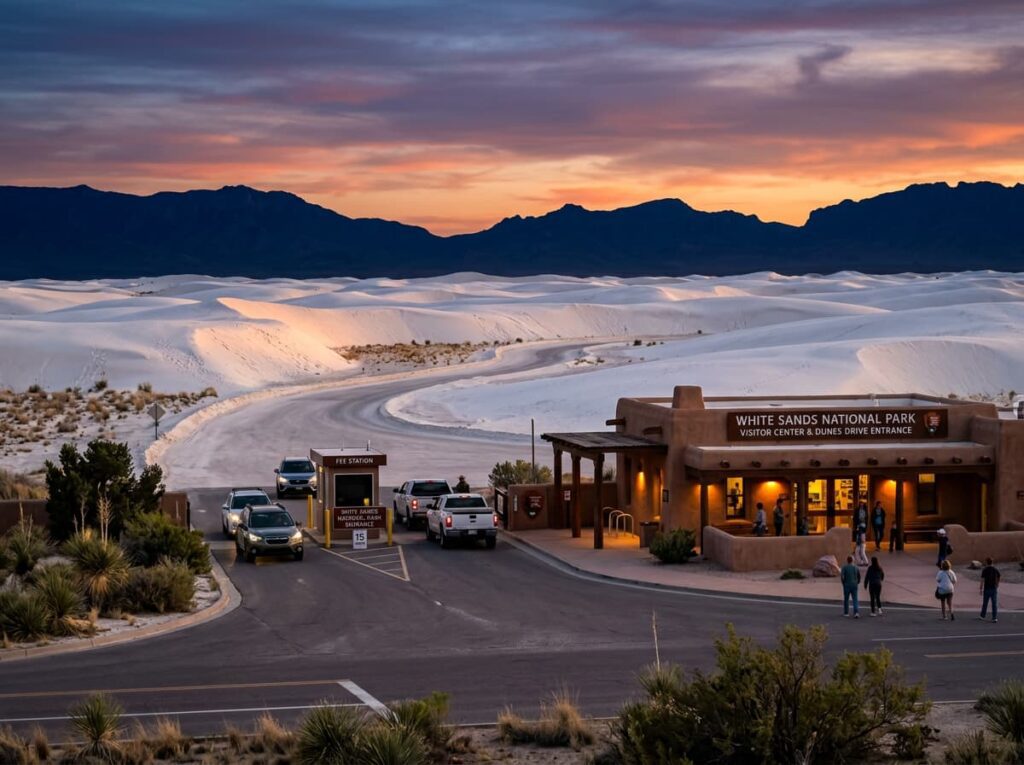
When planning a visit to America’s national parks, some destinations require no prior knowledge to understand immediately upon arrival. White Sands National Park in southern New Mexico is one of those places. The moment the Dunes Drive enters the gypsum dune field and the landscape goes from the tan desert scrub of the Tularosa Basin to pure white in every direction, the park explains itself. There is nothing else that looks like this.
White Sands protects the largest gypsum dune field in the world — 275 square miles of brilliant white sand in the Tularosa Basin between the San Andres Mountains to the west and the Sacramento Mountains to the east. The gypsum comes from the dissolution of selenite crystals in the surrounding mountains, carried by water into Lake Lucero at the basin’s lowest point and deposited as the lake evaporates. The wind picks up the dried gypsum crystals and moves them northeast across the basin in an active dune field that advances up to 30 feet per year. The result is a landscape that is technically a desert but looks nothing like one — white, clean, sculpted by wind into forms that change with every storm, and completely unlike the tan and red and ochre of every other desert park in the system.
The comparison to Great Sand Dunes is the right instinct and the distinction is worth understanding before arrival. Great Sand Dunes is about scale and the improbable combination of dunes against mountain. White Sands is about color — or rather the absence of it — and the way that pure white sand responds to light in a way that tan sand cannot. The photography at White Sands is not the shadow-building raking light discipline of Great Sand Dunes. It is the color temperature discipline of a white surface that turns pink at dawn, gold at sunset, blue in the hour before dark, and blinding white the moment the midday sun arrives. Each color window is brief. Each one is worth arriving early for.
The Landscape That Draws People Here
White Sands National Park sits in the northern end of the Chihuahuan Desert in Otero County, New Mexico, about 15 miles west of Alamogordo and 75 miles northeast of El Paso. The park shares the Tularosa Basin with the White Sands Missile Range, the active military testing facility that surrounds the park on multiple sides and occasionally closes US-70 through the basin for missile testing. This closure is not rare — it happens regularly and can last two to three hours. Checking the White Sands Missile Range testing schedule at wsmr.army.mil before driving US-70 is a practical step for any visit.
The dune field contains several ecological communities that survive in a gypsum environment. The cottonwood, skunkbush sumac, and Rio Grande cottonwood trees that persist in the active dune field are partially buried by advancing sand and have adapted to grow upward as the dunes move over them, producing the pedestaled plant formations — trees elevated on sand pedestals as the wind erodes the sand around their roots — that are specific to White Sands and photogenic in a way that the pure dune field cannot be.
The wildlife that survives the gypsum environment includes several species that have evolved white coloration as camouflage — the bleached earless lizard, the white Apache pocket mouse, and the white sands pupfish in the remnant pools near Lake Lucero. The evolutionary adaptation of these species to the white environment is one of the most rapid and most documented examples of natural selection in North America, visible in the contrast between the white-phase animals in the dune field and the darker relatives of the same species in the surrounding desert.
The Photographer’s Chase
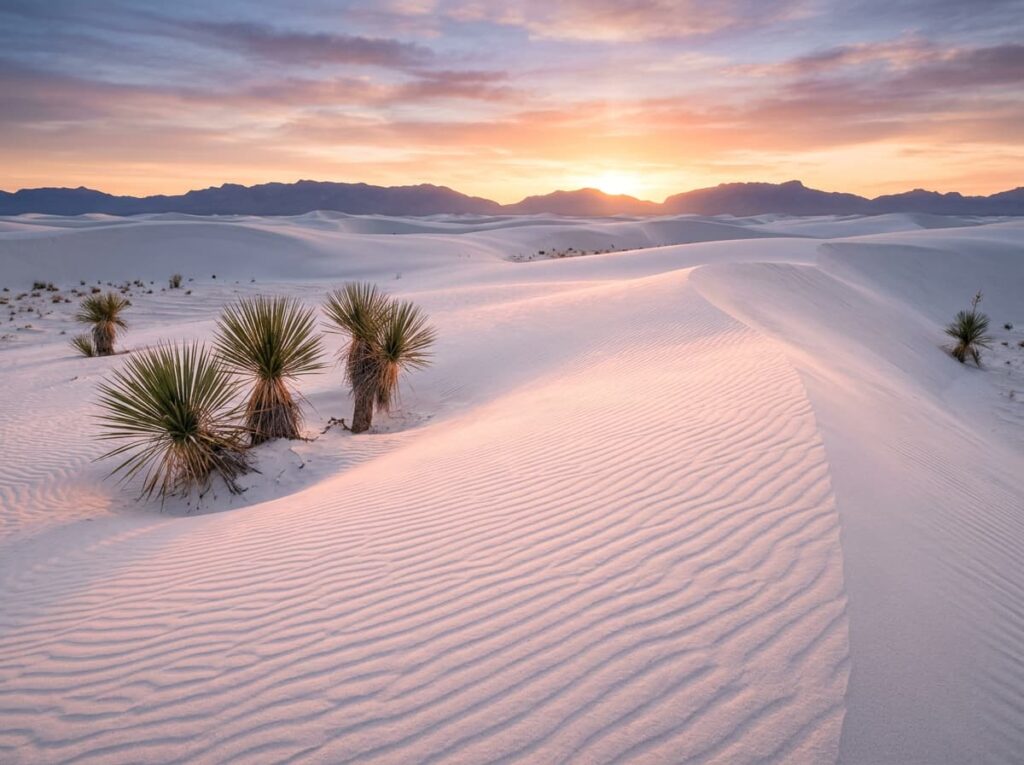
The color temperature windows are the photography discipline at White Sands and they are more numerous and more varied than at Great Sand Dunes. The pure white gypsum acts as a reflector for whatever light is above it — at blue hour before dawn the dunes go a cool blue-white. As the first light arrives from the east they turn pink and then gold. In the hour after sunrise the shadow patterns build into the rippled dune faces in a way that looks very different from tan sand because the white surface makes the shadows appear purple and blue rather than brown. By midday the dunes are featureless white and the photography suffers the same fate as midday anywhere. And in the last hour of the day the cycle reverses — the gold returns, then the pink, then the blue of last light.
The sunset from within the dune field is the most famous photography condition at White Sands — specifically the pink and gold light that saturates the white sand in the last thirty minutes of direct sun. The Interdune Boardwalk and the Alkali Flat Trail positions on the western end of the Dunes Drive provide the open sightlines for the sunset compositions. The NPS offers sunset stroll programs that put a ranger in the dune field at the right time with interpretive context — a useful orientation for a first visit even for experienced photographers.
The pedestaled plant photography is the intimate subject that rewards slow movement through the dune field on the backcountry trails. The soaptree yucca plants partially buried in the advancing dunes, their bases exposed on sand pedestals as the wind erodes the softer sand around the harder root mass, are specifically White Sands subjects. A wide angle from ground level looking up at a yucca pedestal with the dune field behind it produces the scale and the strangeness of the adaptation in a single composition.
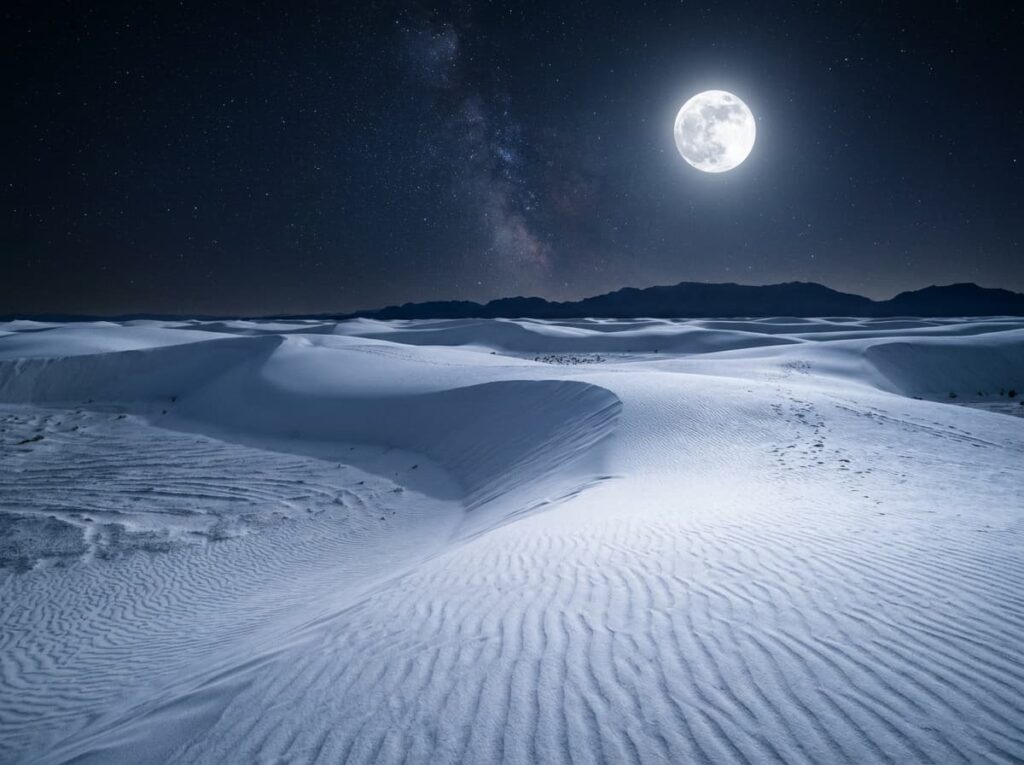
The full moon nights at White Sands are the photography event that the park specifically programs around — the NPS holds Full Moon Night programs during summer months when the park stays open after dark and the full moon illuminates the white dune field in a silver light that has no equivalent in daytime photography. The dunes under full moon are a genuinely different subject from the dunes at dawn or sunset — cooler, more ethereal, the shadow patterns softer and the white surface taking on a luminosity that the direct sun cannot produce. Full Moon Night program dates are available at nps.gov/whsa and sell out quickly.
Visiting the Park
White Sands is open year-round with the caveat of the missile range road closures on US-70. The standard closure lasts two to three hours and the schedule is posted in advance at wsmr.army.mil — checking it the day before and the morning of any visit prevents the frustration of arriving at a closed highway. The park itself does not close during missile testing, but the main access road passes through the range and the closure affects entry timing.
The park became a national park in December 2019, elevated from national monument status. No timed entry reservations are currently required. The Dunes Drive, an 8-mile round trip into the heart of the dune field, is the primary access road. The backcountry camping permit allows overnight stays in the dune field — a specific and extraordinary experience in which the surrounding landscape goes dark and the white sand glows in the moonlight and the stars above the flat Tularosa Basin are the same quality of dark sky that the isolated New Mexico desert has always produced.
Spring and fall are the most comfortable visiting seasons. March and April bring the wildflowers in the surrounding desert scrub and moderate temperatures for extended time in the dune field. September and October provide the low-angle autumn light and the reduced crowds of shoulder season. Summer is hot — the white gypsum reflects the heat as effectively as it reflects the light — but the sunrise and sunset windows are so brief and so productive that summer visits with strict early morning and late evening discipline produce the park’s finest photography. Afternoon thunderstorms in the monsoon season produce the dramatic cloud formations above the white dune field that are worth staying for.
Where to Stay
There is no in-park lodging beyond the backcountry camping sites in the dune field. Alamogordo, 15 miles east, is the primary gateway city with the full range of chain lodging and the White Sands Missile Range Museum — a surprisingly good military history museum that contextualizes the Trinity Site and the missile testing history that shaped this corner of New Mexico. The Holiday Inn Express and White Sands Motel are the most convenient Alamogordo options for the pre-dawn park starts.
Las Cruces, about 60 miles south on I-25, provides a more complete range of lodging and the university city character that Alamogordo lacks. The drive from Las Cruces north on US-70 through the Organ Mountains and into the Tularosa Basin is one of the finer scenic approaches to any park in the system — the Organ Mountains in the morning light on the drive north are themselves a strong photography subject.
For RV travelers, the Oliver Lee Memorial State Park campground south of Alamogordo and the Alamogordo Roadrunner Campground both provide hookup options within a reasonable drive of the park. Backcountry camping in the dune field requires a permit from the visitor center, is limited to ten sites, and requires all food in bear-proof containers and all waste packed out — the most immersive White Sands experience available and worth the planning for photographers targeting the full moon or the pre-dawn blue hour.
If I Were Planning My First Visit
October, with a check of the missile range closure schedule before departure. Two nights in Alamogordo — close enough for the pre-dawn starts without the backcountry camping logistics of the first visit.
In the park at least an hour before sunrise on the first morning — in the dune field before the blue hour begins, in position on the Alkali Flat Trail or the backcountry loop before the pink light arrives. The sunrise color window lasts twenty minutes. Being there thirty minutes early is the only strategy.
The pedestaled yucca photography in the late morning when the overhead light is still low enough to reveal the plant forms. The Interdune Boardwalk for the ecology context and the intimate dune detail that the backcountry trails cannot access as quickly. Then back to the dune field an hour before sunset for the gold and pink that the park is most famous for.
And if a Full Moon Night program date aligns with the visit — that is the event worth building the trip around. The white gypsum under the full moon is the photography condition that exists nowhere else in the national park system. No other park offers white sand. No other park glows like this at night.
The Light I’m Curious About
It is the blue hour light — the specific cool blue-white quality of the dune field in the twenty minutes before the first direct sun arrives from the east, when the sky is bright enough to illuminate the gypsum but the sun has not yet crested the horizon.
The white gypsum in that light is not the warm gold of the sunrise photographs that appear in every White Sands image gallery. It is a cooler, stranger version of the same landscape — the dunes going blue-white against a deepening sky, the shadows in the ripple patterns appearing almost purple, the Sacramento Mountains on the eastern horizon still dark above the line where the sun is about to arrive.
That light is specific to the white gypsum and unavailable at Great Sand Dunes or any other dune park because tan sand does not go blue in pre-dawn light — it simply goes dark. The white surface makes the color temperature of the pre-dawn sky visible in the sand itself. It is a photography condition that requires arriving before the famous pink and gold, before the color most people come for, in the cold and the darkness before the show everyone knows about has started.
A Deeper Exploration
This article is part of my ongoing project documenting and photographing all 63 national parks across the United States.
Along the way, I am creating deeper guides that explore photography locations, travel planning, seasonal light conditions, and personal reflections from the road. White Sands is the park that pairs naturally with Great Sand Dunes in this series — two dune parks, two completely different sand materials, two completely different light disciplines. The comparison makes both parks more interesting and the visit to each more informed.
Because nowhere else in the national park system does pure white sand cover 275 square miles of high desert basin. The light that falls on it does things that tan sand cannot show. I am going to New Mexico to see what those things look like.
One more thing — just between us.
White Sands draws its visitors to the Dunes Drive and the main sunset positions — all of which deliver exactly what the photographs promise. Here are three extensions worth knowing.
Trinity Site — where the first atomic bomb was detonated on July 16, 1945, on the White Sands Missile Range — is open to the public twice a year on the first Saturdays of April and October. The ground zero marker and the original McDonald Ranch House where the bomb was assembled are open for self-guided tours on those two days. The photography of the historic site in the context of the surrounding Tularosa Basin, with White Sands visible to the north, is the human history layer that most park visitors never connect to the same landscape.
The Lake Lucero full moon tour — a ranger-led hike to the dry lake bed where the gypsum crystals form before the wind carries them into the dune field — is offered seasonally and provides the source-of-the-dunes geology context that the dune field itself cannot show. Booking opens at nps.gov/whsa and fills quickly.
And for the geology that created both White Sands and Carlsbad Caverns in the same regional visit, the drive north on US-54 through the Three Rivers Petroglyph Site — halfway between Alamogordo and Carrizozo — passes over 21,000 Jornada Mogollon petroglyphs on a basalt ridge above the Tularosa Basin. The petroglyphs in the late afternoon light, with White Sands visible to the south and the Sierra Blanca above to the north, is the human history photography that most visitors to this corner of New Mexico never find. A very specific and very rewarding detour.