A Photographer’s First Look at Texas’s Wild Corner — Where the Desert, the Mountains, and the River Meet Under the Darkest Sky in the Lower 48
When planning a visit to America’s national parks, remoteness is usually a complication to manage. At Big Bend, it is the entire point.
Big Bend National Park sits in the southwestern corner of Texas where the Rio Grande makes its great southward bend before turning north again — 801,000 acres of Chihuahuan Desert, the Chisos Mountains rising from the desert floor to 7,800 feet, and 118 miles of river forming the international boundary with Mexico. The nearest commercial airport is four hours away. The nearest large city is farther than that. There is one gas station inside the park. Cell service is essentially nonexistent beyond the Panther Junction visitor center area.
I have not been to Big Bend. It is on the list for the next couple of years, and the more I research it the more I understand that the distance and the difficulty are not obstacles to the experience — they are the experience. The photographers who know this park best describe it as the place that finally broke them of the habit of rushing. You cannot rush Big Bend. The park is too large, too remote, and too varied. You have to choose what you are going after and commit to going slowly enough to find it.
What I am going after is the light. And by every account I have found, the light at Big Bend is worth every mile of the drive to get there.
The Landscape That Draws People Here
Big Bend contains three distinct landscapes within its boundaries, each with its own photography logic and its own best season. The Chihuahuan Desert — the largest desert in North America — covers the lower elevations of the park with creosote and lechuguilla and ocotillo, the desert floor stretching flat to the horizon in some directions and broken by volcanic intrusions and canyon cuts in others. The Chisos Mountains rise dramatically from the desert floor, their forested upper slopes a biological sky island that supports plant and animal species found nowhere else at this latitude. And the Rio Grande corridor — the river running through three canyons of extraordinary geological drama, Santa Elena, Mariscal, and Boquillas — provides the water photography that the desert cannot.
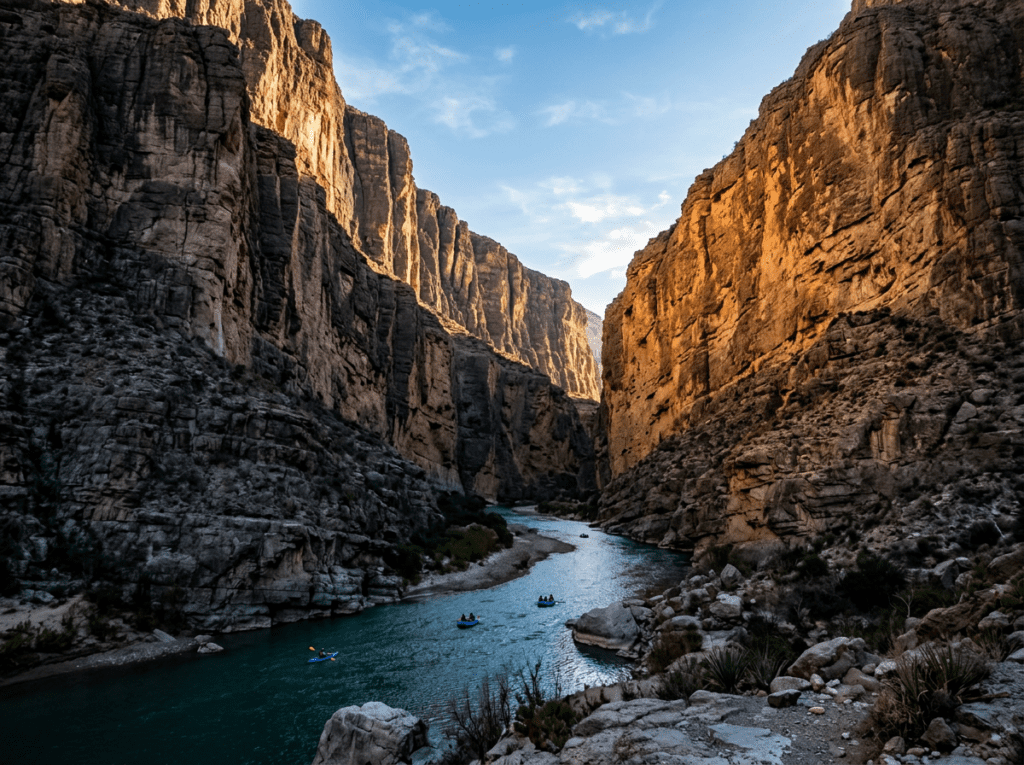
Santa Elena Canyon is the park’s most iconic geological subject — a 1,500-foot sheer limestone canyon where the Rio Grande narrows to a slot and the walls rise on both sides in a formation that has no equal in the Texas park system. The canyon mouth, accessible via a short trail from the Santa Elena Canyon trailhead, frames the river in a composition that is specific to this place and deeply compelling — the blue water, the vertical walls, the strip of sky above. The light inside the canyon is directional and specific; morning light illuminates the Mexican wall to the south while the Texas wall stays in shadow, and late afternoon reverses the equation.
The Chisos Basin, enclosed within the mountain range at 5,400 feet, is the park’s population center in the sense that population applies to a place this remote — the lodge, the campground, the visitor center, and the trailheads for the basin’s hiking trails all concentrate here. The Window View Trail, an easy half-mile walk to an overlook framing the desert far below through a V-shaped gap in the mountain wall, is one of the park’s most photographed sunset positions. The basin in the early morning, before the day hikers arrive from the lodge, has a quiet and a wildlife activity — javelinas, Carmen Mountains white-tailed deer, the Colima warbler found nowhere else in the US — that the midday basin cannot offer.
The Photographer’s Chase
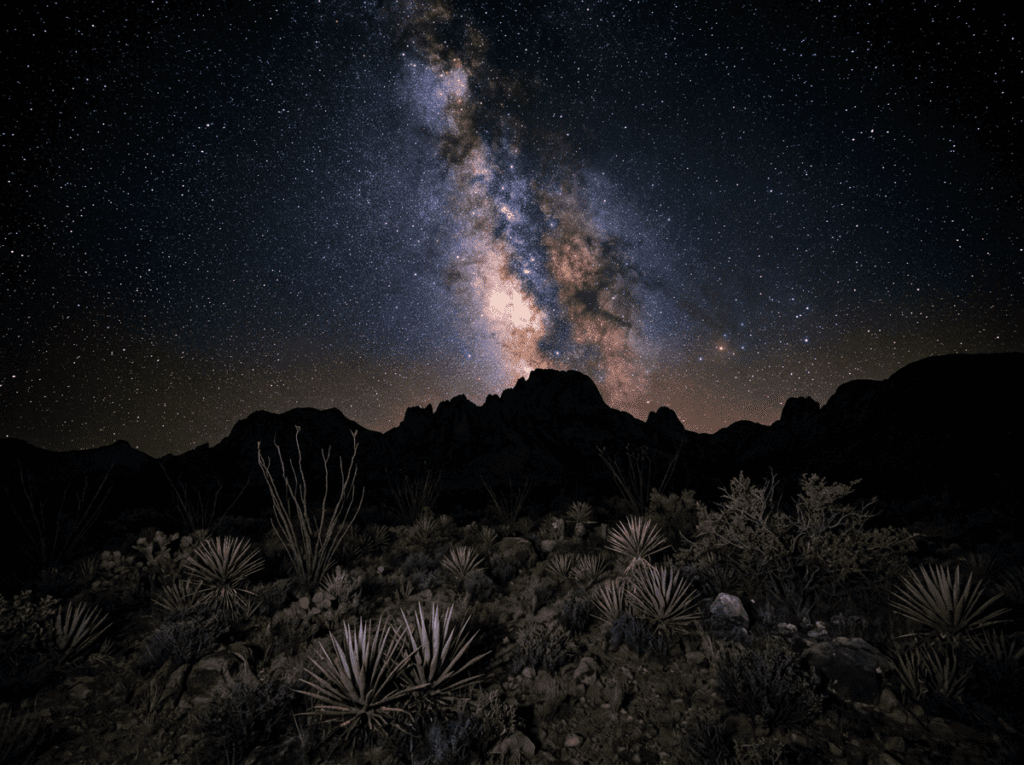
The dark sky is the photography subject I am most anticipating at Big Bend — and by most accounts it is the finest dark sky in the contiguous United States. The park is certified as an International Dark Sky Park and sits in one of the lowest light pollution zones in the country, far from any significant city, with an elevation that thins the atmosphere and a desert air that is typically dry and stable. The Milky Way above the Chisos Mountains, above the desert flats, above the Rio Grande canyon walls — these are astrophotography compositions that photographers travel specifically to make, and Big Bend delivers them with a reliability that few parks can match.
The Sotol Vista overlook and the Chisos Basin overlooks are the primary dark sky positions — elevated enough to provide a clear horizon in multiple directions, far enough from the lodge lights to preserve night vision, and close enough to the road to be accessible without a technical backcountry approach. Spring and fall are the best seasons for Milky Way photography, when the galaxy core is positioned above the southern horizon during the dark hours and the desert air is dry and stable. A moonless night in April or October, at Sotol Vista, with the desert spreading below and the galaxy above — that is the image I am planning this trip around.
The desert wildflower bloom in March and April — in years with adequate winter rainfall — transforms the lower desert into a subject it cannot be in the dry months. Bluebonnets and desert marigolds and the striking red of the claret cup cactus bloom across the flats, and the combination of desert color against the volcanic formations and the Chisos Mountains behind produces a landscape photography condition that the desert Southwest rarely offers. The bloom is not guaranteed — it requires monitoring the winter rainfall and being ready to move when the conditions align, the same calculation as the Death Valley super bloom.
The Rio Grande Village area on the park’s eastern edge is the birding and river photography section — 450 species of birds have been recorded in the park, the highest count of any national park in the system, and the riparian habitat along the river concentrates species that the desert cannot support. A morning along the Rio Grande Village nature trail, with a telephoto and patience, produces bird photography that the mountain and desert sections of the park cannot offer. The river itself, with Mexico on the far bank and the canyon walls visible upstream, is the human geography photograph that makes Big Bend unlike any other park in the system — the international boundary as a landscape element.
Visiting the Park
The remoteness of Big Bend requires planning that most national parks do not. The nearest commercial airports are Midland International (MAF), about 230 miles north, and El Paso International (ELP), about 320 miles northwest. Both require a multi-hour drive across West Texas to reach the park — plan for fuel stops, as services are extremely limited once you leave the interstate. The town of Marathon, about 40 miles north of the park entrance on US-385, and Alpine, about 80 miles north, are the last reliable fuel and grocery points before entering the park. Fill the tank and stock the cooler before you arrive.
The primary photography season runs from October through April — the cooler months when the desert temperatures are manageable and the light quality is at its annual best. Summer temperatures in the lower desert regularly exceed 110 degrees Fahrenheit and the hiking becomes genuinely dangerous in the midday heat. November through March is the sweet spot: cool days, cold nights, excellent light, and the lowest crowds of the year outside of the summer heat season. The park currently has no timed entry reservation requirement.
Cell service is essentially absent throughout most of the park. Download offline maps — Gaia GPS and AllTrails both have downloadable Big Bend maps — before leaving the last area with reliable service. The park’s emergency communication relies on satellite and radio, not cellular. Tell someone your itinerary before you go in, especially for any backcountry travel.
Where to Stay
The Chisos Mountains Lodge, inside the park in the Chisos Basin, is the only in-park lodging — a collection of stone cottages and motel-style rooms at 5,400 feet, operated by Forever Resorts. The Basin location puts you at the center of the park’s best hiking trailheads, within walking distance of the Window View Trail sunset position, and far enough above the desert floor that the summer temperatures are meaningfully cooler than the lower park. It books out for the peak October through March season well in advance. The rooms with Chisos Mountain views are worth requesting specifically.
Outside the park, the town of Terlingua — a former mercury mining ghost town that has evolved into one of the more characterful gateway communities in the national park system — sits just west of the park entrance. Terlingua has a genuine personality: independent lodging, a legendary chili cook-off history, and the Starlight Theatre Restaurant which is exactly what its name suggests — an outdoor dining experience under the West Texas sky. Study Butte, immediately adjacent to Terlingua, has additional lodging and the last gas station before the park. Marathon to the north, about 40 miles, has the historic Gage Hotel — a 1927 property that is one of the finest small hotels in Texas and worth building into the itinerary as a bookend to the park visit.
For RV travelers, Big Bend is one of the most RV-friendly remote parks in the system — the Chisos Basin Campground, Rio Grande Village Campground with hookups, and Cottonwood Campground are all accessible to standard rigs. Rio Grande Village is the only campground with electrical hookups, reservable through recreation.gov. The Chisos Basin road has a vehicle length restriction of 24 feet due to the switchbacks; rigs longer than that must use Rio Grande Village or Cottonwood instead. The park also has numerous backcountry primitive camping sites accessible by high-clearance vehicle on the park’s dirt road network — a serious option for photographers who want complete solitude and dark sky access far from the campground lights.
If I Were Planning My First Visit
I am planning it. Here is where the thinking stands.
November is the target month — past the summer heat, before the holiday crowds, the light at its low-angle November quality and the desert cooling into the season that makes it photogenic rather than hostile. A minimum of five nights — two in the Chisos Basin for the mountain and Window View photography, two at Rio Grande Village for the river canyon and the birding, and at least one night positioned for the dark sky work, ideally at a backcountry site or as far from campground lighting as the itinerary allows.
The Santa Elena Canyon hike is the first full day — early morning to catch the Mexican wall in the direct light before the canyon goes to shadow, then the full canyon walk at whatever pace the light dictates. The Window Trail at sunset from the Chisos Basin. The Rio Grande Village nature trail at dawn for the birds.
And at least one full moonless night outside with the camera pointed at the Milky Way. The four-hour drive from Midland, the no cell service, the one gas station — all of it is the price of admission for the darkest sky in the lower 48. For a photographer who has been chasing light across the national park system, that price is not a deterrent. It is an invitation.
The Light I’m Curious About
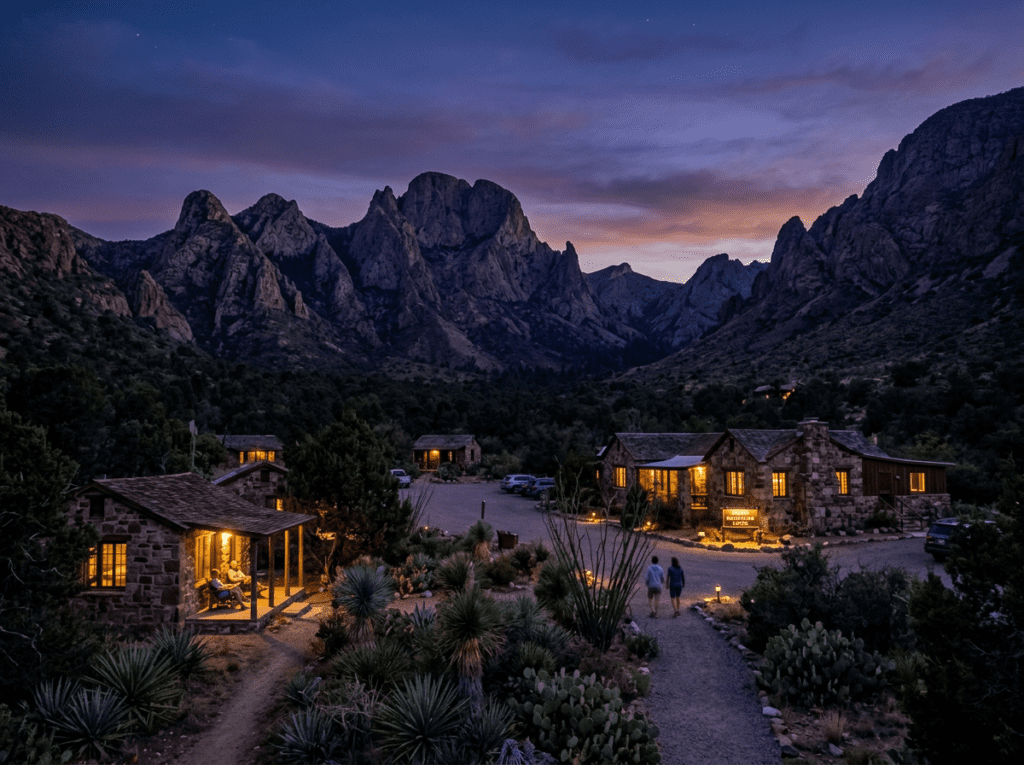
It is the desert light at first dawn — specifically the twenty minutes before sunrise in the Chihuahuan Desert when the sky goes from deep indigo to the first warm suggestion of color on the eastern horizon, and the desert floor catches that light at an angle so low it illuminates every spine and every stone and every dried stem of lechuguilla from the side rather than from above.
Desert photographers describe this light as the hour the desert reveals itself — the flat, bleached quality that the midday sun imposes completely absent, replaced by a raking light that builds texture and shadow into a landscape that the noon photographer would describe as featureless. The Chisos Mountains going from silhouette to the first warm color on their upper faces. The Rio Grande catching the pre-dawn sky in the canyon. The desert floor suddenly three-dimensional in a way it is not at any other hour.
This is the light that is available to anyone who gets to Big Bend and gets up early enough. The four-hour drive from the airport has already filtered out the visitors who were not serious about being there. The 5am alarm filters out a few more. What remains is the desert in the best light it produces, available to the photographer who is already in position when it arrives. I intend to be that photographer.
A Deeper Exploration
This article is part of my ongoing project documenting and photographing all 63 national parks across the United States.
Along the way, I’m creating deeper guides that explore photography locations, travel planning, seasonal light conditions, and personal reflections from the road. Big Bend is the park in this series I am most aware of not yet having experienced — the remoteness, the dark sky, the river canyon, the mountain basin have all been living in my imagination long enough that arrival will inevitably be a correction of that imagination. I am looking forward to finding out what the correction is.
Because the best landscapes are always more specific than the photographs suggest. Big Bend has been waiting a long time for someone to show up and find out exactly how.
One more thing — just between us.
Big Bend’s remoteness is its own crowd filter — the park is never overrun the way the more accessible western parks can be. The insider tip here is about going further into the territory that surrounds it, because the Big Bend region is extraordinary well beyond the park boundary.
Big Bend Ranch State Park— immediately west of the national park along FM 170, the River Road — is Texas’s largest state park and protects 300,000 acres of equally dramatic Chihuahuan Desert with almost no visitors relative to its size. The River Road itself, following the Rio Grande between Presidio and Lajitas, is one of the great scenic drives in Texas and a photography subject in its own right — the river, the canyon walls, the desert, and Mexico on the far bank.
For a completely different West Texas experience, the town of Marfa — about 60 miles north — is the unlikely art destination that has made the West Texas high desert internationally known, with the Chinati Foundation’s permanent art installations, the famous Marfa Lights viewing area, and a creative community that has built something genuinely interesting in an extremely remote place.
And the Gage Hotel in Marathon — 40 miles north of the park on the drive in or out — is a 1927 historic property that is one of the finest small hotels in Texas and the perfect bookend to a Big Bend trip. Stay a night. The West Texas sky from the Gage courtyard at midnight is the preview of what the park will deliver.