A Photographer’s First Look at America’s Newest National Park and the Ancient River That Made It
Some landscapes become part of our imagination long before we ever visit them. New River Gorge is not one of those landscapes — not yet, not for most people. It became a national park only in December 2020, elevated from national river status in the same legislation that created the first new national park in the system in years. Most Americans still don’t know it exists.
That obscurity is, for now, one of its greatest gifts.
The New River is one of the oldest rivers in the world — geologists estimate it has been flowing in its current course for somewhere between 10 and 360 million years, making it among the most ancient rivers on the North American continent. It cuts through the Appalachian Plateau in southern West Virginia, carving a gorge 1,000 feet deep and 50 miles long through some of the most rugged and least-visited terrain in the eastern United States. The result is a landscape of dense hardwood forest, exposed sandstone cliffs, and a river that runs clear and cold through the bottom of a canyon that feels, in the early morning mist, like a place that has not yet decided to let the modern world in.
For photographers who have been working the crowded corridors of the more established eastern parks, New River Gorge is a recalibration. The crowds are thin. The infrastructure is still developing. The light is extraordinary and almost entirely unclaimed.
The Landscape That Draws People Here
The park encompasses about 70,000 acres along a 53-mile stretch of the New River and its gorge. The landscape divides naturally between the rim and the river — the elevated overlooks along the gorge rim, where the full scale of the canyon and the bridge become visible, and the river corridor below, where the scale shifts to intimate and the photography becomes about water, rock, and the dense riparian forest along the banks.
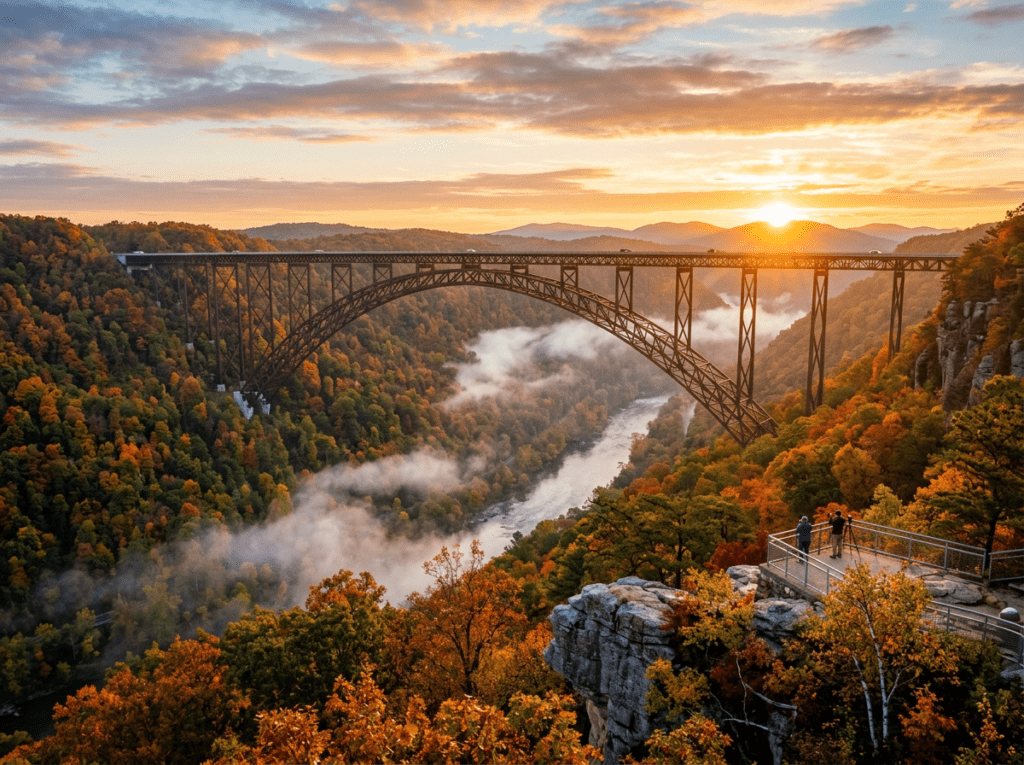
The New River Gorge Bridge is the park’s most iconic structure — a 3,030-foot steel arch bridge that, when it was completed in 1977, was the longest steel arch bridge in the world. It still ranks among the longest. From the Canyon Rim Visitor Center overlook, the bridge spans the full width of the gorge with the river visible 876 feet below — a scale that photographs struggle to communicate and that in person produces a genuine physical response. Once a year, on Bridge Day in October, the bridge is closed to vehicles and open to pedestrians, rappellers, and BASE jumpers. It is the largest single-day festival in West Virginia and one of the most unusual photography events in the national park system.
Beyond the bridge, the gorge contains a layered history of the American coal industry — abandoned company towns, stone foundations emerging from the forest floor, historic railroad grades along the river that now serve as trails. The Thurmond historic district, a once-thriving coal town now nearly ghost-town quiet, provides the kind of atmospheric human-history photography subject that the western parks cannot offer. Old brick buildings, a still-operating Amtrak station, and the sense of a place that time has moved through and left behind.
The Photographer’s Chase
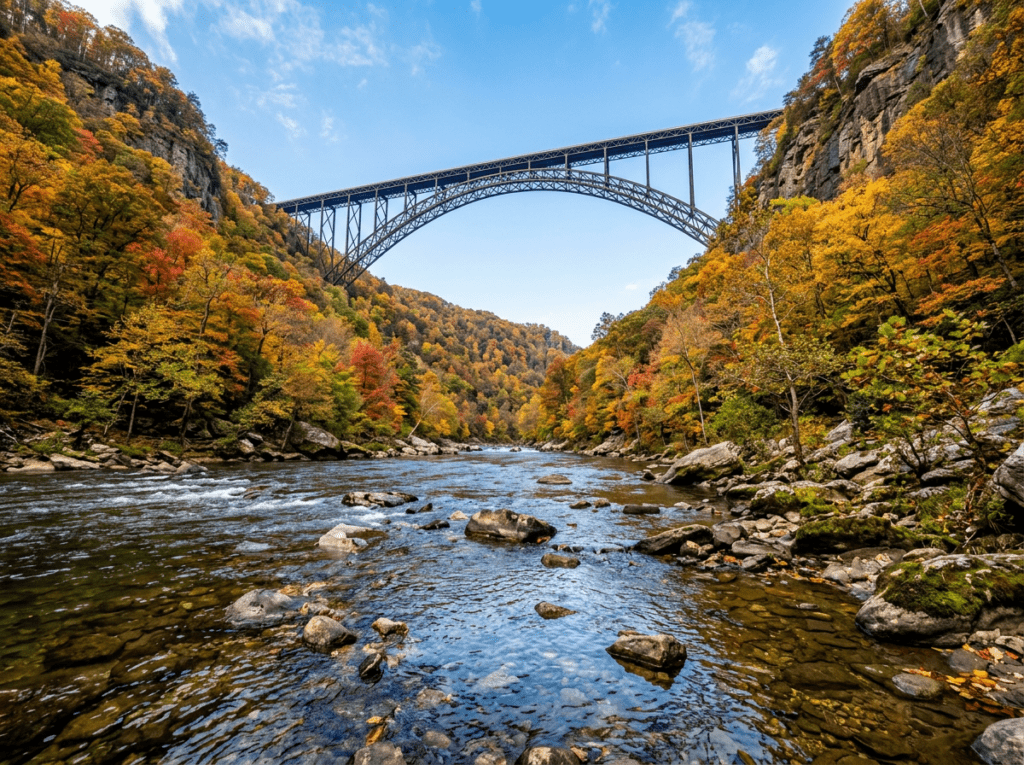
The bridge is the primary subject and the most technically demanding one. Photographing a steel arch bridge that spans nearly two-thirds of a mile across a gorge nearly 900 feet deep requires thinking carefully about scale, position, and light direction. The Canyon Rim overlook provides the standard view — bridge center frame, gorge below, forest on both walls — and it is a strong composition in the right light. But the more interesting bridge photography comes from the gorge floor, looking up at the arch from below with the river in the foreground and the bridge spanning the sky above. That perspective communicates the true vertical scale of the gorge in a way the rim view cannot.
Morning mist is the atmospheric condition that defines the gorge photography. The New River runs cold year-round, and on autumn mornings the temperature differential between the river surface and the cooling air above it produces a mist that rises from the water and fills the lower gorge before the sun has cleared the rim. The bridge emerging from that mist — the arch visible above the fog layer while the river below disappears into white — is the image that most specifically and most beautifully captures what this place is. It requires being on the rim overlook before sunrise, watching the mist build and the light arrive.
Fall color at New River Gorge arrives in mid-October and is, by most accounts of photographers who have been there, among the finest in the Appalachians — the density of the hardwood forest covering the gorge walls produces a wall-to-wall color event that the more open landscapes of Shenandoah cannot match. Looking across the gorge from the rim overlooks in peak color, with the steel bridge spanning the far wall of color and the river below catching the reflected amber and gold of the canopy above — that is the October image worth planning a trip around.
The Long Point Trail — a 3.2-mile round trip through the forest to a sandstone outcropping above the gorge — provides the elevated perspective on the bridge and the river that the Canyon Rim overlook cannot: the bridge seen from the side rather than head-on, the full sweep of the gorge visible in both directions, and the sense of being in the forest rather than at a developed overlook. It is the less-visited view and, for a photographer, often the more interesting one.
Visiting the Park
New River Gorge is still in the early years of its national park status, which means the visitor infrastructure is less developed than the older eastern parks. The Canyon Rim Visitor Center near Fayetteville is the primary hub and the best starting point for orienting to the park. The visitor center staff are notably knowledgeable and enthusiastic about a park that most of the country is still discovering — worth a conversation before heading out.
Fall — specifically the two to three weeks around mid-October — is the primary photography season, combining peak fall color with the morning mist conditions and the Bridge Day festival if the timing aligns. Spring brings higher river flow and wildflowers along the gorge trails. Summer is warm and green and the least crowded season outside of winter — an early morning in the gorge in July, before the heat builds, is quieter than almost any time at the more established eastern parks.
No timed entry reservations are currently required, which makes New River Gorge one of the most spontaneously accessible parks in the system. The roads in and around the gorge can be narrow and winding — the Gorge Road along the river is particularly tight in sections. Worth knowing before bringing a larger vehicle.
Where to Stay
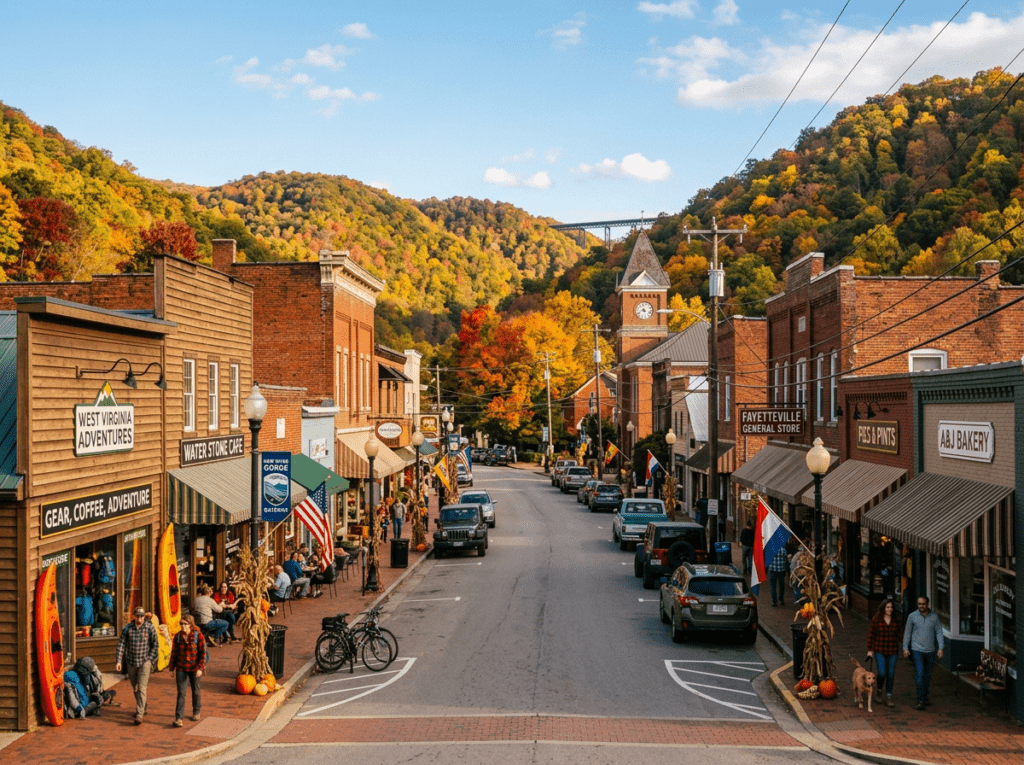
Fayetteville, West Virginia — a small town on the rim above the gorge — is the natural base camp. It has a genuine character: independent restaurants, outfitter shops serving the whitewater and climbing crowd, and a walkable downtown that feels like a community rather than a tourist infrastructure. The Cathedral Cafe and Fayetteville’s handful of independent restaurants make it the kind of place worth lingering in after a long shooting day.
Lodging options range from the historic Fayetteville Inn to vacation rentals in the wooded neighborhoods above the gorge. The Adventures on the Gorge resort complex, right at the rim near the bridge overlook, offers a range of cabin and lodge accommodations with the gorge immediately accessible — a strong choice for photographers who want to be at the rim overlook before dawn without a drive. It books out for Bridge Day weekend months in advance.
Camping inside the park is available at Grandview Campground on the rim — a small, quiet campground with good access to the rim overlooks and the Grandview area trails. Stone Cliff and other primitive sites along the river corridor provide the closest camping to the gorge floor and the river-level photography. RV access is limited on the tighter gorge roads; Grandview accommodates standard rigs, but confirm current size limits and road conditions before routing a larger vehicle.
If I Were Planning My First Visit
I would time it for mid-October, close enough to Bridge Day to feel the energy of the festival without being in the middle of the crowd. I would base in Fayetteville and be at the Canyon Rim overlook before sunrise on the first morning — watching for the mist to build in the gorge below as the temperature drops overnight and the river exhales into the cooling air.
I would hike the Long Point Trail on the second morning — the side view of the bridge, the forest around me in fall color, the gorge opening below the sandstone outcrop at the end of the trail. That is the less-documented view and likely the more personal image.
And I would walk down to the river. Not to shoot the bridge from below necessarily — though I would do that — but to stand at the water’s edge of one of the oldest rivers on the continent and feel the scale of the gorge from the bottom up rather than the top down. Some landscapes reveal themselves differently depending on which direction you’re looking. New River Gorge is one of those. The rim view is impressive. The river view is humbling.
The Light I’m Curious About
It is the mist light in the gorge at dawn.
The New River runs cold. On an October morning, the temperature differential between the water and the air produces a mist that rises from the surface and fills the lower gorge before the sun has cleared the rim above. The bridge sits above the mist layer — the arch visible, the towers emerging, the river below disappeared into white. Then the sun clears the eastern rim and the first direct light crosses the top of the fog and touches the steel of the bridge and the canopy of the gorge walls above the fog line, and for perhaps fifteen minutes the scene is divided into two worlds: the lit world above the mist and the hidden world below it.
That is the image I have been thinking about since I first started researching this park. Not the bridge in clear air — that shot is there and it is strong. The bridge in the mist, half-revealed, the gorge below it implied rather than shown. America’s newest national park, still largely unknown, producing light that most of the country hasn’t seen yet.
That is worth getting up early for.
A Deeper Exploration
This article is part of my ongoing project documenting and photographing all 63 national parks across the United States.
Along the way, I’m creating deeper guides that explore photography locations, travel planning, seasonal light conditions, and personal reflections from the road. New River Gorge is the park in this series I am most curious to discover fresh — no established photographic canon to navigate around, no iconic image everyone has already seen. Just a gorge, an ancient river, a bridge, and light that is still largely unclaimed.
Because sometimes the best place to find new light is in the park that most people haven’t found yet.
One more thing – just between us.
The Canyon Rim Visitor Center and the bridge overlooks handle most New River Gorge visitors and the bridge view earns its fame completely. Here are three ways to find a different relationship with the gorge.
The Grandview area in the park’s southern section provides the most elevated and most dramatic rim overlook in the park — the gorge visible far below through the hardwood forest, the river a thin silver line at the canyon’s depth, and the fall color in October concentrated along the rim in a way that the bridge overlooks cannot provide from the same angle. The Grandview Rim Trail connects several overlooks along the rim edge and sees far fewer visitors than the northern section.
For the bridge photography that most visitors take from the overlook but few take from below, the Long Point Trail — a 3.2-mile round trip through the forest to a rocky outcrop — provides the only view of the New River Gorge Bridge from below and at an angle that communicates the bridge’s relationship with the gorge depth in a way the overlook above cannot. The bridge from below, framed by the gorge walls and the river, is the photograph that most visitors to Bridge Day never make.
And for the West Virginia experience that extends beyond the park, the town of Lewisburg — about 45 miles southeast — is one of the finest small towns in Appalachia, with a historic downtown, independent restaurants, and the Lost World Caverns immediately above the town. Worth an overnight stay that transforms a park visit into a complete southern West Virginia experience.