A Photographer’s Return to the Place That Started as a Strange Smooth Rock in a Bowl on a Shelf
Some landscapes become part of our imagination long before we ever visit them. Petrified Forest National Park became part of mine before I could read — as a smooth, colorful, impossibly heavy piece of stone sitting in a bowl on a shelf at my grandparents’ house. I picked it up and asked what it was. They told me about a place in Arizona where ancient trees had turned to stone over millions of years, where the forest floor was covered in wood that was no longer wood — that had been replaced, molecule by molecule, by silica and iron and manganese until it held the shape and the grain of a tree trunk but rang like rock when you tapped it.
That piece of petrified wood lived in my imagination for years before I encountered the place in school, and for decades more before I drove past it — past it, not through it — during the rush of visiting all fifty states in the year I turned sixty. I was on a schedule. The park was there. I kept moving. The bowl on my grandparents’ shelf had waited fifty-plus years for a proper visit; it could wait a little longer.
It has waited long enough. The return trip is about what the drive-past could never deliver: being inside the landscape that stone came from, understanding what it actually looks like in context, and slowing down enough to let a place that has been transforming itself for 225 million years show a photographer what it has become.
The Landscape That Draws People Here
Petrified Forest National Park protects 221,000 acres of northeastern Arizona’s Painted Desert — one of the largest concentrations of petrified wood on earth, along with a landscape of colorful badlands, ancient archaeological sites, and a section of the Painted Desert that produces some of the most dramatic color photography in the American Southwest. The park straddles Interstate 40 at the Holbrook exit, which is why it appears on the map of anyone driving across Arizona and why it has been passed by so many people on exactly the kind of schedule I was keeping during the 50 at 60 journey.
The petrified wood formed from trees that fell into the floodplains and swamps of the Late Triassic period, approximately 225 million years ago — when this region was a tropical forest near the equator, before the continents had separated into their current configurations. The trees were buried by volcanic ash and sediment, and over millions of years the organic wood was replaced by silica carried by groundwater, with trace minerals providing the colors: iron oxides for reds and yellows, manganese for purples and blues, carbon for black. The resulting logs are not wood. They are quartz crystals in the shape of wood, colored by chemistry, polished by erosion, and scattered across a landscape that looks like a lumber yard after a geological catastrophe.
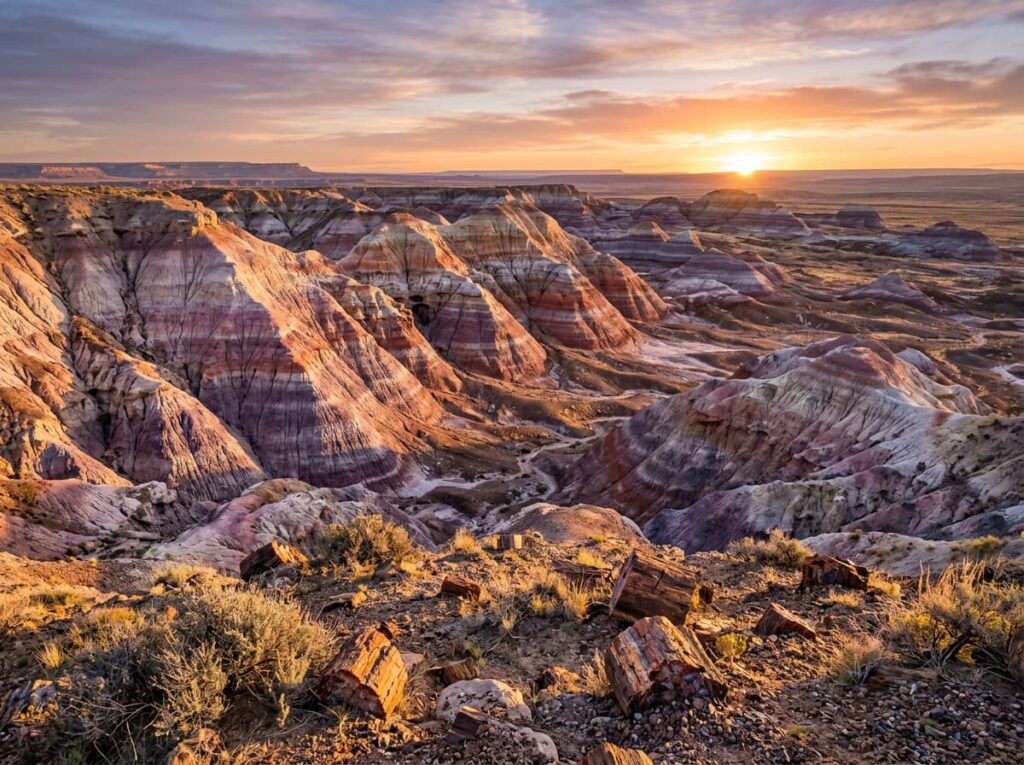
The Painted Desert section of the park, in the northern half above Interstate 40, is the landscape photography counterpart to the petrified wood — a badlands of banded bentonite clay in shades of lavender, pink, red, orange, and white that shift color continuously with the light. The Painted Desert is most dramatic at sunrise and sunset when the low-angle light rakes across the banded formations and builds dimension into colors that the overhead midday sun flattens completely. The northern overlooks — Tawa Point, Tiponi Point, and the Painted Desert Inn at Kachina Point — provide the primary positions for the badlands color photography.
The Photographer’s Chase
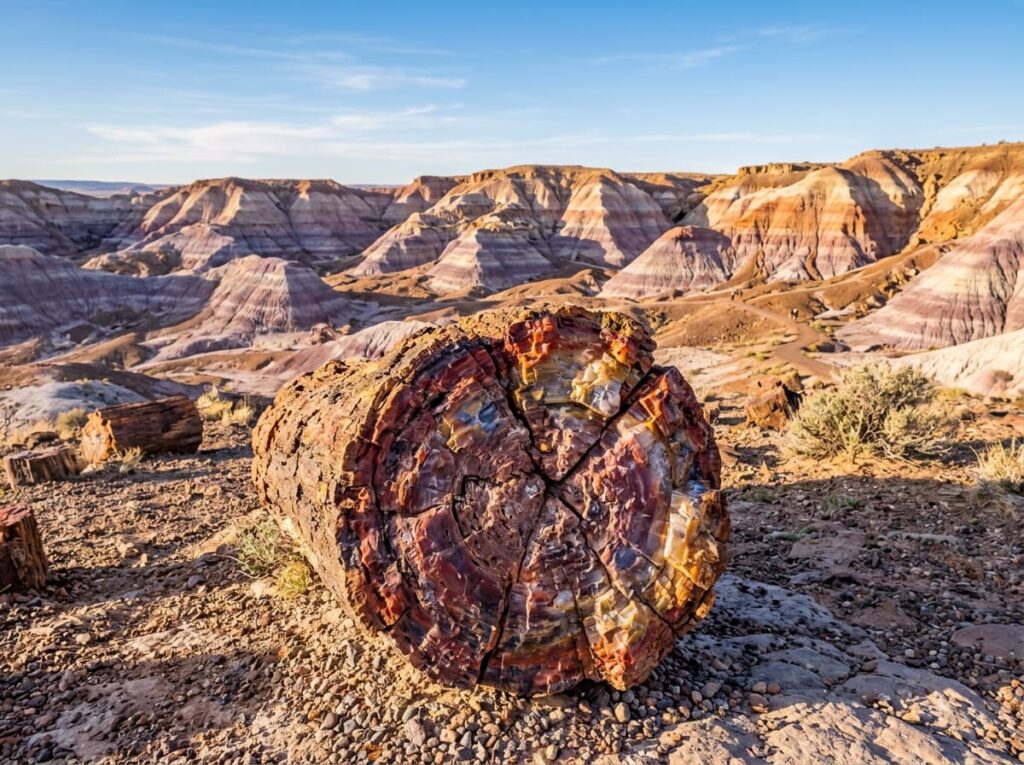
The petrified wood photography is a macro subject as much as a landscape one — the close-range detail of the crystallized wood grain, the color patterns in individual log sections, and the way the quartz crystals catch and scatter light differently from the surrounding matrix rock are all subjects that require getting close and getting low rather than standing back for the wide view. A macro lens or a close-focusing zoom at ground level, with the log section filling the frame and the Painted Desert visible behind it, is the composition that communicates both the intimacy of the material and the scale of the landscape it sits in.
The Rainbow Forest area in the southern park — accessible from the southern entrance off US-180 — contains the densest concentration of large petrified logs and the most colorful specimens. The Giant Logs trail, a 0.4-mile loop immediately behind the Rainbow Forest Museum, passes Old Faithful — the largest log in the park at nearly 10 feet in diameter — and a concentration of intact log sections that communicate the scale of the original trees. The morning light from the east, arriving at a low angle across the log field, illuminates the crystal surfaces and the wood grain texture in a way that the midday sun cannot.
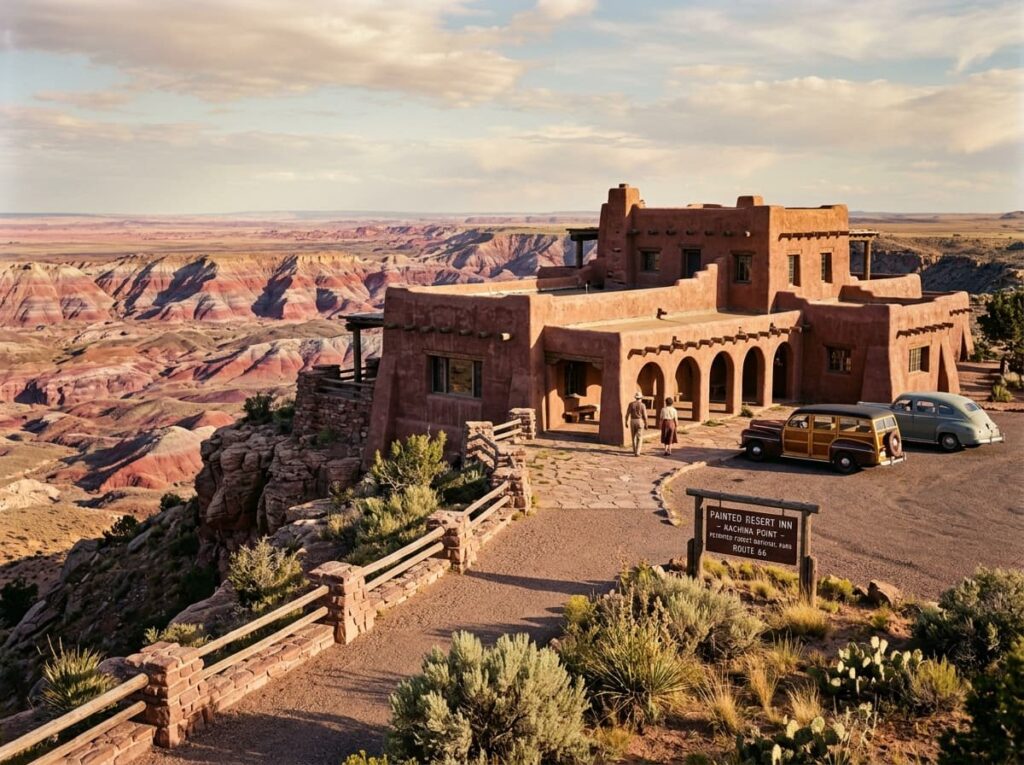
The Painted Desert badlands photography is governed by the same light logic as every badlands landscape in this series — the raking sunrise and sunset light that builds shadow and dimension into the banded formations is the condition the color photography requires. The northern overlooks are positioned to catch the eastern light at sunrise, and the short walk from the parking areas to the rim overlooks means that a pre-dawn start is practical without significant hiking. The Painted Desert Inn at Kachina Point, a 1940 National Historic Landmark, provides the architectural foreground for a badlands panorama that the open overlooks cannot — the historic building in the foreground, the Painted Desert extending to the horizon behind.
The park’s archaeological sites add a human history layer that most petrified wood visitors overlook. Newspaper Rock — a large sandstone boulder covered in petroglyphs carved by the ancestral Puebloan people who lived in this landscape for thousands of years — is visible from a telescope at the roadside overlook and accessible on a short trail. Puerco Pueblo, a 100-room ancestral Puebloan village occupied from approximately 1250 to 1380 AD, sits along the Puerco River at the park’s center with a trail through the partially excavated ruins. The petroglyphs at these sites, combined with the petrified wood and the Painted Desert, make Petrified Forest one of the most layered and most time-rich landscapes in the Arizona park system.
Visiting the Park
Petrified Forest is open year-round and accessible from two entrances — the north entrance off Interstate 40 at Exit 311 near Holbrook, which accesses the Painted Desert section first, and the south entrance off US-180 near the town of Holbrook, which accesses the Rainbow Forest and the petrified wood sections first. The 28-mile park road connects the two entrances and can be driven in either direction; entering from the north and exiting from the south — or vice versa — allows a linear route rather than backtracking.
Spring and fall are the strongest photography seasons. March through May brings wildflowers to the desert floor in good rainfall years and temperatures that make extended time outdoors comfortable. September and October bring the low-angle autumn light ideal for both the petrified wood detail photography and the Painted Desert badlands color. The park receives only about 10 inches of rain annually but summer monsoon storms from July through September can produce dramatic sky photography — the thunderheads building over the flat Arizona desert horizon with the Painted Desert foreground are one of the region’s most dramatic landscape photography conditions.
No timed entry reservations are currently required. The park entrance fee applies; an America the Beautiful pass covers it. A critical note about petrified wood: it is illegal to remove any petrified wood from the park — even the smallest chip. The park loses an estimated 12 tons of petrified wood to theft annually despite the prohibition, and the formations visible today are a fraction of what existed when the park was established. The piece in my grandparents’ bowl almost certainly came from private land outside the park boundaries, where collection has historically been permitted. Inside the park, it stays.
Where to Stay
There is no in-park lodging at Petrified Forest. The Painted Desert Inn at Kachina Point, though a National Historic Landmark and a park facility, is a museum rather than a hotel. Holbrook, about 25 miles west of the north entrance, is the primary gateway city — a classic Route 66 town with the Wigwam Motel, a 1950 roadside motor inn where the rooms are shaped like concrete teepees, which is either exactly the right place to stay near a national park of geological curiosities or absolutely not, depending on one’s aesthetic preferences.
Flagstaff, about 90 miles west on Interstate 40, provides the most complete range of lodging and dining in the region and serves as a natural hub for a broader northeastern Arizona itinerary that might include the Petrified Forest, the Painted Desert, Canyon de Chelly, and Monument Valley. Gallup, New Mexico, about 70 miles east, provides additional lodging options closer to the park’s eastern approach.
There is no traditional campground inside the park, though backcountry camping is permitted with a free permit from the visitor center — a genuine wilderness experience in a landscape with almost no other visitors after the day-trippers leave. For RV travelers, Holbrook’s commercial campgrounds provide full hookup options within a reasonable drive of both park entrances. The Route 66 character of Holbrook adds a road trip dimension to the logistics that most national park gateway towns cannot match.
If I Were Planning My First Visit
The first visit has been building since a grandparents’ shelf in childhood. The return trip — the first actual entry through the park gate — gets the time and the intention the place deserves.
North entrance at sunrise, arriving at the Painted Desert overlooks before the light hits the badlands formations. The banded clay colors in the raking morning light, the Painted Desert Inn as foreground at Kachina Point. Then south through the park road, stopping at every pullout, following the time sequence from the Painted Desert’s Triassic geology to the petrified wood of the Rainbow Forest.
The Giant Logs trail at the Rainbow Forest in the afternoon — low to the ground with the macro lens on the log sections, the crystal detail and the wood grain and the color patterns that a childhood piece on a shelf could only suggest. Old Faithful, the largest log, from a distance that communicates the diameter. The afternoon light raking across the log field from the west.
And Newspaper Rock — the petroglyphs carved by people who lived in this landscape a thousand years ago, beside the petrified wood from trees that fell 225 million years ago. The geological time and the human time in the same frame. That is the Petrified Forest photograph that closes the loop from a curious child picking up a smooth stone at his grandparents’ house.
The Light I’m Curious About
It is the morning light on the petrified wood — the specific quality of the first direct sun on the crystal surfaces of the log sections, when the quartz catches the light and scatters it in the way that crystal does and wood does not, and the grain patterns and the color bands in each log are illuminated in a way that a childhood piece on a shelf could only suggest.
The piece in my grandparents’ bowl was smooth and cold and impossibly heavy for its size and it caught the light from the window in a way that regular rock does not. I did not have the vocabulary at the time to describe what I was seeing. A macro lens at ground level in the Rainbow Forest at 7am, with the morning sun just clearing the eastern horizon and the crystal surfaces of the log sections catching and scattering the light in that specific way — that is the photograph that gives me the vocabulary.
225 million years of transformation, from tropical tree to silica crystal, waiting in the Arizona desert for a photographer who first encountered it as a smooth stone in a bowl on a shelf. That is a long time to wait. The morning light will make it worth it.
A Deeper Exploration
This article is part of my ongoing project documenting and photographing all 63 national parks across the United States.
Along the way, I’m creating deeper guides that explore photography locations, travel planning, seasonal light conditions, and personal reflections from the road. Petrified Forest is the park that started as a childhood mystery and became a lifelong deferred visit. The 63-park project exists partly for exactly this — the places that have been waiting in the back of the mind for long enough.
Because some places earn their visit across a lifetime. A grandparents’ shelf. A grade school lesson. A highway drive-past at sixty. And finally, the morning the gate opens and the road leads in and the wood that is stone is there on the desert floor, exactly where it has been for 225 million years, waiting.
One more thing — just between us.
Petrified Forest draws its visitors along the park road between the two entrances, and most never venture beyond the established pullouts. Here are three places worth knowing for the visit that wants to go deeper.
Crystal Forest trail — a 0.75-mile loop in the park’s southern section — passes the densest concentration of smaller, more colorful petrified wood specimens in the park, including sections where the quartz crystal surfaces catch the light with a brilliance that the larger logs cannot match.
Most visitors do the Giant Logs trail and skip Crystal Forest; the two together tell a more complete story of the wood variety. Just outside the park’s eastern boundary, Holbrook’s Petrified Wood Park — a free city park in downtown Holbrook containing a collection of large petrified wood specimens and concrete dinosaur sculptures from the 1930s — is the Route 66 roadside Americana complement to the national park’s geological seriousness. It is exactly as strange as it sounds and worth 20 minutes and a camera.
And for the broader Painted Desert and ancient Southwest context, Canyon de Chelly National Monument — about 80 miles north near Chinle — is one of the most culturally significant and most photogenic canyon landscapes in the Southwest, still inhabited by Navajo families and accessible only with a Navajo guide except for the rim overlooks. The Spider Rock overlook, with the 800-foot sandstone spire rising from the canyon floor, is the photograph that most Petrified Forest visitors drive to the park without knowing exists nearby. The detour is worth making.