A Photographer’s First Look at the Longest Cave on Earth — and the Kentucky Forest Above It
Every photographer eventually builds a list of subjects that require a specific piece of equipment rather than a specific piece of landscape. Mammoth Cave National Park is the second cave in this series that belongs on that list — the Sony with its high ISO performance and its image stabilization is the enabling technology for photography inside the longest cave system on earth, where the light is artificial, the tripod is not permitted on most tours, and the passages extend for 420 surveyed miles beneath the Kentucky karst plateau.
420 miles. That number requires a moment. The next longest cave in the world is approximately 150 miles long. Mammoth Cave is not merely the longest cave on earth — it is almost three times longer than its nearest competitor, and the surveyors keep finding more. New passages are discovered and mapped regularly. The full extent of the Mammoth Cave system is not yet known.
The comparison to Carlsbad Caverns is instructive and worth making directly. Carlsbad is the more visually dramatic cave — the stalactites and stalagmites and the extraordinary boxwork formations produce the theatrical photography that the NPS lighting system was designed to reveal. Mammoth Cave is the more architecturally extraordinary cave — the passages, the domes, the underground canyons carved by ancient rivers, and the sheer scale of the space communicate a different kind of geological grandeur. Where Carlsbad looks like a cathedral filled with ornament, Mammoth Cave looks like a cathedral filled with nothing except the dimensions of the space itself. Both are extraordinary. They are not the same experience.
The Landscape That Draws People Here
Mammoth Cave National Park protects 54,000 acres of the Kentucky karst plateau in south-central Kentucky, about 90 miles south of Louisville. The park is a UNESCO World Heritage Site and an International Biosphere Reserve, recognized for both the cave system and the above-ground forest ecosystem of the Green River valley. The cave formed over millions of years as slightly acidic groundwater dissolved the soluble limestone beneath the sandstone cap rock, carving passages along bedding planes and fractures in the rock. The sandstone cap rock that sits above the limestone in the Mammoth Cave area is what preserves the cave — it prevents the acidic rainfall from reaching the limestone directly and allows the cave to remain dry and structurally intact.
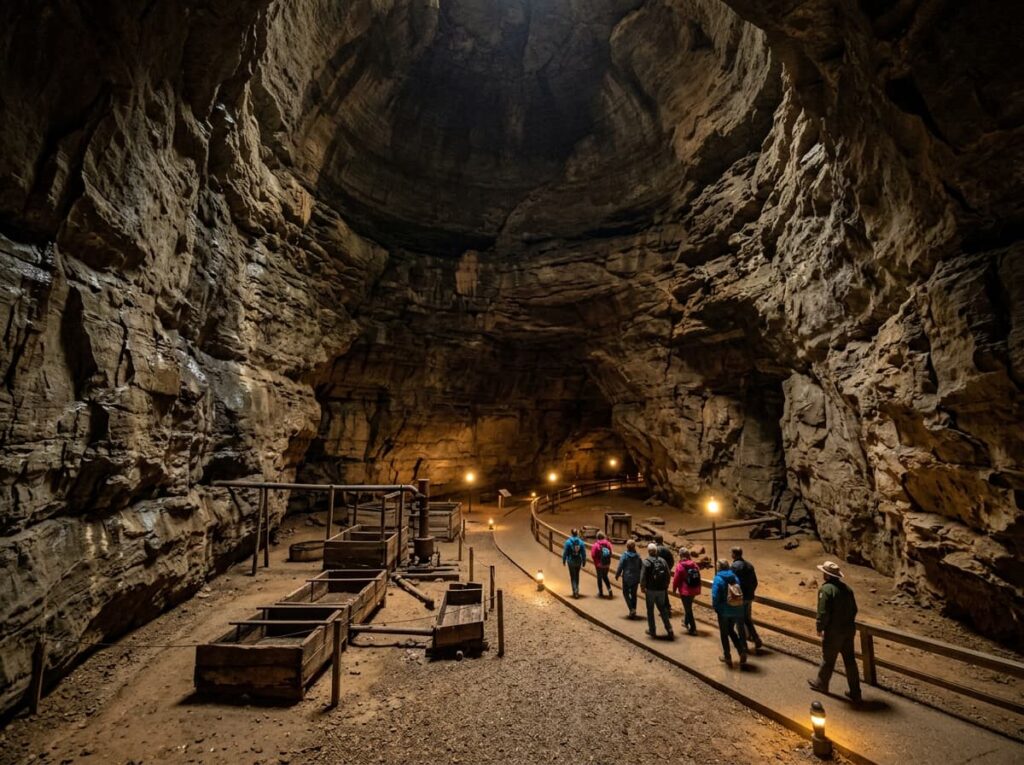
The cave contains multiple distinct environments within its vertical range. The upper Historic Tour levels are the dry, wide passages where the cave’s human history is most concentrated — the saltpeter mining operation that produced gunpowder during the War of 1812, the tuberculosis hospital that was briefly operated in the cave in the 1840s, and the signatures and inscriptions of 19th-century visitors visible on the cave walls. The lower passages, carved by the active underground rivers, are the wild cave zones where the water that formed the cave is still present. The Echo River and the River Styx still flow through the cave’s lowest levels.
The above-ground park is its own significant landscape — 54,000 acres of mixed hardwood forest and the Green River valley, with 70 miles of hiking trails through terrain shaped by the same karst geology that produced the cave below. The Green River, one of the most biologically diverse river systems in North America, flows through the park and supports an extraordinary concentration of freshwater mussel, fish, and crayfish species. The sinkholes and depressions visible on the forest floor above the cave are the surface expression of the dissolution that created the passages below — the above-ground karst topography is the cave’s autobiography written on the forest floor.
The Photographer’s Chase
The cave photography at Mammoth follows the same technical parameters as Carlsbad — high ISO, image stabilization, handheld shooting in artificial light with no tripod on the standard tours. The Sony’s performance at ISO 3200 to 6400 is the enabling factor, and the cave’s NPS lighting system — while less theatrical than Carlsbad’s — creates directional light in the passages that builds shadow and texture into the geological surfaces.
The scale photography is the primary Mammoth Cave challenge and the primary reward. The passages are large — the Rotunda is one of the largest cave rooms in the eastern United States, and the height of some passage ceilings exceeds what a standard wide angle can capture in a single frame without significant distortion. The technique that works best in the large Mammoth Cave passages is the human-scale foreground — placing a tour group member in the immediate foreground of a wide shot with the passage extending behind them, the human figure communicating the scale of the space in a way that abstract measurements cannot.
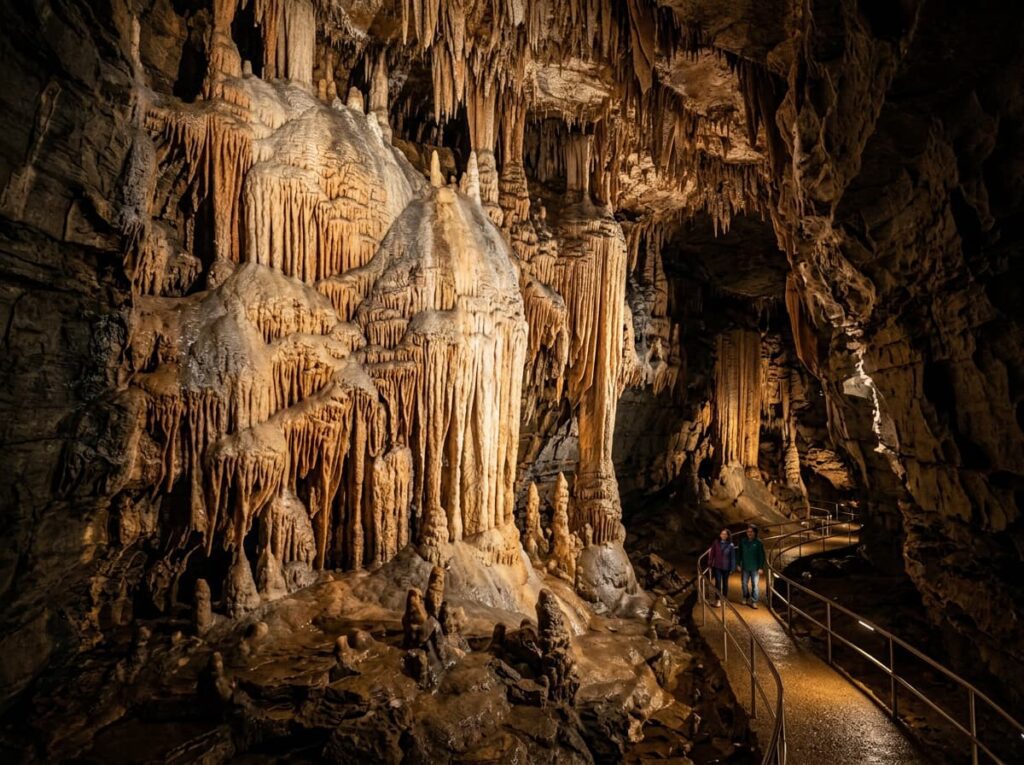
The Historic Tour is the foundation of any Mammoth Cave photography visit — the 2-mile, two-hour walking tour through the upper dry passages that covers the cave’s primary historical and geological features. The Frozen Niagara Tour provides access to the cave’s most decorative section, where stalactites and stalagmites and flowstone formations concentrate in a section of the cave that resembles the ornamental cave photography more typical of Carlsbad. For photographers specifically, combining both tours on the same visit provides the full range of Mammoth Cave’s photographic subjects — the architectural dry passages and the decorated formations — in a single day.
The wild cave tours — the Introduction to Caving tour and the more demanding Wild Cave Tour — take small groups through undeveloped sections of the cave that the standard tours do not access. The wild cave photography, in passages that still look as they did before the NPS installed lighting, uses handheld lanterns and headlamps as the only light source. The lantern light on unimproved cave passages, with the original cave surface and the absence of any developed trail, is a different photography discipline from the standard tour and produces images that the lit tours cannot replicate.
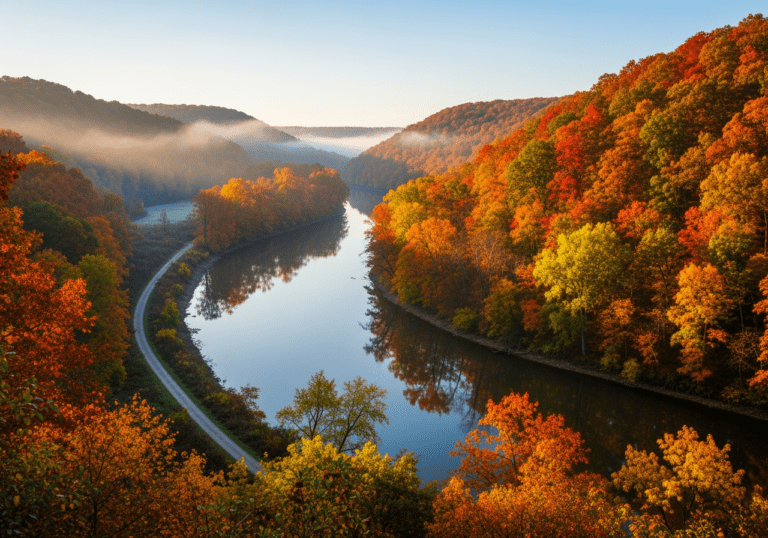
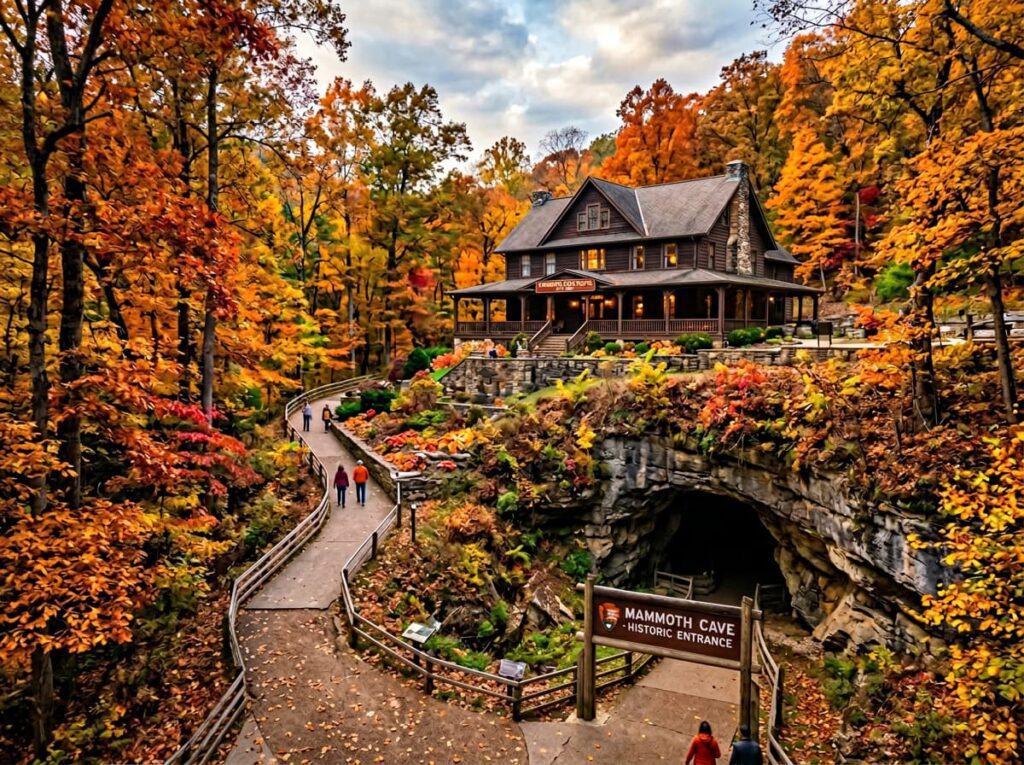
The above-ground park provides the landscape photography counterpart to the cave — the Green River Bluffs Trail and the Cedar Sink Trail traverse the karst topography above the cave in a forest that is striking in fall color. October at Mammoth Cave brings the full Kentucky hardwood fall color to the forest above the cave and the first cool temperatures that make cave visits more comfortable. The cedar forests around the natural sinkholes — surface depressions that connect directly to the cave system below — are the most specifically karst above-ground photography subjects in the park.
Visiting the Park
Mammoth Cave National Park is open year-round and the cave tours operate daily except Christmas Day. Cave tours of various lengths and difficulty levels are available, all requiring advance reservations through recreation.gov — the Historic Tour and the Frozen Niagara Tour are the most popular and sell out on weekends throughout the spring and fall seasons. Booking tours before finalizing travel dates is the right sequence.
The cave maintains a constant temperature of 54 degrees Fahrenheit regardless of the season — bring a jacket on even the hottest Kentucky summer day. The above-ground park is subject to the full range of Kentucky seasons — hot and humid in summer, brilliant fall color from mid-October through November, and the occasional ice storm in winter that closes the park roads while the cave tours continue unaffected below.
The nearest airports are Nashville International (BNA) about 90 miles south and Louisville Muhammad Ali International (SDF) about 90 miles north. Both provide convenient arrival points for a Mammoth Cave visit and natural anchors for a broader Kentucky itinerary. The park sits on Interstate 65 between the two cities, making it an accessible day trip from either and a natural midpoint stop on a Nashville to Louisville or Louisville to Nashville road trip.
Where to Stay
The Mammoth Cave Hotel, inside the park above the cave entrance, is the only in-park lodging — a collection of cottages and lodge rooms operated by the park concessionaire. The location directly above the cave entrance provides the most convenient access to early morning tours before the day visitors arrive, and the setting in the Kentucky forest above the cave has a character that the highway corridor hotels cannot replicate. The hotel books out for fall foliage season and summer weekends well in advance.
Cave City and Horse Cave, the small towns on Interstate 65 near the park entrance, provide the full range of chain lodging at lower prices than the in-park hotel. Both towns have the roadside character of Kentucky highway communities — modest, practical, and within 15 minutes of the park entrance. The Kentucky Down Under Adventure Zoo near Horse Cave and the Kentucky Caverns nearby are additional regional attractions that extend a Mammoth Cave visit into a broader karst region experience.
For RV travelers, the Mammoth Cave Campground inside the park has sites with electrical hookups, reservable through recreation.gov. The campground’s position in the Kentucky hardwood forest provides the fall color photography access that a highway campground cannot. The Headquarters Campground and the Houchin Ferry Campground provide additional in-park primitive camping options near the Green River.
If I Were Planning My First Visit
October — the fall color in the Kentucky hardwood forest above, the comfortable cave temperature in contrast to the October air outside, and the Historic Tour and Frozen Niagara Tour booked in advance for the same day. The Sony charged and the high ISO settings confirmed before the tour begins.
The Historic Tour first — the architecture of the dry passages, the scale of the Rotunda, the saltpeter mining history and the tuberculosis hospital that make Mammoth Cave one of the most historically layered cave systems in the world. The human-scale foreground technique for the large passage photographs, with the tour group providing the scale reference that the passage dimensions alone cannot communicate.
The Frozen Niagara Tour in the afternoon for the formation photography — the stalactites and the flowstone and the draperies that give the cave’s decorative sections the ornamental quality that Carlsbad offers throughout. The comparison between the two caves, having visited both, will be interesting and informative for both this series and the deeper photography guide that follows.
And the Cedar Sink Trail above ground in the late afternoon — the karst topography of the forest floor, the sinkholes that open directly to the cave below, the Kentucky hardwood fall color in the low October light. Above and below the same landscape. The cave writing its autobiography on the forest floor.
The Light I’m Curious About
It is the light in the largest passages — the specific quality of the NPS illumination in the Rotunda and the Methodist Church and the Broadway corridor, where the ceiling height and the passage width create a space large enough that the artificial light behaves like light in a large interior architectural space rather than a cave.
Carlsbad taught me that cave photography is about finding the position and the framing that works with the fixed light rather than waiting for the light to change. Mammoth Cave applies the same discipline to a different architectural vocabulary — the horizontal corridors and the domed chambers rather than the vertical stalactite forests. The Sony at ISO 6400 in the Broadway corridor, with the passage extending ahead in both directions and the ceiling lost in the darkness above and the tour group providing the scale that makes the dimensions comprehensible — that is the photograph I am going underground to make.
The longest cave on earth has been producing this light every day since the NPS installed the system. It will be producing it the day I arrive with the Sony and the patience to work the architecture that 420 miles of passage has created. Carlsbad was the graduate course in cave photography. Mammoth Cave is the final exam.
A Deeper Exploration
This article is part of my ongoing project documenting and photographing all 63 national parks across the United States.
Along the way, I am creating deeper guides that explore photography locations, travel planning, seasonal light conditions, and personal reflections from the road. Mammoth Cave is the 62nd post in this series — the penultimate stop in a project that began at the Everglades, went to the Arctic Circle, climbed to 10,000 feet above Maui, descended into the earth at Carlsbad, and arrives here in a Kentucky forest above the longest cave on earth.
One more park after this one. The count is nearly complete. The cave has been here longer than the project. It will be here after. The Sony and I are going underground.
One more thing — just between us.
Mammoth Cave draws its visitors to the Historic Tour and the Frozen Niagara Tour, which are the right starting points. Here are three places worth knowing for the visit that goes deeper.
The Green River ferry crossing inside the park — a small cable-operated ferry that crosses the Green River for foot passengers and bicycles — is one of the last hand-operated river ferries in the national park system and accesses the more remote northern sections of the park where the hiking trails see very few visitors. The Green River in fall color, crossed by a hand-operated ferry in the Kentucky morning mist, is the above-ground Mammoth Cave photograph most visitors never find.
For the broader Kentucky cave region that extends the experience, Lost River Cave in Bowling Green — about 30 miles south — offers a boat tour on the underground river that runs through it, a photography experience completely different from the walking tours of Mammoth Cave and one of the few underground boat experiences available in the eastern United States.
And for the Kentucky whiskey country that brackets the drive to Mammoth Cave from Louisville, the Kentucky Bourbon Trail passes through some of the most photographically atmospheric distillery landscapes in the country — the aging warehouses, the rolling bluegrass, and the limestone spring water that connects the bourbon geology to the same karst aquifer that feeds the springs inside Mammoth Cave. The limestone is the thread that runs through all of it.