A South Florida Photographer’s Honest Reckoning With the Park in His Own Backyard
Some landscapes become part of our imagination long before we ever visit them. The Everglades is not one of those landscapes — not for most people, and not even, I have to admit, for someone who has lived in South Florida for years and has the park essentially in his backyard.
I have driven Alligator Alley more times than I can count, that straight shot across the northern edge of the wetlands on I-75, the sawgrass stretching flat to the horizon on both sides, the occasional anhinga on a fence post. That is not the Everglades. I have taken airboat rides south of Marco Island, the flat-bottomed boats skimming across the shallow water at speeds that make conversation impossible, and those were out in the Ten Thousand Islands area that borders the park’s western edge. That is not quite the Everglades either. And I drove into the park through the main entrance down near Miami once, a summer afternoon with time to spare and no particular plan, and what happened next I will get to in a moment.
The short version: I live about an hour from one of the most ecologically extraordinary national parks on the planet, and I have essentially not photographed it. That is a failure of proximity. The parks that are closest to home are sometimes the ones we treat with the least seriousness, assuming they will always be there, assuming there is no urgency. The Everglades has been waiting patiently for me to show up at the right hour with the right intention. It is still waiting.
That changes.
The Landscape That Draws People Here
Everglades National Park protects the southern tip of Florida — 1.5 million acres of subtropical wilderness that is unlike any other park in the system. It is not a park of dramatic elevation or geological spectacle. There are no mountains, no canyons, no glaciers. The highest point in the park is eight feet above sea level. What the Everglades is, instead, is a river. A river fifty miles wide and six inches deep, moving so slowly it is invisible to the eye — a sheet of freshwater flowing south from Lake Okeechobee through the sawgrass prairie to Florida Bay and the Gulf of Mexico. The Calusa people called it Pahayokee: grassy waters. It is the largest subtropical wilderness in the United States and the only place on earth where alligators and crocodiles coexist.
The park divides into distinct ecosystems that each offer different photography subjects and different access logic. The sawgrass prairie of the main park road — the 38-mile route from the Ernest F. Coe Visitor Center to Flamingo on Florida Bay — is the backbone of the park and the most accessible. The hardwood hammocks, elevated tree islands rising slightly above the sawgrass, create the visual punctuation in the flat landscape and harbor the wading bird colonies. The mangrove coast along Florida Bay and the Ten Thousand Islands to the west is the saltwater edge of the freshwater system, where the mixing of ecosystems produces some of the highest wildlife density in the park. And the pinelands on the park’s northeastern edge, elevated slightly above the surrounding wetlands, offer a completely different habitat and a different set of subjects.
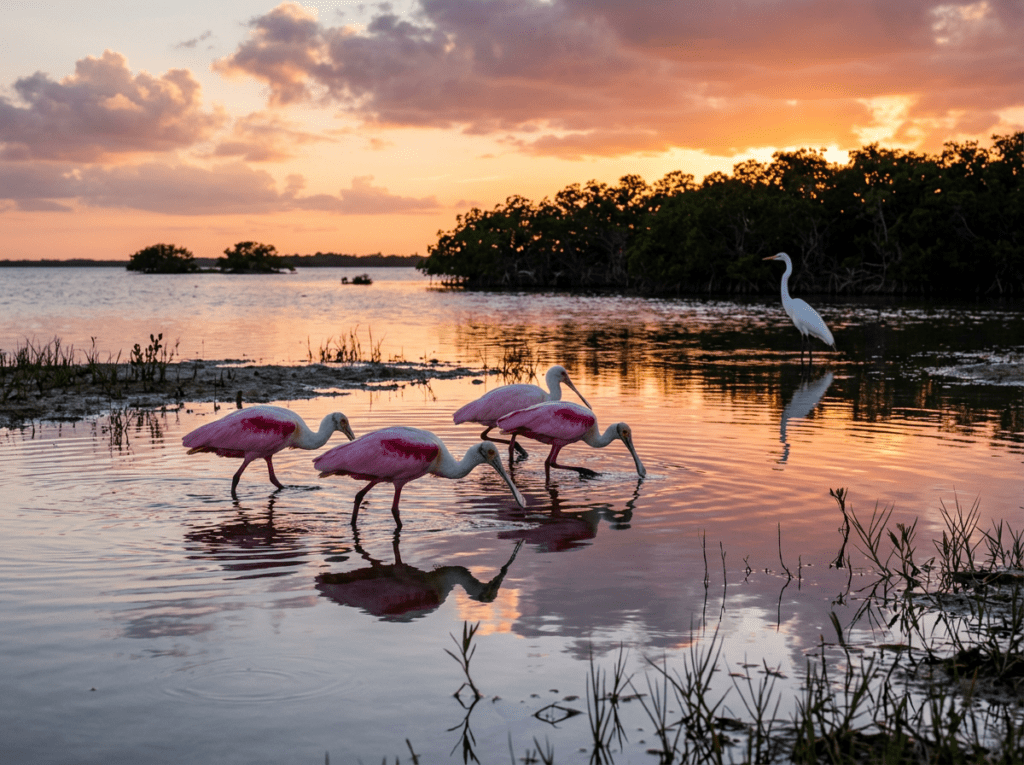
The wading birds are the Everglades photography subject that most rewards a properly timed visit — great blue herons, roseate spoonbills, snowy egrets, tricolored herons, wood storks, anhingas, and the great egret colonies that gather at the Anhinga Trail and the Eco Pond at Flamingo in the dry season. In the winter dry season, as the water levels drop and the prey concentrates in the remaining pools, the bird activity at the water holes intensifies to a level that wildlife photographers travel from across the country to experience. And I live an hour away.
The Photographer’s Chase
Let me tell you about that summer afternoon visit.
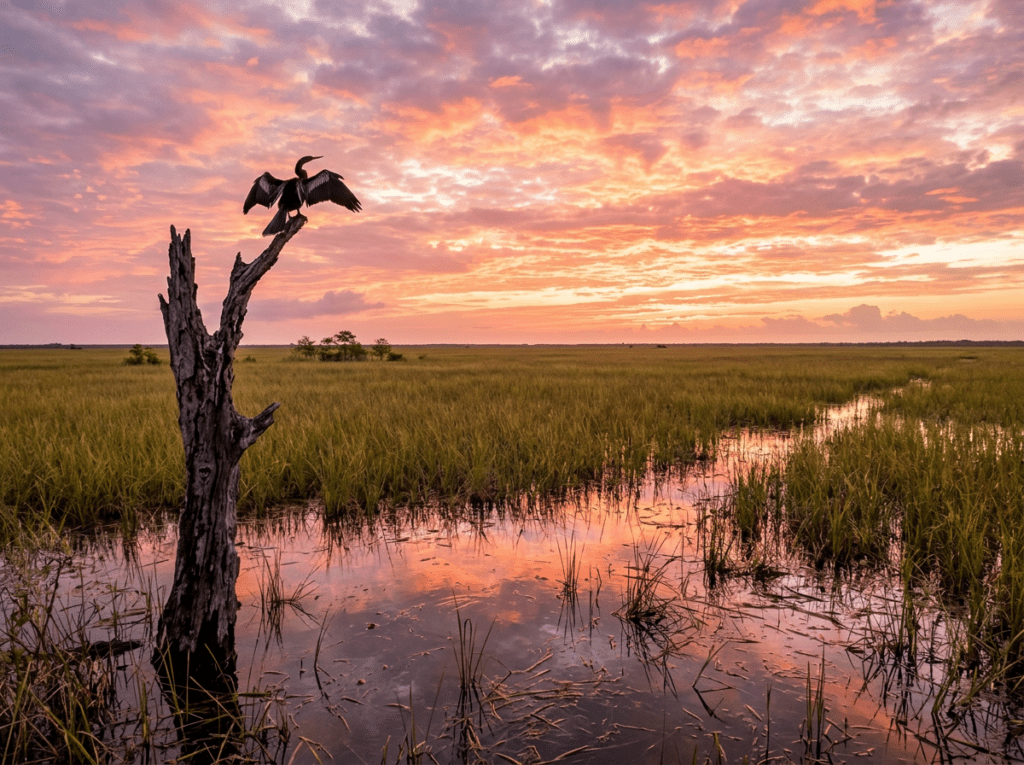
I had driven into the park through the main entrance and was moving down the main park road when the light hitting the clouds and the water at one of the roadside pullouts caught my eye. The reflection looked interesting — the kind of sky and water combination that can produce a genuinely strong image if you stop and work it. So I stopped. I got out of the car. I got the camera out. I had been standing at the roadside for perhaps five minutes when I heard it.
A sound. Distant at first, then getting louder. A buzzing, droning sound that I can only describe as what it would sound like if several helicopters were approaching simultaneously from multiple directions. I looked around. The sky was clear. And then they arrived — a cloud of mosquitoes of a size and density and apparent personal hostility that I was completely unprepared for. I am a Florida resident. I know mosquitoes. These were not the mosquitoes I know. These were the Everglades summer mosquitoes — creatures of a different category entirely, the size of small hummingbirds, operating in coordinated formations, landing on my neck, my back, my shoulders, my face, all at once, before I had processed what was happening.
I ran back to the car. I am not embarrassed to say this. I ran, swatting, cursing quietly, and I got in the car and closed the door and sat there for a moment taking stock. The photograph was not made. The mosquitoes had made their position very clear.
This is what summer in the Everglades looks like. The mosquito population in the wet season — June through October — is not an inconvenience. It is an ecological force. The park’s own literature has historically described certain areas as having the highest mosquito density ever recorded anywhere on earth. The dry season photography — November through April — is when the park transforms. The mosquitoes diminish to manageable. The water levels drop and concentrate the wildlife. The wading bird colonies gather at the remaining water holes in numbers that are genuinely extraordinary. The light in the dry season morning, low and warm and raking across the sawgrass and the still water, is the Everglades I have been living an hour from without properly experiencing.
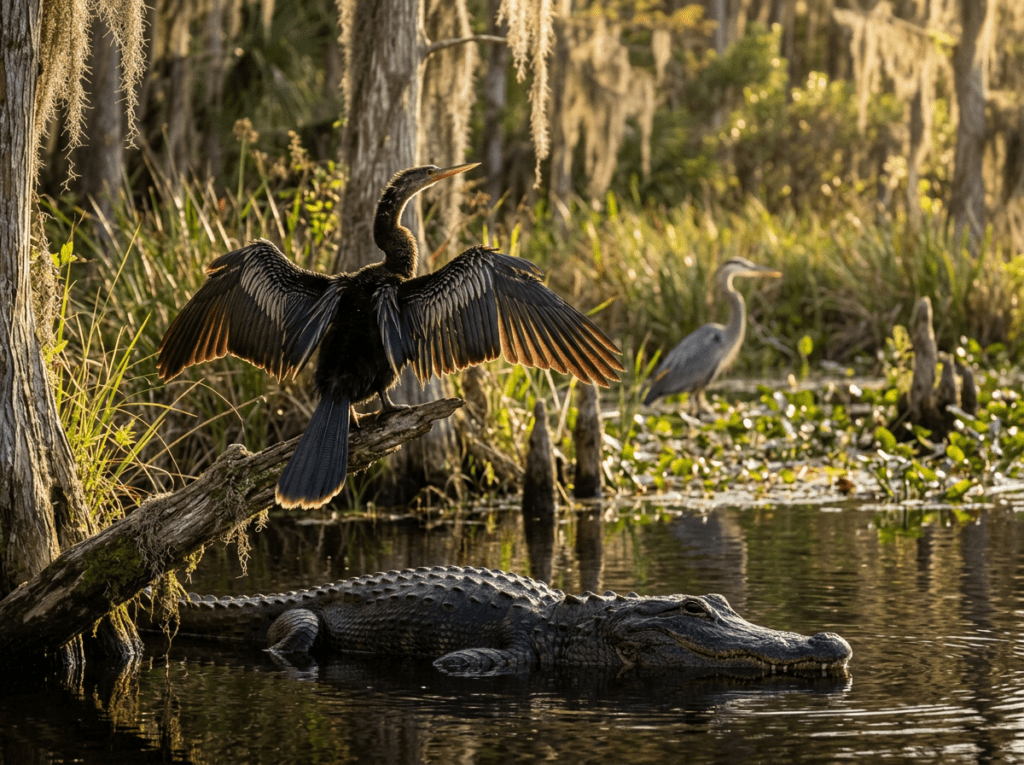
The Anhinga Trail at the Royal Palm area is the dry season photography destination that produces the most consistently spectacular results — a short paved path where anhinga, heron, egret, and alligator are present close enough to the trail that a moderate telephoto is more than sufficient. The birds are so accustomed to people on the trail that they continue feeding and displaying without retreating, which allows the kind of behavioral photography that most wildlife locations cannot offer. Early morning at Anhinga Trail in January, with the low winter sun backlit through the wings of a drying anhinga and an alligator motionless in the dark water below — that is the image I live closest to and have not yet made.
Visiting the Park
The single most important planning decision at Everglades National Park is the season. Visit in the dry season — November through April — and you encounter one of the finest wildlife photography environments in North America. Visit in the wet season — June through October — and you encounter the mosquitoes. That is not a small distinction. The wet season transforms the park’s ecology in ways that are genuinely interesting from a scientific perspective, and some photographers specifically target the wet season for the dramatic storm light and the lush green of the flooded sawgrass prairie. But they arrive prepared, with head nets and DEET and long sleeves, knowing what they are walking into. A casual summer afternoon visit without those preparations ends in a sprint back to the car. I have empirical evidence.
December through March is the photography sweet spot. The winter dry season brings the lowest water levels, the highest wildlife concentration at the remaining water holes, and the coolest and most comfortable temperatures — daytime highs in the low 70s, low humidity, the kind of Florida winter weather that the rest of the country is paying a premium to visit. The roseate spoonbills, which are the park’s most spectacular and most sought-after photography subject, are most reliably present at Eco Pond near Flamingo from November through February.
The park has multiple access points and they are not all equivalent for photography. The main park road from the Ernest F. Coe entrance near Homestead to Flamingo is the primary photography corridor — 38 miles of access to the sawgrass prairie, the hardwood hammocks, the sloughs, and the Florida Bay coastline. The Shark Valley entrance on the park’s northern edge provides access to the interior wetlands via a 15-mile tram road loop and a 65-foot observation tower with panoramic views across the sawgrass. The Gulf Coast entrance near Everglades City on the western side accesses the Ten Thousand Islands by canoe and kayak — a completely different landscape and a completely different photography experience.
Where to Stay
I live in West Palm Beach. This should simplify my lodging situation considerably, and yet I have managed to underutilize this geographic advantage more thoroughly than almost any other park in the project. The main park entrance near Homestead is about an hour and fifteen minutes from West Palm Beach — a pre-dawn departure gets you to Anhinga Trail at first light without an overnight stay. But the serious photography trip deserves a night or two closer to the park, specifically to access the Flamingo area at the southern end of the main road without a two-hour drive each way.
The Flamingo Lodge — a recently renovated in-park lodging property at the park’s southern terminus on Florida Bay — reopened after hurricane damage and offers the closest possible base to the Eco Pond roseate spoonbill photography and the Florida Bay sunrise. Staying at Flamingo puts you at the far end of the park at first light, which is where the best dry season wading bird activity concentrates. It books out for peak winter season; reserve well in advance.
Homestead and Florida City, just outside the main entrance, offer the full range of lodging options for those not staying in the park. For RV travelers, the Long Pine Key Campground inside the park is in the pinelands section with access to both the main road photography and the Royal Palm area. Flamingo Campground at the southern end has both tent and RV sites directly on Florida Bay. Both are reservable through recreation.gov and fill quickly for the December through March peak window.
If I Were Planning My First Visit
The honest answer is that I have already visited, multiple times, and produced almost nothing worth keeping. What I am planning now is the visit I should have made years ago.
January. The heart of the dry season. A two-night stay at Flamingo or as close to the southern end of the park as I can manage. First morning at Anhinga Trail before sunrise — on the path in the dark, camera ready, position chosen before the light arrives. The anhinga are there year-round and in the winter dry season they are there in numbers, close, unhurried, completely indifferent to a photographer who respects the trail boundaries and moves slowly.
Eco Pond at Flamingo in the afternoon for the roseate spoonbills — the pink is more saturated in the low winter sun than at any other time of year, and the birds feeding in the shallow pond with the Florida Bay behind them is the image I have been living closest to and somehow never made. Shark Valley at sunrise on the third morning, the observation tower at first light with the sawgrass extending to every horizon and the wading birds moving through the slough below.
No summer visits. No impromptu afternoon stops without repellent. No standing outside the car in June without adequate preparation and a clear exit strategy. I have learned these things. It only took one cloud of mosquitoes the size of small hummingbirds to teach me permanently.
The Light I’m Curious About
It is the January dawn light on the sawgrass prairie.
The Everglades in summer light is flat and harsh and actively hostile to anyone standing outside a car. I know this. The Everglades in winter morning light — the low January sun coming up over the eastern sawgrass, the shallow water catching the color of the sky above it, the wading birds beginning to move through the sloughs as the temperature warms — is a completely different place. The flatness of the landscape that works against dramatic photography in harsh light becomes an asset in low, raking light: everything is at the same elevation, so the reflections are everywhere, the water reads the sky in every direction, and the birds move through a mirror.
That is the Everglades I have been living an hour from. A river fifty miles wide, in the best light of the year, in one of the most ecologically extraordinary places on the continent. I have a home park advantage that I have barely used. The 63 parks project is, among other things, the motivation to finally fix that.
A Deeper Exploration
This article is part of my ongoing project documenting and photographing all 63 national parks across the United States.
Along the way, I’m creating deeper guides that explore photography locations, travel planning, seasonal light conditions, and personal reflections from the road. The Everglades is the park I have the least excuse for not knowing better — and the most motivation to finally get right.
Because sometimes the most extraordinary national park is the one closest to home. And sometimes it takes a project that spans all 63 of them to make you stop treating the nearest one as something you can always get to later.
One more thing – just between us.
The Everglades rewards the visitor who moves off the main Anhinga Trail and Pa-hay-okee overlook circuit and into the quieter sections of the park that the summer crowds and the mosquito reputation keep largely to themselves.
The Flamingo area at the park’s southern tip — 38 miles from the main entrance on the longest dead-end road in the national park system — is where the park’s most productive birding and the best kayaking access to Florida Bay and the backcountry mangrove channels are concentrated. The American flamingos that have been appearing in Florida Bay in recent years are occasionally spotted here, and the sunset over Florida Bay from the Flamingo Marina is one of the quietest and most beautiful in South Florida.
For the mangrove photography that most Everglades visitors never find, the Hell’s Bay canoe trail cuts through the interior mangrove wilderness in a series of marked channels accessible by kayak or canoe from the Flamingo area — a tunnel of mangrove roots and branches above still dark water that produces the most intimate and most specifically Everglades photography available in the park.
And for the broader South Florida ecosystem context, a dawn visit to the Corkscrew Swamp Sanctuary near Naples — about 90 minutes north — puts you in the largest old-growth bald cypress forest in North America on a boardwalk that delivers wood stork, barred owl, and alligator photography in a swamp that looks unchanged since the Cretaceous. A very small and very rewarding club.